This is a unique exploration of the experience of children who survived the Holocaust—including Roma and Sinti victims—and the genocides in Cambodia, Rwanda, and Bosnia. Children are among the principal victims of armed conflicts and slaughters; nonetheless, they perceive events through the prism of their unique perspective and have a different range of coping techniques than adults. This overview of the writings of ninety-one child survivors bears evidence to a wide range of human ruthlessness. The author presents little-known texts along with famous memoirs and autobiographical fiction, with abundant quotations. Many of these are not only compelling as historical testimony, but poetic, moving and stirring.
Yudit Kiss has not written a historical study or literary criticism of the children’s books. She explores, instead, what the authors went through and what they felt and understood about their experience. Accessible and captivating, this volume presents a close-up, human-size dimension of destruction. The books written by child survivors also describe the resources and means that helped them to remain human even in the deepest well of inhumanity, offering precious lessons about resistance and resilience.
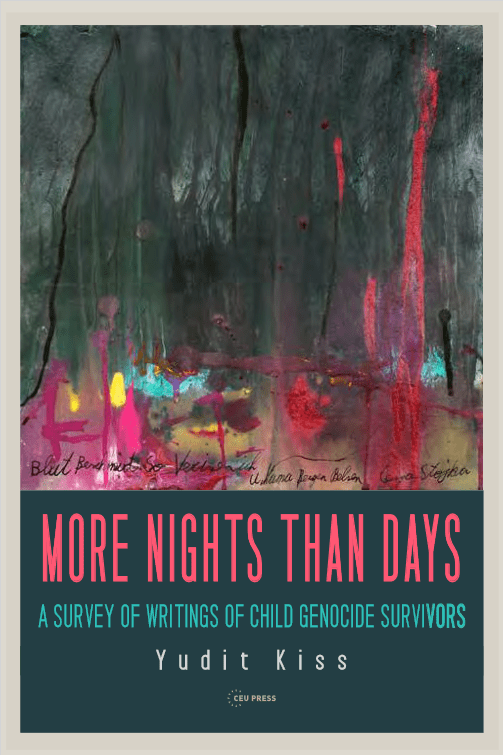
Note by the author: Dear friends, I’m very pleased to let you know that my book More nights than days has been published by CEU Press. The book presents the experience of child survivors of the Holocaust and the Cambodian, Rwandan and Bosnian genocide through their literary writings. It has been a long and painful project. I felt as if I were a gold-miner who has to descend to hellish depths to bring up tiny pieces of gold. These nuggets are the humanity, beauty and hope these books contain against all odds.
Thank you all who expressed curiosity, encouraged, and helped me on this journey. I attach the acknowledgements. The book is part of CEU’s Open Access publications, so you can look into it online.
Acknowledgements At the beginning of this book there was a young man in Budapest who kept pestering me to read János Nyíri’s Battlefields and Playgrounds. I was reluctant. I don’t like to read books about the Holocaust; they make me anxious and despaired. Still, after a couple of years, I gave in and took the battered old copy he lent to me. I read it and had a pleasant surprise; the book was alive, full of humor and depth. I was astonished to find that it was practically unknown in Hungary and, after an enthusiastic reception in the early 1990s, completely forgotten abroad. I received a modest grant from the British Society of Authors to write a piece about Nyíri’s life and oeuvre (which I gratefully acknowledge) and while I was researching the subject, another friend told me about Magda Dénes’s book. I read it and I was condemned. During the years that followed, I was immersed in a subject I never wanted to work on.
I discovered a huge body of literature written by child Holocaust survivors that were either unknown or forgotten. I increasingly felt that I owed them an effort to make their voices heard. Exploring these books and the reasons they were written evidently led me to the books of child survivors of later genocides. Despite my initial reluctance I am very grateful to the series of accidents that made me discover the works of these authors, because they have a unique richness and a precious, urgent message to pass on. While I was working on the book, the genocide against the Yazidis took place and mass murders continued in Sudan and Myanmar, among other places. I am very sorry to say that there is a lot of future work for people who would venture to explore this field further.
In a documentary film about his life and struggle against oblivion, Maurice Kling, one of the protagonists of this book, recounts that after a meeting with high-school students in Paris, one of them went up to him to say: “Thank you for surviving.” First and foremost, I would like to thank all the authors who are presented in this book, dead or alive, for surviving and having the strength to write about their experiences. And thanks to all who encouraged and supported them in their perilous undertaking.
I am very grateful to Eva Hoffman and Anthony Rudolf who read the very first, very rudimentary version of this book and encouraged me to continue. I would like to thank Peter Rossman for his careful reading of the manuscript and his very useful comments. Thanks also to two anonymous reviewers for their helpful comments and suggestions. Thanks to CEU Press for the courage to accept this manuscript. Special thanks to Linda Kunos for her editorial guidance and John Puckett for his thorough language editing. During the long lonely years while I was working on this book the support of my family and friends who believed in this project was a very precious support. Special thanks to my dear friends Margherita Frankel and Gabi Fekete and to my mother, all of whom saw the beginnings of this project and were eager to see it accomplished, but didn’t live to see it published.
 After the truth-shower