The Amazon rainforest brims with some of the world’s most diverse flora and fauna. Countless species of fungi dot the landscape, many still unnamed and awaiting discovery. Rockefeller and Quark carefully collect data by photographing and cataloguing each specimen for submission to the national herbarium in Quito and eventual DNA sequencing.
Words and photographs by Rachel Bujalski
Twilight is falling in the Ecuadorian jungle when the two scientists spot their first zombie. The smell of damp earth and vegetation rises as Alan Rockefeller takes slow, careful steps, scanning the forest floor with an ultraviolet light.
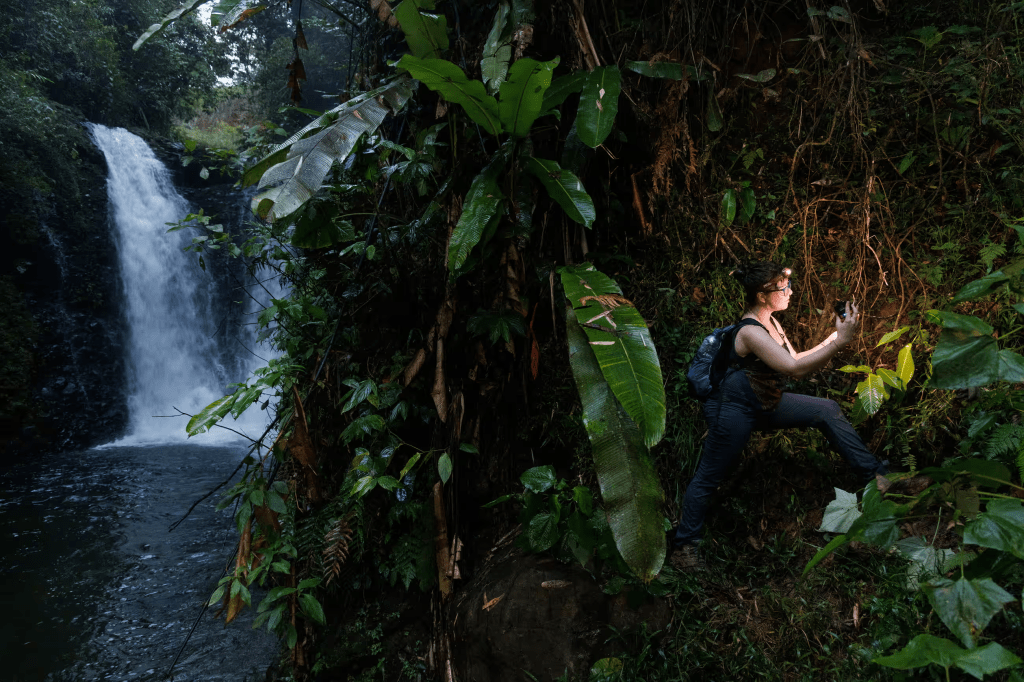
Quark examines a mushroom on a rainforest wall beside a waterfall
Suddenly, a fragment of undergrowth glows: strands of luminous cordyceps, turned fluorescent by the torch. Dubbed the “zombie fungus”, cordyceps is known for colonising its insect hosts compelling them to seek a suitable spot to release spores. That is the spot where the host will die.
Mandie Quark kneels in the wet, spongy earth, carefully digging her fingers around the entomopathogenic fungus to unveil the insect nestled beneath the surface: a thumb-sized beetle. The pair carefully light and photograph their find before beginning their two-mile trek home.
The Amazon rainforest brims with some of the world’s most diverse flora and fauna. Countless species of fungi dot the landscape, many still unnamed and awaiting discovery. Rockefeller and Quark carefully collect data by photographing and cataloguing each specimen for submission to the national herbarium in Quito and eventual DNA sequencing.
Here in the mountains of Ecuador, the two mycologists have embarked on a research expedition in the unprotected rainforests of the upper Amazon. Their mission is to meticulously document some of the world’s rarest fungi, which have been rapidly declining due to changes in climate, illegal logging and mining. Rockefeller and Quark’s ultimate aim is to share their discoveries about Amazonian fungi with the world, helping ecological conservation efforts in Ecuador and beyond. They work alongside the Indigenous Sacha Wasi community, who have invited the scientists to operate on their land, exchanging information on different fungi species and their culinary or ecological potential….
https://www.theguardian.com/environment/2024/jan/05/mushrooms-amazon-ecuador-rare-fungi-aoe
Find more age of extinction coverage here, and follow biodiversity reporters Phoebe Weston and Patrick Greenfield on X for all the latest news and features
 After the truth-shower