Russian Opposition leader Alexei Navalny was the most vocal leader of longtime Russian leader Vladimir Putin. He was serving a 19-year prison sentence for conviction on a charge of extremism.
Outlook Web Desk
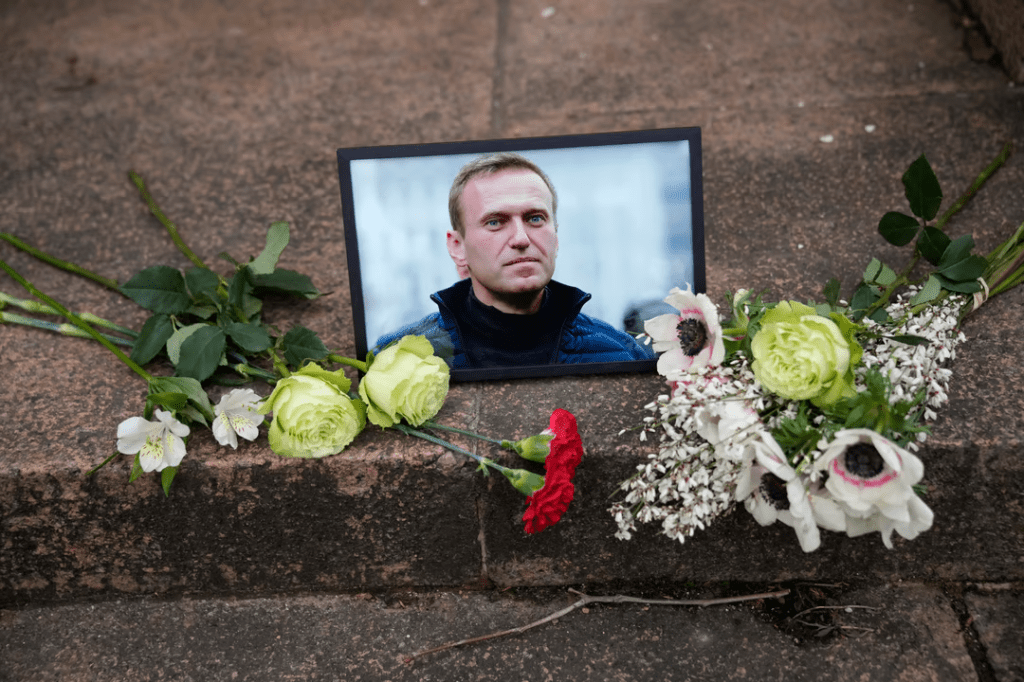
A portrait of Russian opposition leader Alexei Navalny are pictured as people demonstrate near the Russian embassy to France after authorities reported his death in prison. AP Photo/Christophe Ena
The Russian prison service on Friday said that Alexei Navalny, the most vocal Opposition leader in the country, has died in prison. He was 47-years-old. Navalny was the Founder of the Anti-Corruption Foundation (ACF) and the leader of the Russia of the Future party. He was the fiercest critic of long-time Russian leader Vladimir Putin.
While the Russian prison service said that Navalny has died, his spokesperson Kira Yarmysh said she does not have immediate first-hand confirmation. She said a lawyer of Navalny was headed to Kharp where he was imprisoned to assess the situation. Navalny was serving a 19-year prison sentence for conviction on charge of extremism. The conviction has been widely believed to be politically-motivated. Before his conviction and sentencing, he campaigned on an anti-corruption platform, organized major protests against Putin’s regime, and contested the election to be the Mayor of Moscow, the capital of Russia.
Navalny also suffered nerve agent poisoning in 2020 and was airlifted to Germany for treatment. He had blamed the poisoning on Putin. He was arrested after his return and was imprisoned. Here we trace the life and political journey of Navalny, explain his anti-corruption activism, and explore what we know so far of his death.
Who Was Russian Opposition Leader Alexei Navalny?
Alexei Navalny was born on June 4, 1976. He studied to be a lawyer and began anti-corruption activism. Over the years, he gained worldwide recognition as one of the fiercest critics of Vladimir Putin, the Russian leader who has ruled the country since 1999.
In the early years of Putin’s rule, while there were still hopes that Opposition might still hold some sway in the country, Nevalny joined Yabloko in 2000, a political party that favoured liberal democracy and free market economy. He rose to the local leadership of the party but was expelled in 2007. While Navalny said he was expelled for personality clashes with party leader Grigory Yavlinsky, the party said he was thrown out for “nationalistic activities” and far-right marches.
Following the exit from the Yabloko party, Navalny started his journey of anti-corruption activism. In 2013, besides his anti-corruption activism, he dove into active politics and ran for the mayoral office in Moscow. That also marked the beginning of his political consequences. In 2014, Navalny was given a three-and-a-half-year suspended sentence on fraud charge and his brother was imprisoned for three-and-a-half years. Over the years, Navalny has maintained that his convictions have been politically motivated to rule out any opposition to Putin.
The Associated Press noted that Navalny’s rise in Putin’s Russia as his critic was extraordinary as he continued to grow in a country where “political opponents often faded amid factional disputes or went into exile after imprisonment, suspected poisonings, or other heavy repression”.
“But Navalny grew consistently stronger and reached the apex of the opposition through grit, bravado and an acute understanding of how social media could circumvent the Kremlin’s suffocation of independent news outlets,” noted AP, highlighting that his dogged pursuit of his causes let him to make the decision to return to Russia after recovering in Germany where he was airlifted to after a nerve agent poisoning in 2020. The AP further noted, “He faced each setback —whether it was a physical assault or imprisonment— with an intense devotion, confronting dangers with a sardonic wit. That drove him to the bold and fateful move of returning from Germany to Russia and certain arrest.”
Anti-Corruption Activism And Politics Of Alexei Navalny
In 2008, Alexei Navalny entered anti-corruption activities with his stakeholder activism. He used to buy stakes in publicly traded Russian companies and gain entry into shareholders meetings where he used to grill officials about corruption….
*****************************************************
The Bolshevik Heritage. By Dilip Simeon
Russia targets its oldest human rights group, Memorial
The Gulag Archipelago: An Epic of True Evil
Aleksandr Solzhenitsyn: Letter to the Soviet Leaders (1974)
Samizdat: Russia’s Underground Press (1970)
Decentralizing the Cold War: an interview
Halliburton equipment worth $7.1m imported into Russia in past year
Russia wants this young anarchist to stay in prison forever
The invasion of Iraq was a turning point on to a path that led towards Ukraine
Formula Pinochet: Chilean Lessons for Russian Liberal Reformers during the Soviet Collapse
Against homogenisation: Advancing diversity through Democratic Confederalism
The news has become intolerable and inhumane. Democracy’s vital feedback mechanism is broken
Alternatives to the nationalism of the conspicuously ignorant: Markha Valenta
 After the truth-shower