Averroes (Ibn Rushd; 1126–1198) was one of the greatest polymaths of the ancient Islamic world, whose practice expanded into philosophy, theology, astronomy, physics, linguistics and more
Averroism’, ‘radical Aristotelianism’ and ‘heterodox Aristotelianism’ are nineteenth- and twentieth-century labels for a late thirteenth-century movement among Parisian philosophers whose views were not easily reconcilable with Christian doctrine. The three most important points of difference were the individual immortality of human intellectual souls, the attainability of happiness in this life and the eternity of the world. An ‘Averroist’ or ‘Radical Aristotelian’ would hold that philosophy leads to the conclusions that there is only one intellect shared by all humans, that happiness is attainable in earthly life and that the world has no temporal beginning or end. Averroists have generally been credited with a ‘theory of double truth’, according to which there is an irreconcilable clash between truths of faith and truths arrived at by means of reason. Averroism has often been assigned the role of a dangerous line of thought, against which Thomas Aquinas opposed his synthesis of faith and reason. Source: Routledge Encyclopaedia of Philosophy
Averroes was an Andalusian polymath during the Islamic Golden Ages. He wrote countless works in philosophy, theology, law, medicine, astronomy, physics, Islamic jurisprudence, mathematics, and linguistics. He is best known for his commentaries on Aristotle, which later instigated a movement in the West known as Averroism. Like all great thinkers, Averroes faced as much controversy as recognition during his lifetime.
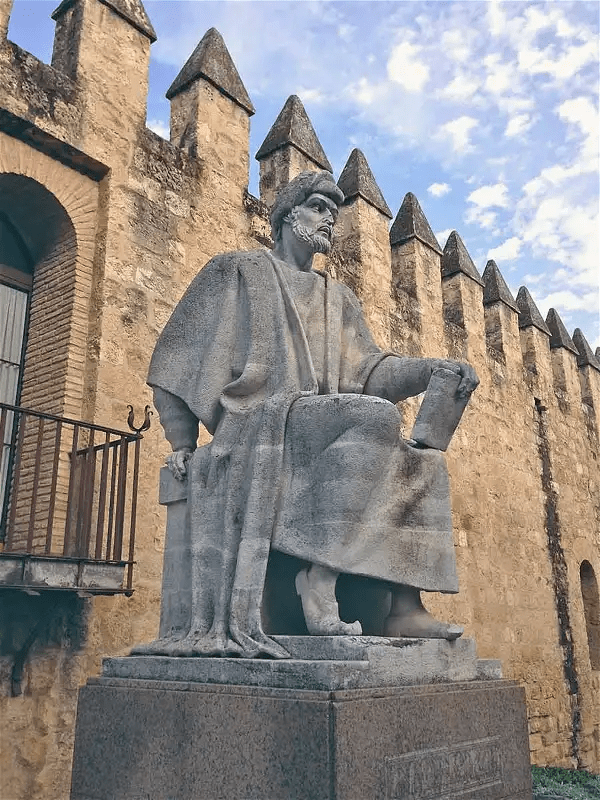
The Statue of Averroes in Cordoba. Source: Wikimedia
Background and Education
Muḥammad Ibn Aḥmad Ibn Rushd, known in the Arab world as Ibn Rushd and in the West as Averroes, was born in Cordoba on the 14th of April 1126 CE. His family was well-reputed in Andalusia for the prestigious positions they held in the judicial system and their contributions to the religious sciences. Averroes received a diverse education, studying philosophy, theology, jurisprudence, medicine, and many other subjects under the tutelage of the leading experts in each field. There is no doubt that the diversity of his education and the mastery of his teachers contributed to his ability to specialize in such a wide variety of fields. When Averroes moved to Seville, he participated in meetings with poets, philosophers, and physicians. His refined social entourage not only contributed to his intellectual evolution but also led to an encounter that would change the course of the rest of his life…
In 1153, Averroes met Ibn Tufayl in Marrakesh. Ibn Tufayl was an Andalusian polymath and the vizier and physician of the Almohad caliph, Abu Yaqub Yusuf, to whom he introduced Averroes in 1169. When the caliph met Averroes, he challenged him with a question about heaven. Averroes was reluctant to answer, fearing that if he were to share his thoughts, the caliph would condemn their unorthodoxy. But the caliph ended up having an unconventional philosophical discussion himself about the subject with Ibn Tufayl, making Averroes more at ease to express his views. The caliph was impressed by Averroes’ intellectual power and asked Ibn Tufayl to entrust him with the task of interpreting the works of Aristotle for him. Such is how Averroes proceeded to write his famous Aristotelian commentaries, and how he entered royal favor…
https://www.thecollector.com/who-was-averroes
************************************************
Peter Brown: A Life of Learning (2003)
Tracing the Hard Edges of Religion: On Peter Brown’s “Journeys of the Mind”
Christianity, Violence, and the West
Sanskrit translation of Don Quixote rescued from oblivion
Sabry Hafez: the Novel, Politics and Islam – Haydar Haydar’s Banquet for Seaweed
Andha Yug by Dharamvir Bharati (1953): Theatre of Roots
Andha Yug (Dharamvir Bharati, 1953) / धर्मवीर भारती लिखित नाटक ‘अन्धा युग’
 After the truth-shower