The spectacle is the guardian of sleep: Guy Debord
# 136 The monotheistic religions were a compromise between myth and history, between the cyclical time that still governed the sphere of production and the irreversible time that was the theater of conflicts and regroupings among different peoples. The religions that evolved out of Judaism were abstract universal acknowledgments of an irreversible time that had become democratized and open to all, but only in the realm of illusion. Time is totally oriented toward
a single final event: “The Kingdom of God is coming soon.” These religions were rooted in the soil of history, but they remained radically opposed to history. The semihistorical religions establish a qualitative point of departure in time (the birth of Christ, the flight of Mohammed), but their irreversible time-introducing an accumulation that would take the form of conquest in Islam and of increasing capital in Reformation Christianity-is inverted in religious thought and becomes a sort of countdown: waiting for time to run out before the Last Judgment and the advent of the other, true world. Eternity has emerged from cyclical time, as something beyond it. It is also the element that restrains the irreversibility of time, suppressing history within history itself by positioning itself on the other side of irreversible time as a pure point into which cyclical time returns and disappears. Bossuet will still say: “By way of time, which passes, we enter eternity, which does not pass.”
# 137 The Middle Ages, an incomplete mythical world whose consummation lay outside itself, is the period when cyclical time, though still governing the major part of production, really begins to be undermined by history. An element of irreversible time is recognized in the successive stages of each individual’s life. Life is seen as a one-way journey through a world whose meaning lies elsewhere: the pilgrim is the person who leaves cyclical time behind and actually becomes the traveler that everyone else is symbolically. Personal historical life still finds its fulfillment within the sphere of the ruling powers, in struggles waged by those powers or in struggles over disputed power; but the rulers’ irreversible time is now shared to an unlimited degree due to the general unity brought about by the oriented time of the Christian Era – a world of armed faith, where the adventures of the masters revolve around fealty and disputes over who owes fealty to whom. Feudal society was born from the merging of “the organizational structures of the conquering armies that developed in the process of conquest” with “the productive forces found in the conquered regions” (The German Ideology), and the factors contributing to the organization of those productive forces included the religious language in which they were expressed…
Extracted from Guy Debord’s Society of the Spectacle
**********
But certainly for the present age, which prefers the sign to the thing signified, the copy to the original, representation to reality, the appearance to the essence… illusion only is sacred, truth profane. Nay, sacredness is held to be enhanced in proportion as truth decreases and illusion increases, so that the highest degree of illusion comes to be the highest degree of sacredness: Ludwig Feuerbach, The Essence of Christianity (1841)
++++++++++++++++++++++++
Guy Debord’s Society of the Spectacle, is available on Marxist Internet Archive. Self-proclaimed leader of the Situationist International, Guy Debord (1931-1994) was certainly responsible for the longevity and high profile of Situationist ideas, although the equation of the SI with Guy Debord would be misleading. Brilliant but autocratic, Debord helped both unify situationist praxis and destroy its expansion into areas not explicitly in line with his own ideas.
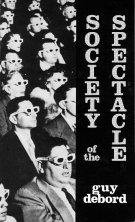
His text (see an AV talk here): The Society of the Spectacle remains today one of the great theoretical works on modern-day capital, cultural imperialism, and the role of mediation in social relationships. The following extracts are taken from this online PDF, which is annotated and is a more recent translation:
1: In societies where modern conditions of production prevail, all of life presents itself as an immense accumulation of spectacles. Everything that was directly lived has moved away into a representation.
2: The images detached from every aspect of life fuse in a common stream in which the unity of this life can no longer be re-established. Reality considered partially unfolds, in its own general unity, as a pseudo-world apart, an object of mere contemplation. The specialization of images of the world is completed in the world of the autonomous image, where the liar has lied to himself. The spectacle in general, as the concrete inversion of life, is the autonomous movement of the non-living.
14: The society which rests on modern industry is not accidentally or superficially spectacular, it is fundamentally spectaclist. In the spectacle, which is the image of the ruling economy, the goal is nothing, development everything. The spectacle aims at nothing other than itself.
16: The spectacle subjugates living men to itself to the extent that the economy has totally subjugated them. It is no more than the economy developing for itself. It is the true reflection of the production of things, and the false objectification of the producers.
17: The first phase of the domination of the economy over social life brought into the definition of all human realization the obvious degradation of being into having. The present phase of total occupation of social life by the accumulated results of the economy leads to a generalized sliding of having into appearing, from which all actual “having” must draw its immediate prestige and its ultimate function. At the same time all individual reality has become social reality directly dependent on social power and shaped by it. It is allowed to appear only to the extent that it is not.
21: To the extent that necessity is socially dreamed, the dream becomes necessary. The spectacle is the nightmare of imprisoned modern society which ultimately expresses nothing more than its desire to sleep. The spectacle is the guardian of sleep.
23: The oldest social specialization, the specialization of power, is at the root of the spectacle. The spectacle is thus a specialized activity which speaks for all the others. It is the diplomatic representation of hierarchic society to itself, where all other expression is banned. Here the most modern is also the most archaic.
24: The spectacle is the existing order’s uninterrupted discourse about itself, its laudatory monologue. It is the self-portrait of power in the epoch of its totalitarian management of the conditions of existence. The fetishistic, purely objective appearance of spectacular relations conceals the fact that they are relations among men and classes: a second nature with its fatal laws seems to dominate our environment…..
Though separated from what they produce, people nevertheless produce every detail of their world with ever-increasing power. They thus also find themselves increasingly separated from that world. The closer their life comes to being their own creation, the more they are excluded from that life…
Download The Society of the Spectacle
Avant-Garde Women: Michele Bernstein, Queen of the Situationists
***************************************
Unsolicited thoughts from an elder citizen
History and revolution in Debord’s The Society of the Spectacle
Society of the Spectacle / इमेज – Image: A Poem on Deaths in the Age of Covid
‘Aham Brahmasmi’ – The Grandiose Self
‘इमेज’: The Emperor’s Order: A Poem on Deaths in the Age of Covid by Puneet Sharma
The Intellectual We Deserve (2018)
What is truth? said jesting Pilate, and would not stay for an answer
Ten Theses on the Proliferation of Egocrats (1977)
Walter Benjamin: Capitalism as Religion (1921)
Against homogenisation: Advancing diversity through Democratic Confederalism
Shyam Saran: India’s soul has been seared
Vamsee Juluri: What will the PM do with the lie of delusion?
Anupam Kher: “there is much more to life than just image-building”
 After the truth-shower