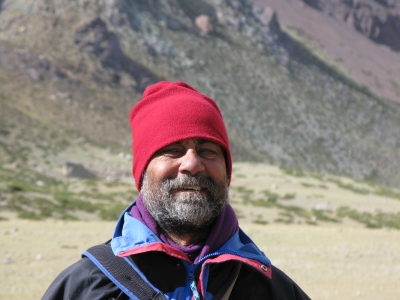
I was searching for meaning and purpose so I became an academic philosopher. Reader, you might guess what happened next
Pranay Sanklecha
Why did you decide to study philosophy?’ asked the Harvard professor, sitting in the park in his cream linen suit. ‘Because I want to find out how to live,’ I said. ‘I want to find out what matters and I want to live my life accordingly.’
He smiled affectionately, leaning forward in his deck chair. ‘If you want to find meaning, Pranay, don’t study philosophy. Go fish, become a carpenter, do anything. But don’t expect to find it by studying philosophy.’
If by ‘philosophy’ we refer to the played-out game of academic analytic philosophy, he was right. But if by philosophy we refer to the mysterious human activity of searching for truth, to processes of thought and perception, to communal seeking, to genuine dialogue and true encounter, to the moment when our minds open and something true rushes in – if we refer to any of these things, then the professor from Harvard was about as wrong as one could be.
Afew years later, I finished my doctorate at the University of Graz in Austria and embarked on life as a post-doc. Someone in that position usually has to churn out paper after paper on arcane aspects of philosophy for journals that no one reads. She has to attend conferences on subtle disputes, esoteric matters, where even the people attending look bored. She has to waste the best years of her life involving herself in intricate disputes that make no difference to her or anyone else’s life.
I had to do some of these things myself, but less than average, because I had lucked into a tenure-track position at Graz. Relative to the usual post-doc, I was free. And, as with so many kinds of freedom, to have it was also to be confronted by a question: how should I use it?
******
In Austria, philosophy departments are funded by the state, which is to say that they are funded by the people of Austria through their taxes. Many academics were even officially contracted to the state as civil servants. I wasn’t, but the fact remained: people, many of them worse off than I was, were paying me to do philosophy. I felt like I owed them something.
The natural option for my post-doc work would have been to plough the departmental furrow and find ever more pedantic things to say about John Rawls. But Austria, I somehow felt, had heard enough about what people thought about the difference principle. Fine. Not that, then. But what instead?
The longer I spent trying to figure out what would be valuable to other people, the more lost I became. Eventually I decided to approach it from the other angle. I would find something that I really cared about – not intellectually, but existentially. That way, at least one person would find my post-doc work valuable.
For a long time, I had been enduring a crisis of meaning. I wanted to live a life that mattered, to do things that were valuable – and I was increasingly haunted by the suspicion that nothing really mattered, that everything was ultimately meaningless. I decided that my new research project would be on the meaning of life….
https://aeon.co/essays/on-breaking-philosophy-out-of-the-seminar-and-back-into-the-world
*********************************************************
Socrates, the soul and the cosmos
Tae-Yeoun Keum: Why philosophy needs myth
The Intellectual We Deserve (2018)
What is truth? said jesting Pilate, and would not stay for an answer
A World After Liberalism: the Radical Right and the dream of tradition
So history didn’t end after all
‘The Poets of Rapallo’ Review: Ezra Pound’s Fascist Paradise
Theodor Adorno’s Minima Moralia is a warning against resurgent fascism
Christopher Bollas: The fascist state of mind (1992)
Alexandre Koyré: The Political Function of the Modern Lie (1943)
Michael Walzer Liberalism and the art of separation
Dr Strangelove: how I learned to stop worrying and love the bomb. Stanley Kubrick, 1963
Peter Kreko, Alan Sokal: In defence of the objective world
History and revolution in Debord’s The Society of the Spectacle
Crispin Sartwell: Truth is real
Stanley Rosen (1929-2014). A great philosopher
My Correct Views on Everything: Leszek Kolakowski’s correspondence with E. P. Thompson (1974)
Topology of Violence, by Byung-Chul Han
Leon Wieseltier: ‘The Wise, Too, Shed Tears’
 After the truth-shower