
For a man who once told his friend Beatrice Webb that he “disliked the profession of diplomacy”, Ivan Maisky was an unusually brilliant practitioner of the art of being an ambassador. Spending 11 years as Stalin’s representative in London, between 1932 and 1943, Maisky not only had his hands full in trying to follow the twists and turns of the political battles between Chamberlain and Churchill over appeasement, he also had to explain and justify Stalin’s U-turns in Soviet relations with Nazi Germany.
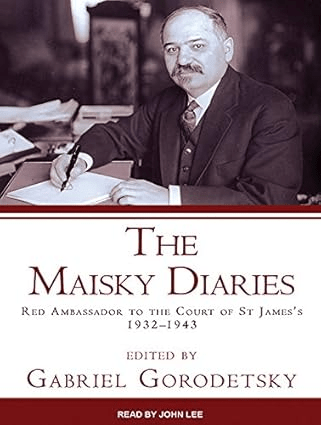
All along he also had to worry about his own survival, given the purges that destroyed the careers, and often the lives, of dozens of Soviet ambassadors and other senior officials in their prime. Yet Maisky found time to sit down most evenings in the study of the Soviet embassy in Kensington and type up his impressions of the day’s encounters. They were not just thumbnail aides-mémoire but wonderfully detailed accounts of confidential conversations with Britain’s high and mighty, laced with wit and subtle observations of character. He also recorded public events with the skill of an accomplished sketch writer, including key debates in parliament as well as state occasions, such as the funeral of George V (“a right old mess”) or bagpipes at a royal banquet (“semi-barbarian music. I like this music. There is something in it … of man’s primordial past”).
Rarely has a foreign diplomat written such lively reports of his professional meetings in London. And what a world they cover. As well as meeting the top politicians of the day, from Halifax to Eden to Churchill, for regular tete-a-tete talks, Maisky made friends with figures such as David Lloyd George, by 1932 an elder statesman but still hugely influential. He also lunched with Lord Beaverbrook, the Astors and newspaper editors, as well as City tycoons and luminaries of the left, from HG Wells and George Bernard Shaw to John Maynard Keynes.
The diary entries are always an entertaining read, but some, such as Maisky’s account of wartime talks with Churchill, have unique historical value, since the prime minister’s one-on-one conversations were not usually recorded by the Whitehall civil service. They reveal Churchill’s supportive acquiescence to Stalin’s pressure on Finland and the Soviet invasion of the Baltics and eastern Poland after the Molotov-Ribbentrop pact of 1939: “Russia has every reason to be the dominant power in the Baltics and should be one. Better Russia than Germany. That’s in our British interests.”…..
https://www.theguardian.com/books/2016/jan/20/the-miasky-diaries-review
+++++++++++++++++++++++++++++++++++++++++++++
The Gulag Archipelago: An Epic of True Evil
Aleksandr Solzhenitsyn: Letter to the Soviet Leaders (1974)
Aleksandr Solzhenitsyn: Historian of Decline and Prophet of Revival. By Madhavan Palat
Victor Serge: The Spirit of Liberty
The Bolshevik Heritage. By Dilip Simeon
Russia targets its oldest human rights group, Memorial
The Russian Empire in full colour (1910)
Reading Vasily Grossman’s ‘Stalingrad’ and ‘Life and Fate’
Historic photos of Russia in 1917
CALL BY THE PETROGRAD SOVIET TO THE PEOPLES OF THE WORLD; March 28, 1917
The Grand Inquisitor and the Holy Fool: Madhavan Palat’s lecture on Dostoevsky
 After the truth-shower