
Yet Orwell has shaped his life. “My father was devoted to me,” he says. “Absolutely devoted.” And Blair is equally devoted to him. He regards himself as the keeper of the sacred flame for his father.
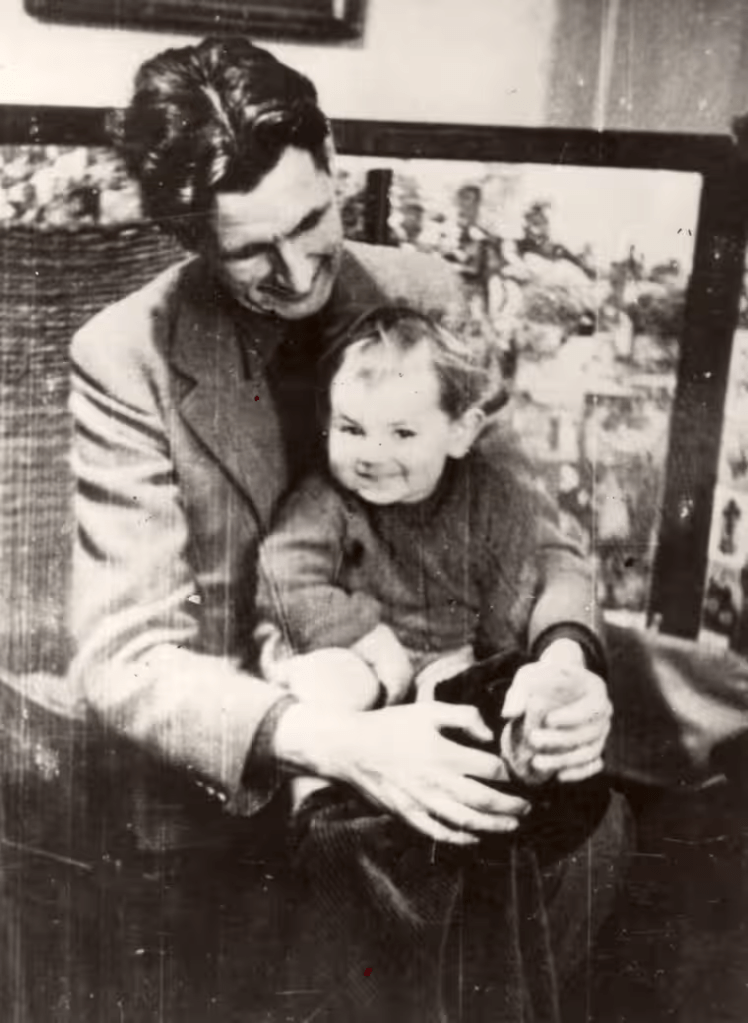
‘My father was devoted to me’ … Blair with Orwell. Photograph: Vernon Richards
Richard Blair didn’t have the easiest start in life. At three weeks old, he was adopted. Nine months later, his adoptive mother, Eileen, died at 39, after an allergic reaction to the anaesthetic she was given for a hysterectomy. Family and friends expected Blair’s father, Eric, to un-adopt him. Fortunately, Eric, better known as George Orwell, was an unusually hands-on dad for the 1940s.
Orwell and Eileen had wanted children for years, but he was sterile and it is likely that she was infertile as a result of uterine cancer. Having finally agreed to adopt after their struggle, Orwell was not going to give up on his son. “The thing he wanted most in life was to have children,” says Blair. “And now I was his family.”
We are in the kitchen of Blair’s home and he is making me a cuppa. On the kitchen wall is a framed poster of his father’s famous instructions for making tea. “Use tea from India or Ceylon (Sri Lanka), not China,” it starts. “Use a teapot, preferably ceramic. Warm the pot over direct heat. Tea should be strong, six spoons of leaves per litre. Let the leaves move around the pot. No bags or strainers. Take the pot to the boiling kettle. Stir or shake the pot. Drink out of a tall, mug-shaped teacup. Don’t add creamy milk. Add milk to the tea, not vice versa. No sugar!”
Orwell, perhaps the most influential writer of the 20th century, railed against totalitarianism in his dystopian novel Nineteen Eighty-Four; chronicled it in his memoir about fighting in the Spanish civil war, Homage to Catalonia; and satirised it in his wonderful fable Animal Farm. Yet it has to be said his tea-making rules verge on the autocratic. Perhaps we shouldn’t be surprised. Orwell, who died at 46 in 1950, was a cauldron of contradictions – a single‑minded rebel so concerned about embarrassing his parents when writing about homelessness that he adopted a pen name; an Old Etonian man of the people; an introverted party animal; an egalitarian socialist and bigot; a man who railed against the “incorrigible dirtiness and untidiness” and the “terrible, devouring sexuality” of women, but who lived in filth and devoured as many women as possible.
+++++++++++++++++++++++++++++++++++++++++++++++
George Orwell Explains in a Revealing 1944 Letter Why He’d Write 1984
For 95 Minutes, the BBC Brings George Orwell to Life
The Only Known Footage of George Orwell (Circa 1921)
George Orwell and Douglas Adams Explain How to Make a Proper Cup of Tea
George Orwell’s Five Greatest Essays (Selected by Pulitzer-Prize Winning Columnist Michael Hiltzik)
Orwellian nightmares: What I learned about today’s rage culture from rewriting 1984
George Orwell Reviews Mein Kampf: “He Envisages a Horrible Brainless Empire” (1940)
Ignorance is Strength; Freedom is Slavery; War is Peace
 After the truth-shower