
Lilya Litvyak became the world’s first female fighter ace, and is better known as the White Rose of Stalingrad
On June 22, 1941, the Third Reich launched its ill-fated invasion of Russia. It was pestilential in scale; more than three million Axis soldiers swarmed Russia’s borders in a matter of hours, overwhelming Soviet defenses. Hitler regarded the peoples of the Soviet Union to be a subhuman rabble against whom victory was inevitable. But the supposed Untermensch turned out to be ferocious opponents, hardened by decades of deprivation and fueled by an unbending love of country.
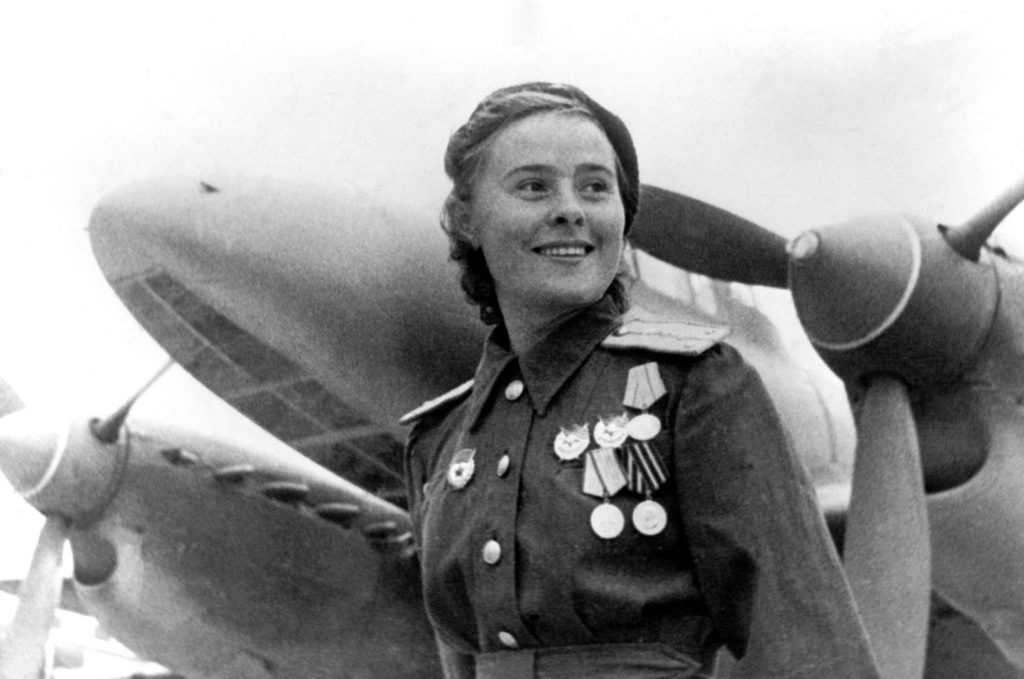
Among those supercharged patriots were eight hundred thousand women who volunteered for frontline action, in roles such as snipers, machine gunners, and tank drivers. Nearly two hundred thousand women served in air defense, including those who flew bombers and fighter planes in Air Group 122, at the time the world’s only all-female air-combat unit. It was established in the fall of 1941 by the twenty-nine-year-old navigator Marina Raskova. Thanks to a series of daring long-distance flights undertaken in the late 1930s, she was one of the most famous people in the Soviet Union, and a role model to millions of young women. Yet, Raskova’s reputation was to be surpassed by one of her students: the petite, baby-faced Lilya Litvyak, who became the world’s first female fighter ace, and is better known as the White Rose of Stalingrad.
Born in Moscow in August 1921, Litvyak knew nothing of the Russia before Lenin, Trotsky, Stalin, and their revolution. Her parents, Anna and Vladimir, had grown up in the countryside. They moved to the city as newlyweds in 1918, peasants in pursuit of the proletarian dream. They settled in a decent apartment and quickly found work; Anna in retail, Vladimir in a factory, before climbing his way up to a bureaucratic post within the People’s Commissariat of Transportation. Their eldest child, Lilya, had a typical post-1917 education. She entered the Little Octobrists and the Young Pioneers – the Soviet version of the Scouts – before joining the ranks of the Komsomol, the youth branch of the Communist Party. In these organizations, she was inculcated with the belief that the USSR had the ability to alter any aspect of life at will. “It was both possible and necessary to alter everything,” is how the author Raisa Orlova, remembers these times, “the streets, the houses, the cities, the social order, the human souls.” Anna Kiparenko, a Komsomol member, likewise believed she was involved in a profound chapter of history: “Human beings of a new kind were being formed.”….
++++++++++++++++++++++++++++++++++++
Sam Jones: From Che Guevara to lockdown: photo book tells story of Madrid
Rare colour photographs from London in World War Two / The Second World War in Colour – in pictures
A New History of the Second World War
Was Vichy France a Puppet Government or a Willing Nazi Collaborator?
Remember this lady. In memory of Irena Sendler
Sophie Scholl and the White Rose
Clara Zetkin: Fascism must be defeated (1932)
Traute Lafrenz, the last of the White Rose anti-Nazi resistance, dies aged 103
In Memory of Johann Georg Elser, the carpenter who nearly prevented the Second World War
Heda Margolius Kovaly (1919-2010): Under a Cruel Star: A Life in Prague 1941–1968
Hitler’s annihilation of the Romanis
ALAN TAYLOR – Historic photos of World War II: Before the War
 After the truth-shower