
Hundreds of conscripted North Africans were sent to fight France’s war in Indochina — instead they found a new life in Southeast Asia
NB: April 30 will be the 50th anniversary of the victory of the National Liberation Front of Vietnam. Along with Palestine, The Vietnam war was a defining episode for my generation and for me personally: My eyes were opened by Bertrand Russell’s searing denunciation of American aggression in Vietnam. The Vietnamese people fought off three imperial powers, France, Japan, and the USA; aside from which they also defeated Chinese aggression in 1979. There is a new series on Netflix called Turning Point, marking the 50th anniversary of the end of the Vietnam War. Some truth speaking by survivors, worth listening to.
Here’s White Bird, a famous pacifist rebel song from 1968
I have added some posts beneath this extraordinary article; and Vietnam also figures in my novel about those years, Revolution Highway. The total tonnage of bombs the United States dropped on North Vietnam surpassed that of the bombing of Germany, Italy, and Japan during World War II. The imperialist war cost the lives of some 3.4 million Vietnamese, and 58,000 American soldiers. Once more I salute the brave people of Vietnam, who defanged the much-vaunted US military, despite all their bombs and chemical weapons. DS
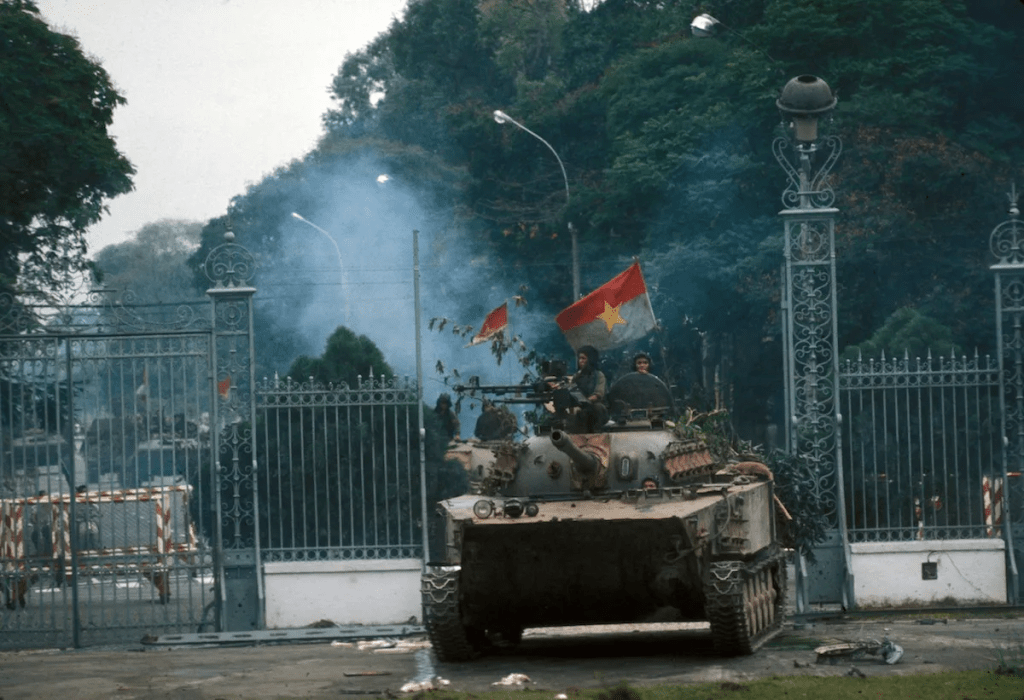
Saigon’s fall and the taking of the presidential palace, on April 30, 1975. Francoise De Mulder—Roger Viollet/Getty Images
When his plane touched down at Rabat’s Sale Airport in 1972, 16-year-old Zika Hajji stepped out into the dry heat of Morocco for the first time, toward the outstretched hand of an imposing man in military uniform with high cheekbones and heavy-rimmed sunglasses. Gen. Mohamed Oufkir greeted him in Moroccan dialect, “Kidayer, labass?” (“How are you doing?”). Zika froze. He didn’t speak any Arabic. His father, who himself had not seen his homeland for nearly 20 years, stepped forward, straightened up and said to the general, “Thank our king for bringing us back.” From the tarmac, Zika could make out a figure in the air-conditioned shadows of the terminal beyond, waving at the new arrivals — King Hassan II.
Now 70, Hajji remembers that moment with a smile — his first step onto what was then a foreign land, one he would later call home.
“It’s a story of love and resistance,” he said in Arabic, but with an accent that he still holds from his life before — the life his father built in a small town outside of Hanoi, Vietnam, with other Moroccan defectors from the French army who fought alongside the Vietnamese in the French Indochina War.
Between 1947 and 1954, more than 120,000 North Africans were sent to fight in the brutal and escalating conflict in what was then called French Indochina, which included parts of modern-day Vietnam, Laos and Cambodia. For nearly a century, Vietnam had been a prized jewel in France’s colonial empire, valued for its fertile lands and strategic position in Southeast Asia. But as the German-led Axis powers defeated mainland France in Europe at the start of World War II, the Japanese occupied Indochina and France lost control.
The war was devastating. The Imperial Japanese soldiers implemented their “three alls” policy — “kill all, burn all, loot all” — that had ravaged China in the preceding decade. Women were forced into sexual slavery. Some 2 million Vietnamese starved to death in an engineered famine during the Japanese occupation. Yet the horrors of the war created an opportunity for the exiled revolutionary, Ho Chi Minh, to return to Vietnam and lead the Viet Minh, a communist movement determined to expel both the Japanese and the remnants of French rule. When Japan surrendered in 1945, the Viet Minh seized Hanoi and declared independence. But France, determined to keep its colonial empire intact, sent its forces back into the region and a brutal eight-year war ensued that was marked by guerrilla warfare in Vietnam’s dense jungles.
The Viet Minh fought with support from China’s Communist Party, which had recently won its own civil war, and the Soviet Union, enabling France to frame the conflict not as an anti-colonial struggle but as a battle against communism.
In that battle, France conscripted more than 100,000 men from other parts of its colonial empire. The majority of those foreign soldiers came from Morocco.
Though France long maintained that recruitment to fight in the French Indochina War was voluntary, historians and veterans paint a fuzzier picture of persuasion, compulsion and deception that drew young men into service. French recruitment officers traveled across Morocco, often stopping at weekly souks — bustling markets where villagers gathered to buy necessities and exchange news. They made promises: a steady income, a chance to see a lush, faraway land that, in their telling, mirrored the Muslim paradise, and the possibility of a lifelong career in the French military.
“Poverty, the desire to escape social constraints, the pursuit of military prestige and the yearning to flee disillusionment” were the key forces behind enlistment, wrote the historian Michel Bodin in his book “L’Armée d’Afrique.”
Though Morocco, as a protectorate, was technically exempt from France’s compulsory conscription laws, many young men found themselves persuaded — or compelled — into joining, including Zika Hajji’s father.
“My father was a prison guard in Kenitra, in western Morocco, where he secretly freed jailed Moroccan resistance fighters,” Hajji recalled. “When the French discovered his betrayal, they gave him two choices: the guillotine or the battlefields of Vietnam.”
He chose the battlefield, though the guillotine — once a symbol of the French Revolution, now turned into an instrument of colonial terror — had also made its way to Vietnam, where, in Hoa Lo prison outside of Hanoi, thousands of Vietnamese resistance fighters met their demise under its blade.
“My dad was always against French colonization,” Hajji said. “There was no way he would fight for them. The moment he arrived in Vietnam, he looked for a way to join the resistance.” It turned out the resistance was looking for him, too.
After grueling days fighting for a colonial power that treated them as expendable — Moroccans were assigned the harshest duties and given lower pay than French troops — Hajji’s father and his unit would scan the crackling airwaves with a small transistor until they found Radio Hanoi. The station broadcast Ho’s speeches, urging all colonized peoples — Moroccans included — to break free, and did so in French. The colonizer’s language facilitated the radicalization of troops from half a world away.
The Viet Minh’s attempts to recruit Moroccan defectors were manifold and powerful. Pamphlets and loudspeaker broadcasts called out to Moroccan troops, invoking a name they revered: Abd el-Krim al-Khattabi, the Moroccan resistance leader whose guerrilla tactics had once humbled the French. Pham Ngoc Thach, a minister in Ho Chi Minh’s government, even reached out to Abd el-Krim in exile in Cairo, urging him to rally North African soldiers. He obliged. “The victory of colonialism, even at the other end of the world, is a defeat for us,” he said. “The victory of liberty anywhere is our victory, the sign of our approaching independence.”
His words reportedly became a rallying cry for defection. Moroccan soldiers, given precise instructions on how to surrender safely, began to desert in droves. They were to approach with their rifles slung over their shoulders, a white cloth at the end of the barrel, arms crossed and hands raised at the command of “Arretez!” (“Stop!”)….
+++++++++++++++++++++++++++++++++++++++++++
Bertrand Russell War Crimes in Vietnam (1967)
Fifty years after the Vietnam War, bombs and landmines still cover an area ‘the size of Tasmania’
Biden Is the Latest President To Tout the Vietnam War as Proud History
Henry Kissinger was the definition of elite impunity
Roaming Charges: Kissinger – the Dr. Caligari of American Empire
Revisiting Foucault and the Iranian Revolution
‘No innocent civilians’: the Violent Legacies of the U.S. War in Vietnam
How the trauma of the Vietnam War led to the age of “alternative facts”
Seymour Hersh on Witnessing American War Crimes in Vietnam
‘I sent them a good boy and they made him a murderer’
The Russell-Einstein Manifesto of 1955Bertrand Russell War Crimes in Vietnam (1967)
 After the truth-shower