The men disappearing along Arunachal Pradesh’s Chinese border
Why would the PLA enter there? Why would they abduct Tapor? Did they chance upon him or were they waiting to ambush him? Was there something about Tapor that they did not know?
IN SEPTEMBER 2015, Tapor Pullom went hunting and never came back.
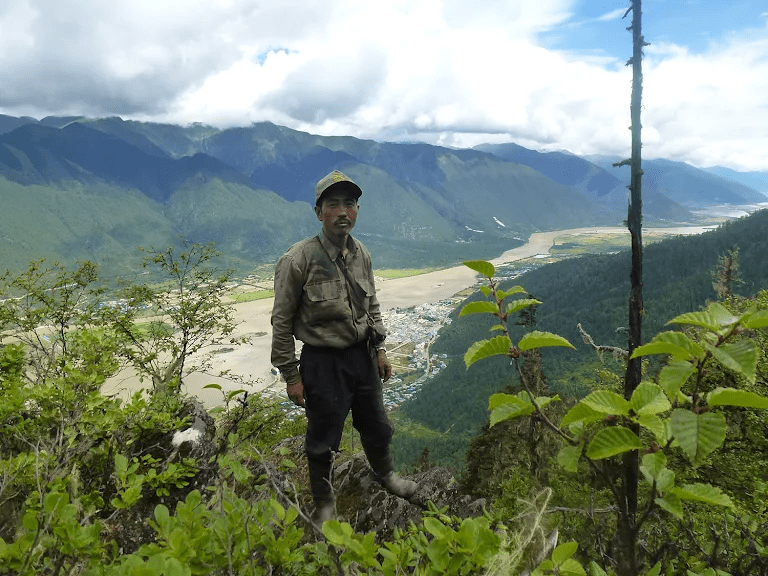
A photo of Tapor Pullom from a pendrive found by his family years after he disappeared in 2015. Special Arrangement
His family did not think much of it at first. The 46-year-old had been venturing into the mountains near his village of Monigong, in Arunachal Pradesh, since he was a child. The mountains were mostly safe. You might at most encounter a bear or a leopard, and even they prefer to keep their distance. When he did not return within a week, the Pulloms began to worry. Winter was coming. The bald peaks visible from the village were starting to pull on a blanket of snow. Tapor had promised to be back before that happened.
Taka Yorchi, a cousin, had accompanied Tapor but returned alone after 11 days. This was unusual. In the jungle, hunters do not abandon each other. It had been Yorchi’s first hunt. He told the Pulloms that he fell sick and that Tapor asked him to return. Seeing his pale face and sunken eyes, they did not ask too many questions.
Instead, the Pulloms decided to comb the forests. It was not going to be easy. Monigong lies at an elevation around two thousand metres. You hack your way through walls of trees, braving insects that can leave you itching for days, or cause dehydration and death. A GPS device is seldom of any help. Rivers are checkpoints, mountain peaks the North Star.
Thankfully, Yorchi told them, Tapor followed the same route that hunters from the village had for generations. They would sleep in caves or in the makeshift bamboo huts that dotted the jungle. Whenever they went deeper, they would carve marks on trees.
Nearly two weeks after Tapor disappeared, his brother Tachuk, his son Vicky and two others entered the forest, carrying rice, water and daavs—traditional broadswords. They found the marks he had left on trees. They even found his winter clothes, dried meat and his 12-bore gun in a cave. His jacket was dry. The food seemed like it had not been touched for days. For the first time, they started suspecting the worst.
As soon as they returned to Monigong, Tachuk marched straight to Yorchi’s house. “It was just the two of you in there,” he snarled. “If something’s happened to him, it’s your life on the line.” Yorchi, a slight and fidgety man, was not used to such confrontations, especially from men carrying swords. “The PLA abducted him!” he cried out. That is the People’s Liberation Army. The Chinese Army.
Monigong is located less than twenty kilometres from the Line of Actual Control, the unfenced and disputed border between India and China that affects nearly a million residents of India’s easternmost state. Many of them say they have always known where it is: along the ice-capped peaks that separate Arunachal Pradesh from Tibet, rising between two and four thousand metres in altitude. Tapor knew it better than most. He had worked as a porter for the Indian Army’s patrols along the border.
Yorchi lives with his three children in Monigong, constructing roads and bamboo shelters for the army. During my visit in October 2023, he had offered to meet me at the Pulloms’ residence. We gathered around a wooden fireplace in the living room, sipping tea. Eight years on, most of them had forgiven Yorchi. He avoided making eye contact with those who had not.
Yorchi said that he joined his cousin for the hunt only because he was facing a money crunch. Tapor was eyeing the prized musk deer, which could fetch over a lakh rupees on the black market. They had agreed to share the spoils fifty-fifty.
“It happened on the eighth day,” he said. While hunting, Tapor and Yorchi would keep some distance between them, to avoid alerting animals. One morning, as he was trailing Tapor by around a hundred metres, a few dozen men emerged out of nowhere. Their language sounded distinctly different from that of the Adi tribe, which dominates both sides of the border in this region. They were wearing PLA uniforms.
The men surrounded Tapor. “It was raining,” Yorchi said. “I couldn’t clearly see what happened next.” His survival instincts took over. He dropped his belongings and legged it.
Why had he not said anything before? “I was scared,” he said. He had no evidence, no alibi to back up his story. And he could not have played the warrior when the soldiers were dragging his cousin away. There were nearly fifty of them.
Shortly after Yorchi’s confession, the Pulloms returned to the mountains. They found the spot where Yorchi recalled last seeing Tapor—a downhill slope with knee-length grass. Fresh flakes of snow now covered it. There was little chance of finding footprints.
Tachuk had been there before while hunting. “It was Indian territory,” he told me. The peaks that marked the start of Tibet were at some distance still. The family has jostled with many questions since. Why would the PLA enter there? Why would they abduct Tapor? Did they chance upon him or were they waiting to ambush him? Was there something about Tapor that the family did not know?
Usually, little of what goes on in Arunachal makes news. The state has 26 tribes and 110 sub-tribes, each with its own culture and language. Like the Pulloms of Monigong, many live in high mountains, separated by thick forests, often without roads and internet connections. It is all too remote, too diverse to cover for India’s mainstream media run from Delhi and Mumbai, thousands of kilometres away. They usually have one reporter for the entire Northeast. Even Arunachal’s local media can seldom afford the expense of last-mile coverage of their own state.
But, in the years after Tapor went missing, big things were happening on the border—the kind that would make the alleged abduction of one hunter from an obscure village in the Himalayas the subject of national conversation.
INDIAN AND CHINESE SOLDIERS came to blows on the LAC in Ladakh in 2020. Dozens died. The world watched nervously as the two nuclear powers ramped up troop deployments in sub-zero temperatures at altitudes over five thousand metres. It is terrain where the human body fights for breath, where even hardy shepherds and their flocks go sparingly.
Around the time, the Indian media started reporting a series of “abductions” by the PLA along the border districts of Arunachal Pradesh: a 21-year-old from Upper Subansiri in March 2020, another five youths from the same district that September, an Upper Siang resident in January 2022. Even in cases where people had gone missing—two men from Anjaw, and two others from East Kameng, in August 2022—China emerged as the prime suspect.
A couple of hundred kilometres from the border, in the town of Pasighat, Amoni Diru had been closely following news reports of such abductions. Diru, aged 25, is the fiancée of Tapor Pullom’s eldest son, Vicky. All the reports, she noticed, said that the abductions happened from Indian territory, as was the case with her future father-in-law.
For years, Diru had been following up with the Indian Army. The army is the most active arm of the state in border villages, often involved in schooling, transport and food supply. Plus, Tapor had worked for them as a porter for years. They would promise to look into it but never call back.
In February 2022, after reading one such news report, Diru pulled up the Facebook page of the Arunachal Times. “I said a prayer to Jesus, said ‘Amen,’ and typed in the comments section. ‘My father-in-law was abducted too,’” she would tell me later that year. The newspaper reached out to her, wanting to write about Tapor.
The article went viral. Soon, Diru had reporters from across India calling her. Seizing the momentum, she went to Itanagar and held a press conference with Yorchi, and recounted the sequence of events. The Bharatiya Janata Party leader Tapir Gao raised Tapor’s abduction in parliament. Diru said the army had called her to their camp and assured her of action.
*In the first three cases listed above, the PLA had released the detainees after a few days. However, it stirred a debate on Chinese encroachment into India. Critics accused China of “salami slicing,” laying claim over a territory, then nibbling away at it slowly but systematically, as it has with islands in the South China Sea. In a series of media interviews, Gao, the member of parliament from Arunachal East, accused China of occupying buffer zones along the LAC and building roads and bridges to enter Arunachal Pradesh. New Delhi mostly kept mum.
China rejects allegations of encroachment, but it has never seen Arunachal as Indian territory. Arunachal’s nearly nine-hundred-kilometre international border was first drawn up in 1914 by Henry McMahon, then foreign secretary of British-ruled India. He drew it primarily along the mountain peaks from the east of Bhutan to the west of Myanmar, with the Dalai Lama’s kingdom of Tibet to the north and British India to the south. “But the McMahon line wasn’t demarcated on the ground,” Mukut Mithi, a former chief minister of Arunachal Pradesh, told me. “That’s how the problem started.”
China considers the McMahon line a British imposition. When it annexed Tibet, in 1959, it extended its claim over the North East Frontier Agency—as Arunachal was called at the time—declaring it part of south Tibet. Its leader, Mao Zedong, would often say that it was China’s responsibility to liberate the region, along with Ladakh and Sikkim. In the 1962 Sino-Indian War, the PLA made it nearly fifty kilometres into parts of the NEFA before withdrawing. Like India’s position on Azad Jammu and Kashmir, China’s official maps today show the whole Indian state within its borders. They call it Zangnan and also have different names for its towns.
India calls this “cartographic aggression,” but the lack of a consensus over the border means soldiers from the two countries often patrol the same stretches. Indian soldiers often report finding Chinese alcohol, cigarettes and packs of instant noodles in jungle camps along the border. Sometimes, there are Chinese flags painted on a rock. They then scrub and replace these with the tricolour. “This has been going on since 1962,” Mithi said.
Such games of one-upmanship seem comical, but happen because neither side wants an all-out war. Despite occasional skirmishes over the years, China and India have shared a mostly peaceful relationship. Army commanders regularly hold flag meetings along the LAC to resolve disputes. At the Indo-Tibetan Border Police camp in Gelling, in late 2023, I saw a board with Hindi, English and Mandarin icebreakers soldiers could use, such as “Have you had your meal?” “Do you need ration?” “I am not fluent in Chinese” and “Please go back.”
***
Yet, concerns over territorial capture remain. The Indian media has often reported China’s attempts to build roads in disputed regions. Since 2016, China has been constructing and fortifying hundreds of border villages in Tibet, complete with houses, airstrips and watchtowers. They also enticed people to move into remote areas by offering spacious homes and generous subsidies. The idea is that they double up as its eyes and ears.
India’s Vibrant Village programme is seen as a direct response to this. It aims at providing over six hundred villages along the LAC with roads, mobile connectivity, employment opportunities and border tourism. “We want people to take pictures and tag them on Twitter or Instagram,” an army officer told me near the Gelling border post, explaining that this helped further legitimise India’s claim over the region.
Caught in this geopolitical tug-of-war are residents of the border villages. For centuries, they had taken cows and goats, hunted bears and deer, and bartered for salt, sugar, ghee and rice in Tibet. In the western region, Buddhist-majority villages often paid taxes to the Dalai Lama’s kingdom, while the Mishmi people of the east sent priests to perform rituals in Tibet. Sonia Shukla, a fellow at the Institute of Chinese Studies who is writing a book on the border villages, told me this continued even after the 1962 war. Soldiers of both countries knew of these deep cross-border ties, she said, but often looked the other way. “After all, the visitors could help with intelligence-gathering from the other side.”
Such abductions have been going on for decades, Vinod Bhatia—a retired lieutenant general and director of the Centre for Joint Warfare Studies, a government think tank—told me. The border villages are often dozens of kilometres away from the nearest police station or administrative centres, and there is little interest in keeping a record of abductions. “Even if I report to the district administration, they’ll say these are normal things that happen every day,” Bhatia said.
The recent spike in abductions, Shukla said, means that there is now an attempt at “hardening the borders.” She pointed to Miram Taron, the Upper Siang resident abducted by China in January 2022. On returning, he alleged that the PLA had tortured him in custody. “If one guy has been beaten up and sent back, he will come back and tell horror stories,” Shukla said. “These will get amplified and will be told in even graphic detail to others in the so-called Chinese whispers. That acts as a deterrent.” Residents of the region had no say when borders were drawn in their backyard. Now, they risk their lives if they cross over.
In 2020, Tadak Pakba, the president of the All Tagin Students’ Union—a tribal youth group—campaigned for the rescue of the five youths the PLA had abducted from Upper Subansiri district. The incident traumatised residents of border villages, he told me. Even after the youths returned, many were too scared to go to the jungles near the LAC. “When they do go, many say they can’t access areas they could fifteen or twenty years ago,” he said. “In some parts, the Indian Army stops them from going. They have to get special permissions to access our own mountains.”
Pakba, too, reckoned that abductions by the PLA have been going on for decades, though their frequency did seem to be increasing. “The difference is, we know of it now because of social media.”
Many of the nearly two dozen people I interviewed echoed the sentiment. Diru did too, during our first conversation in late 2022. The inability of hunters and herders to safely access their mountains was changing their way of life. “It’s part of our identity,” she said. “It’s the only way many people know to survive.”
There was more to Tapor’s abduction, however.
One evening during my October 2023 visit, I sat down for dinner in Diru’s three-room house in Pasighat. The smoky scent of pork over firewood wafted in from the kitchen. In the months since our first chat, Diru had organised protest marches, held press conferences and lobbied politicians on both sides of the aisle. Over time, the legislators became unavailable, and the news cycle moved on. Despite assurances, the Indian Army had little to share on Tapor’s whereabouts. Sitting across from me on a floor mat, Diru looked crushed.
“I think I know why he was never found,” she said. “Because Tapor Pullom used to be an intelligence agent.”
DIRU HAS NEVER met Tapor Pullom. He had been missing for nearly a year when she met Vicky. But she speaks of him with the affection and familiarity of a biographer: his quick temper, his skills with the daav, his religiosity and how he had once kicked Vicky “like a football” for not attending Sunday mass.
Diru and Vicky were born in the then-undivided West Siang district—only fifty kilometres apart, but in completely different worlds. Diru is from Tato, a mountain town in central Arunachal Pradesh where her father is a civil contractor. In a state that largely runs on doles from the union government, where political allegiances are fluid, he benefited from backing the winning horse in assembly elections. Where most of the town’s residents work on farms and live in bamboo houses, the Dirus own a solar-powered bungalow and drive an SUV.
The Adi tribe the Dirus belong to is a patriarchal community, with defined gender roles. Men hunt, women cook. Men drink, women pour. Both genders work on farms and forage in the forest, but only men get to own land and have the final word in disputes.
Diru never buckled to the norms. She excelled at studies, played several sports and won a beauty pageant. She spoke up in family or community disputes and often had men sitting up and hanging on to her words. A lot of them, she realised soon, admired not just her articulation but also her looks. Fluent in eight languages, she made sure to say exactly what she thought of them. These skills came handy in the years she spent looking for Tapor.
Diru met Vicky at a dance rehearsal at his engineering college in 2016. “He was a short, scrawny boy, and he couldn’t dance to save his life,” Diru recalled. But she liked that he was subtle about his affections, even if he sometimes made a fool of himself. At a college potluck, he was the only one who ate the meat broth she had cooked. “He praised it to high heavens,” she said. “I later realised I had forgotten to add salt.”
Their phone calls would go late into the night. Vicky, she found out, was the eldest of three siblings. A year before his father was abducted, his mother had died. Vicky’s parents wanted him to land a government job and had spent all their earnings on top boarding schools. After them, a local church sponsored the education of Vicky and his siblings. “His family story touched me,” Diru said. “Someone who has struggled understands the importance of life and the people. They’d not hurt others.”
***
Vicky started helping her out with assignments, joining her family in the walnut fields during the harvest season. She involved herself in his life, too. When Vicky’s grandfather was trying to sell off Tapor’s land, she travelled to Monigong and initiated legal proceedings against him. Some villagers asked her why she was interfering—she was not even married to Vicky. In the face of this opposition, Vicky stepped in. “Her word is as good as my word,” he told them. It was this trip that firmed up Diru’s resolve to look for her fiancé’s father.
In the past decade, Diru has moved heaven and earth to search out Tapor’s whereabouts. She has written letters to the prime minister and his cabinet, the chief minister and state legislators. Last year, when Rahul Gandhi was in Arunachal Pradesh for the Bharat Jodo Nyay Yatra, she met and requested his intervention. At one point, she told me, she even paid someone Rs 35,000 to cross over into China and make enquiries. “He said there’s someone there, but he’s been transferred to a jail in the Tibetan capital.”
Between 2016 and 2022, Diru said, she made over two dozen trips to army camps in West Siang and Shi Yomi, in Arunachal Pradesh, as well as Assam’s Jorhat district. She would drive for hours, her scooter navigating pockmarked roads alongside SUVs stuffed with people and spilling with bags. At the camps, she almost always met a different officer—people were transferred out regularly. She would recount the story all over again. “They were all polite,” Diru told me. “They always said, ‘Kahiye, main apki kya sahayata kar sakta hoon?’”—Tell me how I can be of help to you—“and promised to look into it. But they’d never call back.”
Simultaneously, she started digging into Tapor’s past. He was part of the village’s warrior clan but often acted like a goon. He had chopped off people’s fingers, bashed them in the head with sticks and fought rival tribes till his fists turned bloody. His friends would say he could take on any adversary—man, animal or nature. His bamboo house was once decorated with the skulls of bears and wild buffaloes.
“Yet, most told me that he had a good heart,” Diru recalled. Tapor had made a name for himself by introducing Catholicism to the village and helping to construct its only church. His house always bustled with friends and neighbours, even those who had once clashed with him. As Vicky recalled fondly, “If he beat you up, he paid for your treatment too.”
Diru’s efforts impressed the residents of Monigong. Theirs is a border village in West Siang, reached after a three-hour ride along bumpy roads and waterfalls from the district headquarter, Tato. During elections, candidates would visit and make tall promises of blacktop roads and cellphone towers. After her interview with Arunachal Times went viral, journalists were coming in too—and exposing how none of their promises had materialised.
***
In March 2022, when Diru organized a protest march in Monigong, hundreds turned up. For an hour, they walked the road connecting their town to the rest of the state, placards in hand, chanting “Release Tapor Pullom” and “We want government intervention.” There were lots of new faces, and tongues wagged freely. “At the time, I overheard some people talking about it, that I shouldn’t be doing this,” Diru said. “Because he used to work with the army.”
Like many in border villages, dozens of men in Monigong work as porters for the army. They accompany the soldiers on patrols, carrying food and tents, and helping them navigate the wily mountains. Tapor’s children thought he did the same, which was why he would sometimes disappear for weeks on end.
The big reveal came only in April 2023. Diru was rummaging through an old suitcase belonging to Tapor and found a USB drive. It had dozens of photos of Tapor and his hunter and porter friends. And then some that absolutely terrified her.
At my request, Diru showed me these photos. In some, you see Tapor, short and lean, gun in hand, dagger by the waist, sitting by bonfires or standing in the snow. Then, the forests dissipate, and you see a sprawling township, with high rises, street lamps and a running track. Then comes a watchtower with a camouflage pattern and army barracks with Chinese flags. All of them clicked from a mountaintop at a considerable distance.
I shared these photos with two military veterans who have served on the Indo-China border. They confirmed the photos were Chinese border settlements in Tibet. “There is no doubt of it,” one said. The job of taking such photos, they said, was usually assigned to “civil assets”—freelancers who are paid tens of thousands per assignment. Most of them are locals from Arunachal’s border areas. If caught, they are meant to destroy their equipment and say they are hunters who crossed over inadvertently.
Diru had guessed as much. “When I started asking people in Monigong, someone shared a list of civil assets who got groceries from the army during such missions, five kilograms of rice and two kilograms of sugar,” Diru said. “Tapor’s name was on it, but it was for a mission in 2014”—a year before he was abducted.
***
Soon after, Diru went back to the army base in West Siang. “As usual, they invited me in politely,” she said. “There was a new officer again. He said, ‘Kahiye, main apki kya sahayata kar sakta hoon?’ My head was spinning. I announced that I had some photos that looked like they’re from the other side of the border in China. I said, ‘I don’t know if he’s really an asset,’ but if they don’t cooperate, these photos will be in the media.”
The officer looked alarmed, Diru recalled. “‘There will be chaos,’ he said. ‘It’s a sensitive issue.’” But she wanted answers—a confirmation or denial of the reason for his abduction—or, at the very least, compensation for all the years Tapor worked for them, for everything the family had suffered after his disappearance. “Finally, the officer said he can’t do anything,” she told me. “He’s since been transferred out.”
Despite her threats at the time, Diru wrestled with the idea of revealing Tapor’s secret. “If it was true, no one would help me,” she admitted. “We see it in the movies too.” Her other worry was how it would affect her fiancé. Vicky had abandoned his engineering degree and joined the army in order to help his family out of financial crisis. “What if they call Vicky seditious and fire him?” Diru said.
With time, Diru said, she had realised the issue was bigger than her. “There are lots of people in border areas who work as civil assets,” she told me. “Most of them are from financially weak families, without connections. There might be many who have gone missing, but their families haven’t spoken up.” If Tapor was found, she said, it would set a precedent for others like him. She was also tired. “I have tried everything. This is my last shot.”
It had been nearly a decade since he went missing, I said, so did she think he was still alive?
She took me to her study, a small room with shelves stacked with books on Indian jurisprudence. She pointed at two photos of the Pulloms pinned on the wall. In one, the family of seven is huddled up awkwardly, in baggy tops and t-shirts. The darkness of their bamboo hut is illuminated only by the camera flash. In another, a lanky Tapor sits on the floor next to his wife. Their arms are barely touching. There is a hint of a smile on his face.
“Usually, photos this old tend to fade,” she said. “His photos haven’t. It gives me hope.”
THERE ARE NO EASY WAYS to verify conclusively if Tapor indeed was an intelligence agent. “Civil assets” like him are usually off the books and work discreetly enough that the state can deny any association if they are caught. Tapor never told his family that he was a spy. Neither the Indian Army nor the Chinese embassy responded to my questions about his case. But all the evidence seemed to line up, and his story is far from unique.
“Are locals used to gather intelligence? The answer is yes,” DS Hooda, a retired lieutenant general who spent part of his four-decade army career overseeing the Indo-China border, told me. “And both sides do it.”
Unlike India’s western border with Pakistan, most of the China border is unfenced. Border villages are often fifteen or twenty kilometres from the LAC. Forests and mountains act as a buffer zone. “To date, a large portion of the LAC has no deployment from either side,” Hooda said. That allows room for civilians—hunters and cattle graziers—to sneak in. Their language, accent, facial features and knowledge of the terrain help them blend in, making them ideal intelligence gatherers.
***
“The Indian security forces would often encourage graziers to go with their cattle to places they felt threatened because of the presence of Chinese patrols,” Shukla, the author and researcher, told me. “So much of it was unsaid. They’d ask, ‘Udhar kya hai?’”—What is there? “The guy would be excited. He’d think he’ll click a few photos too if he’s going there.” In return, they would get money or groceries or a tin shed for their house. “It is fascinating that you can do statecraft like this, but in Arunachal you can.”
It is a risky endeavour. Civil assets or spies do not enjoy the diplomatic immunity that officials of the Research and Analysis Wing—India’s external intelligence agency—who are usually posted safely within Indian embassies, are entitled to. Nor are they covered by international laws such as the Geneva Conventions, which facilitated the return of Wing Commander Abhinandan Varthaman, who had parachuted into Pakistani territory after an aerial dogfight in 2019. In fact, when caught, most countries do not even acknowledge spies.
“It’s not as if he is an employee of the government that you’re honour-bound, [or that] there are rules and regulations that you look after the family,” the former R&AW chief Vikram Sood told ANI last year. “So, we try to do that, look after the family. That’s all we can do, give them employment or jobs.”
This practice is entirely discretionary.
Over the years, several former spies and their families from the border villages of Punjab and Jammu and Kashmir have decided to blow their cover after years of neglect by the Indian government. Some spent decades in Pakistani jails. On returning, they found their parents dead, wives remarried and their families left to fend for themselves. A few sued the Indian government. “We don’t want money,” The Print quoted the brother of Ravindra Kaushik, an agent who had died in custody, as saying. “What we want from the government is recognition.”
***
Why would people do a job where you effectively gamble away your rights as a citizen, with no insurance? Hooda gave several reasons. Some do it out of duty for the country, some for a sense of adventure, or because it raises their standing within their community. “But, honestly, 99.9 percent are doing it for money,” he said. In remote regions, where avenues of employment are few, an assignment can net as much as a few lakh rupees.
In Monigong, I met a hunter who went on one such assignment in 2018. He did not want to be named, for fear of reprisals. For years, he said, he had worked as a porter for the army. But then, his mother fell sick, and he needed extra cash to pay her bills. “For jobs like these, you don’t deal with the army directly,” he told me. “There’s someone in the village who acts as a middleman. They just tell you what to click, where and how. Then you go.”
His job was to make videos of Chinese military installations across the border. There was no training, no written or verbal agreement on what would happen to him or his mother if things went wrong. When he submitted the footage, he promptly received Rs 20,000. He did not push his luck again. “If they’d caught me,” he said, “the Chinese would’ve made chicken fry out of me.”
It is an exploitative practice, Shukla said. “But a justification, if there is any in their head, is by saying that they go there anyway, that it’s part of their land, their route. And China is preventing them from going on their traditional routes.”
The shared tribal identity between residents on both sides of the border also helps. In 2008, the anthropologist Ambika Aiyadurai met a man from the Mishmi tribe hired by the Arunachal Pradesh Special Branch to plant hidden video cameras along the LAC. In a research paper on the border villages, she recalls that she asked him,
“Don’t you feel scared, it’s a risky job. What if the Chinese catch you?” He proudly answered, “There are Mishmis on the other side so they don’t harm us because we also look like Chinese.” He jokingly pointed out to me that, “If you go you will be shot,” and laughed out loud, and continued, “for that matter any educated-looking person will not be spared.”
It is unusual for intelligence agents to identify themselves, especially to a journalist. The one I met in Monigong was through Diru. But, while travelling in the border villages, I met another man who confirmed that Tapor was a civil asset—and that he knew because he was one too. The person said he was disenchanted with the Indian security forces for abandoning the search for Tapor. He said he was speaking to me because, when the PLA abducted his son a couple of years ago, Indian forces nearly abandoned him too. The Caravan is withholding his name over concerns of reprisals.
Ours was a chance encounter. I had fixed up a meeting with the son over the phone, and he had promised to tell the “real story” of his abduction, but his phone was switched off on the day I arrived, and he had not given me his exact address. Luckily, theirs is a village of only fifty families. Most live in houses of bamboo and thatch, on top of a cliff that is connected to the nearby town by a rickety wooden bridge over a violent river. The family, a local grocer had told me, lived in the only house made of concrete. For all its problems, spying paid better than most other vocations in the village.
At their courtyard, my intended interviewee’s mother sat me on a small stool and dialled her husband. In the hour after he arrived, as hens and goats and cows and dogs milled around us, he told me that his son’s public identity as a “hunter” is not strictly true. The Indian Army had once sent his son to take photos near the LAC. “The PLA had set up camera sensors there. That’s how they found out and ambushed him.”
“When I heard of this, I went to the officers and asked how they could send my young son there,” the father said. “The officer threatened me, ‘Ulta seedha baat karoge toh I will hit you’”—If you keep talking rubbish, I will hit you. He recalled replying, “I will also give up my name to China. I will also tell them about your battalion.”
At the time, some journalists with national news outlets were visiting a neighbouring town. “I told them everything,” he said. “But I warned them not to bring up the Indian Army connection, or my son might not come back.” The story made national news. The threats worked. Ten days later, the son was back home. But the PLA had tortured him in custody. He could barely sit or sleep. The Chinese soldiers had electrocuted his genitals.
The father returned to his son’s reporting officer and requested money for his treatment. “I said, ‘I’m not asking for a lakh, just twenty–thirty thousand. The rest I will see.’ They didn’t even give one rupee.” The ordeal left him bitter. He had not expected this to happen to him. “I, too, have worked as a civil asset for many years.”
***
He went on to explain his connection with Tapor. “He and I shared a reporting officer at the local army division,” he said. “That’s where we met in 2013, 2014 and 2015.” During their last meeting, over beer and a meal, Tapor told him that his wife had died and that money was tight. “He couldn’t afford his son Vicky’s school fees. For that, he said, he’d go on a mission one more time. And that would be his last.”
He did not know if Tapor was on an intelligence-gathering mission when he was abducted. But, shortly after, he said, the army company Tapor was working for in Monigong was replaced by another one. “The new officers must’ve thought, ‘It’s been so long, and we have no idea who this person is.’” Tapor’s search, he assumed, fell off the radar. In any case, civil assets like him are expendable.
“Tapor went missing in 2015. His news came out in the media only in 2022,” the father said. “If I too had kept quiet, my son wouldn’t be back.”
“WHENEVER CHINESE SOLDIERS WANT, they come and have picnics inside our territory, and our government could do nothing,” Amit Shah thundered during a campaign speech in the outskirts of Varanasi before the 2014 general election. Shah was in charge of the BJP campaign in Uttar Pradesh that year, and his party took frequent potshots at the Congress-led union government for its inability to secure India’s borders. Once Narendra Modi became prime minister, Shah told the impassioned crowd, intruders would not dare cross the border.
The PLA’s “picnics” have continued during Modi’s decade in power. At the peak of geopolitical tensions in 2020, after India had lost control of parts of Ladakh, Modi rejected reports about it without even mentioning China. In 2023, The Caravan republished a police research paper saying that India had lost access to 26 out of 65 patrolling points in Ladakh.
India’s reluctance to alienate its bigger, richer, mightier neighbour is understandable. Like most of the world, India’s economy is greased by Chinese manufacturing. Every year, the country imports goods worth over $100 billion, including electronics, machinery, clothing and pharmaceuticals, from China—accounting for nearly fifteen percent of its total imports. Despite the union government’s Make in India scheme, the trade deficit is only skewing in China’s favour by the year.
Things seem to be getting better, though. Since August 2022, there have been no reported abductions in Arunachal Pradesh. In October 2024, foreign secretary Vikram Misri said that the two sides had resolved the four-year military standoff along the border. Although, any détente is conditional on mutual understanding. And a 2023 Pew Research Center survey indicated that two-thirds of Indians—a historic high—still held an unfavourable view of China.
In a 2016 paper published in the Indian Defence Review, Nicolas Groffman, a lawyer and consultant who has studied China for decades, writes how a lack of understanding about each other hinders good relations between the two countries. China and India are neighbours that barely talk to each other. “Most significantly, they do not spy on each other competently,” he writes. “India has some very skilled operatives within the Research and Analysis Wing, but few that specialize in China. China has an enormous pool of resources spread across several government departments … However, China’s intelligence services generally behave as if India is not worth spying on.” Effective intelligence lessens the likelihood of conflict. “Without sufficient information to the contrary,” however, “Indian bureaucrats have convinced themselves that their Chinese counterparts are far more hostile than they are, and vice versa.”
***
Little has changed in the eight years since Groffman’s essay. And today, the dispute over Arunachal Pradesh includes a battle for its residents’ hearts and minds.
In the aftermath of the 1962 war, most stood with India. But, for the newer generations, there is an increasing realisation that the state has been ignored in India’s growth story. In my two trips to Arunachal Pradesh, in 2023 and 2024, many complained that the issues they face every day—rampant corruption, poor road and mobile connectivity, lack of employment opportunities and patchy implementation of government schemes—seldom make national news.
In comparison, the infrastructure, GDP and quality of life in Chinese-controlled Tibet have grown exponentially. Indian civil assets have witnessed it firsthand. “When I saw a Tibetan village for the first time, it was a beautiful sight,” the hunter from Monigong told me. “They have so much development. High-speed internet, four-lane highways, streetlights, watchtowers. If you drive on the roads here, your car goes ghadaam–ghadaam.”
That explains India’s recent allocation of hundreds of crores of rupees for development initiatives along the border—Vibrant Villages, Battlefield Tourism and a host of promises to “overhaul” the road, education and infrastructural aspects. Monigong is among the villages identified for development. In November 2024, the governor visited the village and reiterated the promises. But locals had heard it too often.
“The government is only interested in us today because of the China dispute,” Diru said. Arunachalis, she added, are tired of being pawns in a geopolitical battle, not a stakeholder in India’s growth story.
In August this year, it will be ten years since Tapor went missing. There has been no information about his whereabouts. When we met in 2023, I asked Diru if she thinks it is still possible for him to return. “Yes,” she said firmly. “Because I know someone who had been similarly kidnapped, tried, jailed and returned after years.”
***
That is how, one evening in October 2023, I met Tapor’s uncle Nime, better known as “Chinaman.” Nime is in his late eighties. He lives in a bamboo hut in Monigong. Weapons and woollens hung on the walls, with a fireplace at its centre. Age had greyed Nime’s eyes, bent his back and knocked out his teeth. It had not, however, diminished his flair for storytelling.
For centuries, Nime told me, locals in border villages like Monigong had little connect with India. After its 1962 defeat, the Indian Army started building its presence across the state. In Monigong, fascinated residents watched as men with guns, in trucks and tanks, started building outposts and waving the tricolour. For many, it was their first encounter with India. Having heard of China’s invasion of Tibet, its detention and torture of Tibetans who resisted, they largely welcomed the army’s efforts.
“Since 1963, the army wanted to know what China was up to,” Nime said. The humiliation of 1962 was fresh. The army offered five rupees a day—which was worth far more back then. Nime signed up. His task, he said, was to observe the PLA’s numbers and positions, and where it had built roads and camps. Nime had an uncle in Tibet. His family would go over for rituals or to celebrate harvest festivals. If caught or questioned, Nime was to say that he was a hunter and only visiting. “Between 1963 to 1970, I went 22 times,” he said. “After the twenty-third time, the army was going to give me a medal. Then my uncle ratted me out.”
Nime was produced in a Chinese court and sentenced to nine years in prison. He was handcuffed for most of the first four, along with Tibetan freedom activists. He initially hoped India would come to his aid. When no one did for eight years, he wrote a letter to the jail superintendent confessing his espionage activities. Soon, he told me, he was shifted to a lower security prison.
“Here, they gave me warm clothes and good food,” Nime said. “I lived like a king.” After he completed his sentence, a group of Chinese soldiers accompanied him to the LAC near Monigong. “They stopped at one point and said, ‘Go, this is your land.’”
Nime’s family could barely believe he was back. The Indian Army was even more suspicious. “They wanted to check if the Chinese had brainwashed me.” So, two days after his arrival, they detained him and held him in custody for six months.
Nime returned home for good only in 1980. His wife made him swear he would not work for the state again. But his ties with the army personnel continued. “Even today, if they do anything wrong, I go over and give them a smack on the head,” he said.
I asked whether Tapor had also worked for the intelligence agencies.
“Yes,” Nime said. The two would speak about it.
Was Tapor on the job when he was abducted?
“No.” Tapor had stopped going after his wife died. “If he’s indeed there,” Nime added, “the maximum jail term is nine or ten years. There’s no death to civil assets. I might die but, you see, he will return.”
As we bade him goodbye that night, I noticed a buoyant Diru smiling to herself. Later, she told me that she often daydreams of Tapor’s return. “The first thing I’ll say is, ‘Swagat hai apka apke ghar mein’”—Welcome to your home. “Then I will hug him such that he forgets his years in captivity.”
Tapor will have a lot of catching up to do. With his youngest son, who was only five years old in 2015 and cannot picture his father anymore. With his daughter, who often rued the fact that she never spent enough time with him. Diru and Vicky want to get married, but the traditional way involves a hefty bride price. “This includes 12 mithuns, 17 or 18 pigs, seven kilograms ghee and butter, a hundred kilograms rice, a few dozen litres of rice and millet beer, and Rs 50,000 in cash,” Diru said, “Perhaps he could help with that.”
For the first month, she told me, she would warn everyone not to say a word about China, so that he can process the trauma. “When he is ready, I will want to know everything. Everything from the abduction, jail, if there was torture and how he was released. I will make sure I bring it to the world, so it won’t happen again.”
All these years, Tapor Pullom has been Diru’s quest. In flesh, he will likely be her stubborn, irascible and temperamental father-in-law. “We’re both strong personalities,” she said. “But I think we’ll get along.”
**********
Omkar Khandekar is a journalist from Mumbai, and an alumnus of Cardiff University. His reporting from India, the Maldives and the United Kingdom has appeared in numerous publications, including The Caravan, Open and Scroll
Source: CARAVAN
++++++++++++++++++++++++++++++++++++++++++++++++
 After the truth-shower