By Angus Watson
It appears in satellite pictures like great blotches of blue and green ink; swirling, spreading, sinking into parchment paper. In Australia’s arid center, those blotches represent a new inland sea, born from a deluge that has traveled hundreds of miles through the veins of a giant, parched continent.
The rare event is now breathing life into the desert, bringing mammals, birds and tourists to the heart of the Australian outback.
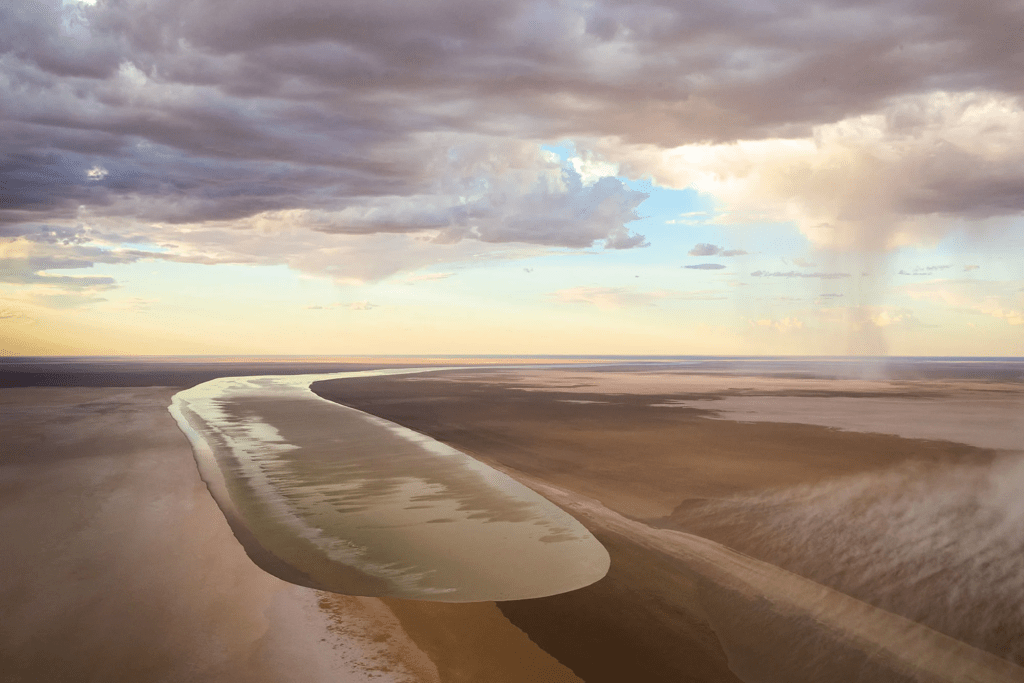
A photo of the Kalamurina Wildlife Sanctuary taken in 2018 shows floodwaters from north-west Queensland flowing into the area, traveling more than 600 miles over two months. A similar event is happening now, on a much bigger scale, and may not take its full effect until October. Brad Leue/Australian Wildlife Conservancy
“Imponderable” is how ecologist Richard Kingsford of the University of New South Wales describes the possibilities for scientific discovery offered by the rise of this sudden oasis in one of the world’s thirstiest areas. “It’s the water birds, the spectacular flowing water through the middle of a desert. It’s the fish that are in the rivers. It’s also the months afterwards, where you get carpets of wildflowers growing across the desert,” he says.
“Rare events are not well understood, because they’re rare. We don’t know quite how big this flood is going to be.” Kati Thanda-Lake Eyre is a 3,668-square-mile ephemeral lake and, despite the name is rarely very wet, receiving just 5.5 inches of rain on average per year. It could be more readily thought of as a giant salt pan in the South Australian desert.
In 1964, British speed record breaker Donald Campbell used Kati Thanda-Lake Eyre as a racetrack, rocketing to a then-world land record speed of 403.1 mph across the wide, unbroken expanse.
Ten years after Campbell’s shot across the salt flats, in 1974, the lake filled to its capacity for just the third time on record. That flooding has been taken as the high-water mark and not seen since, though smaller-scale events have been recorded in recent years.
This year, after Tropical Cyclone Alfred dumped on inland Queensland in March, the water flowing down to Kati Thanda-Lake Eyre appears to be filling it for just the fourth time in 160 years.
‘A tremendous tourism boom’
There are two main arteries feeding Lake Eyre — the Georgina-Diamantina River, which began filling Kati Thanda-Lake Eyre’s north in early May, and the Cooper Creek system. Cooper Creek, named somewhat erroneously by early British explorer Charles Sturt, is hardly a creek.
“It can be 60 to 80 kilometers (about 37-50 miles) wide in a flood,” says Kingsford.
The water brought by that second system has not yet reached Kati Thanda-Lake Eyre and may not take its full effect until October.
By the time it does arrive, the desert ecosystem will be feeling the explosive extremes of its boom-and-bust cycle. Shrimps and crustaceans will be spawning, fish numbers will skyrocket, mammals like the endangered Crest-tailed Mulgara and the Dusky Hopping Mouse will get their chance to propagate. Pelicans, stilts and other waterbirds will find their way to Kati Thanda-Lake Eyre from as far away as China and Japan. The dust and sand will turn green, blooming in native shrubs with colorful flowers….
https://edition.cnn.com/2025/06/25/travel/australia-outback-flooding-kati-thanda-lake-eyre-intl-hnk
+++++++++++++++++++++++++++++++++++++++++++++++++++
 After the truth-shower