Teeming with wildlife under lush canopies, this area in Australia’s island state is one of the world’s most remarkable – and one most in need of protection
Elfy Scott
Witnessing Takayna/Tarkine is a rare privilege. After I press through metres of the dense, dry shrubs that skirt the forest floor, the rainforest quickly opens into a dewy landscape of verdant greens bathed in golden light. The ground is a ballroom floor, moist to the touch, carpeted in soft mosses and punctuated by broad myrtle trunks. Tiny ferns unfurl towards the canopy, where shafts of sunlight streak through the treetops. It is an overwhelmingly beautiful place.
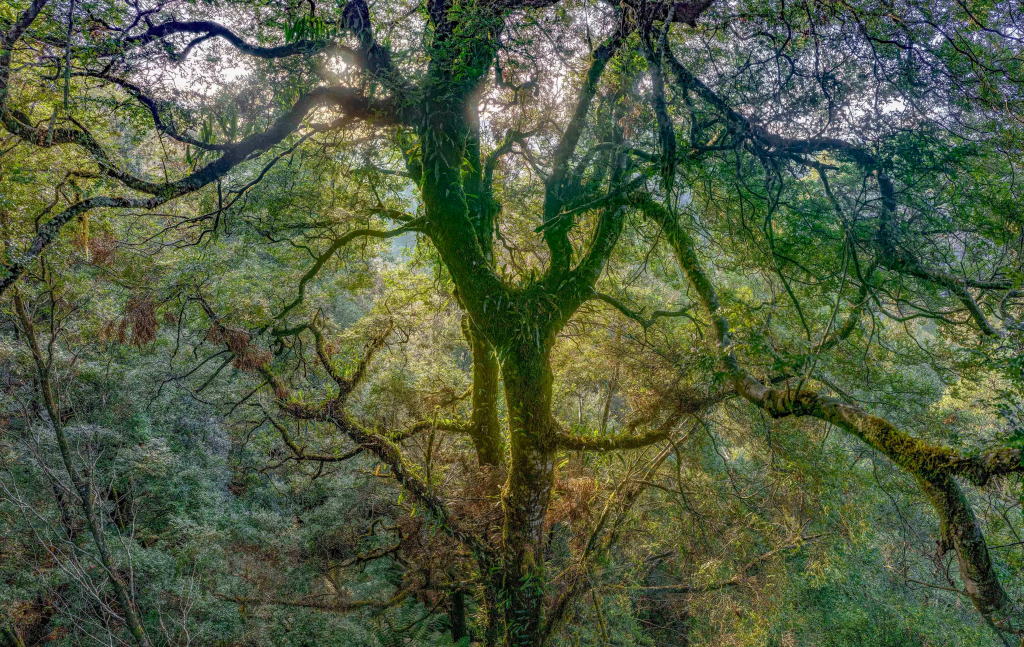
Photograph by Rob Blakers
In a world experiencing an increasingly rapid montage of alarming climate events caused by a warming planet, Tasmania’s Takayna presents an alternate world, one that is primal and untouched by the ravages of industrialisation.

Takayna is home to more than 100 species of birds, including the azure kingfisher. Photograph: Adam Hardy
I pause for a moment on a fallen tree trunk, in a place where a rich network of delicate spiderwebs, lichens and leaves capture my gaze. Old-growth forests (forests unscathed by industrial-scale human development) are complex places. “They have structural components that are completely absent from a forest that could be 150 or 200 years old, so they’re essential for biodiversity,” says Prof Hugh Possingham, a conservation researcher and Queensland’s former chief scientist.
Achieving such structural ecological complexity takes aeons. These forests are a palimpsest of natural intricacy, where eras are written upon eras. Takayna’s rich and unique past is seen in the selection of species that have survived and evolved, and the density of life that is sustained today. In these ancient places, you can see the marks of time: hollows, fallen trees, growth on growth.
The Unesco-listed Tasmanian wilderness world heritage area is one of the largest conservation areas in Australia. However, it doesn’t include Takayna within its borders, leaving it untouched by the protection afforded by the title. Today, only a fraction of Takayna is conserved under a national heritage listing.
To scientists, environmental activists and amateur appreciators of nature, this lack of acknowledgment has long seemed irrational and untenable. Adding Takayna would provide world heritage protection and recognise the area’s outstanding universal value. Takayna is one of the largest areas of cool temperate rainforest in the southern hemisphere. It contains living reminders of the ancient supercontinent Gondwana and is filled with evidence of a long and deep history of Aboriginal connection to place.
There is broad consensus among those who have studied Takayna’s forests that the area exhibits a more than adequate showing for international recognition and protection.
The forest itself was preserved as a stowaway from Gondwana, an ancient supercontinent that saw present-day Australia, Antarctica, India, South America (and, at one stage, Africa) fused together until about 150m years ago. By about 50m years ago, these land masses had drifted apart, although Tasmania remained connected to mainland Australia by a land bridge until sea levels rose 12,000 years ago.
Evidence of this long (and rather ecologically productive) Gondwana connection still exists today in the classes of flora and fauna shared across baffling oceanic divides, such as the marsupials scattered throughout Australia and South America, the beech trees found throughout South America, Australia, New Zealand and parts of New Guinea, as well as leaf fossils found in Antarctica.
These ancient forests have also long sustained human lives and culture. There is abundant evidence that humans have had an intrinsic connection to the landscapes of Takayna for millennia. It’s generally accepted that Aboriginal people have lived in Tasmania for more than 40,000 years, and within that time, some of the largest groups thrived in the north-west, including within the borders of Takayna.
The forest and its bordering lands were altered, managed and maintained by these original custodians. There are numerous sites of archaeological significance between the Arthur and Pieman rivers, including middens, ceremonial stone arrangements, petroglyphs carved into coastal rocks and depressions left by semi-permanent beehive-shaped huts….
++++++++++++++++++++++++++++++++++++++++++++++++++
Australia is still in denial, its history of forgetting a festering wrong
 After the truth-shower