
NB: Waiting for the Barbarians by JM Coetzee (2017); and The Natural History of Destruction by WG Sebald (1999); are two books that show the mirror to ‘Western civilisation’ and Israel, inheritors of an atrocious history of exterminism and genocidal mania stretching from the Roman destruction of Carthage till the Armenian genocide of 1915, the Nazi death camps and the atomic bombings of Hiroshima & Nagasaki. We need not wait: the barbarians are among us, they are not confined to any particular country or culture or religion. We have lots of them in Asia. But the USA and UK and Israel remain the vanguard of the natural history of destruction – the title of a book about their favourite activity: killing and destroying from the sky above. The book was titled Luftkrieg und Literatur; (Air war and literature). DS
Anthedon Harbour, Gaza, Palestine
Anthedon is the first known seaport of Gaza, mentioned in Islamic literature with the names of Tida, apparently an abbreviation of Anthedon, or Blakhiyeh. The city was inhabited from 800 BC to 1100 AD, and witnessed a series of different cultures: Neo-Assyrian, Babylonian, Persian, Greek, Roman, Byzantine and early Islamic rules (Umayyad, Abbasid, Tulunid and Fatimid).
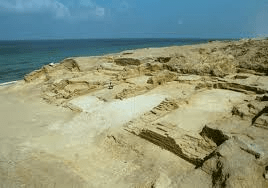
Source: The Conversation
One km south of the seaport of Anthedon lies the ancient harbour of Maiumas, then identified with the harbour of Gaza, which was also continuously populated and became, during the Roman period, a flourishing and well-developed coastal town. Maiumas, which is mentioned only in late classical sources, dates back to an earlier period, at least when the trading with Greece began. “Maiumas” derives from an Egyptian word, which means “maritime place”.
The archaeological site of ancient Anthedon has not been precisely identified: there are several heaps of ruins in the neighbourhoods of Gaza which have been considered to be the old harbour; however, the site of Anthedon may probably be identified with a tell located to the north of Gaza known to the natives as Tida. In the Middle Age, Anthedon was known for sure as Tida or Taida.
The present site consists of a variety of elements which spread in the area from the seashore, including the underwater archaeology, to the inland: the ruins of a Roman temple and a section of a wall have been uncovered, as well as Roman artisan and living quarters, including a series of villas, testifying of the city ofAnthedon. Mosaic floors, warehouses and fortified structures are found in the area.
The acropolis of Anthedon shows archaeological remains dated from the late Iron Age II, Persian, Hellenistic, Roman and Byzantine periods. Basically, below the post-Byzantine level, traces of stone walls of the Roman period were found, which in turn rest on Hellenistic and Persian levels with constructions of mud brick. These latter structures, built on the tell’s summit, consist of an enormous mass of mud bricks, which has been cleared to a height of 8 metres. It projects towards the sea as a tower, and its sides are filled with casemate walls.
The excavated site is about 20 dunums (corresponding to circa 2 ha.) and consists of a 65 metres long mud-brick wall, formerly of the old commercial city centre, which was part of the eastern extension of the harbour, and other earthen works. The massive walls, which stretch 30 metres eastwards, form the coastline to the inner land, display an extraordinary height, 8 m, and thickness, 6 m, and are in a well-preserved state of conservation. Five sizes of mud bricks (adobe) have been found within the masonry of the uncovered structures, plastered with earth….
https://whc.unesco.org/en/tentativelists/5719/
++++
Destruction of Gaza heritage sites aims to erase – and replace – Palestine’s history
Cultural property has been a target of the Israeli offensive since the beginning of the conflict and, as early as November, the devastation of the cities of northern Gaza far exceeded that caused in the infamous bombing of Dresden in 1945. We cannot forget that the Gaza Strip is just a narrow area of coastal land measuring some 365 km², rich in archaeological and historical sites, that the international community has recognised as occupied territory since 1967.

The Great Mosque of Gaza, located in Gaza’s Old City, was the largest and oldest mosque in the Strip. It was destroyed in a bombing in December 2023. Alaa El halaby/Wikimedia Commons, CC BY-SA
Research over the last century has counted at least 130 sites in Gaza that Israel, as an occupying power, is obligated to protect under international law along with the rest of the area’s cultural and natural heritage. These obligations are laid out in the following conventions: Convention on the Prevention and Punishment of the Crime of Genocide (1948); the Geneva Conventions (1949) and their annexes, and the Hague Convention for the Protection of Cultural Property in the Event of Armed Conflict (1954).
As of 17 September 2024, UNESCO has verified damage to 69 sites: 10 religious sites, 43 buildings of historical and artistic interest, two repositories of movable cultural property, six monuments, one museum and seven archaeological sites. Other reports give a much higher number of affected sites. These assessments are made in very difficult situations, in the midst of constant bombardment, thanks to testimonies and studies on the ground and supported by satellite images…

+++++++++++++++++++++++++++++++
Chris Hedges: The Gaza Riviera
 After the truth-shower