
Nuno P. Monteiro and Fritz Bartel, eds., Before and after the fall: world politics and the end of the Cold War, Cambridge, 2021
Reviewed by Lorenzo Cladi
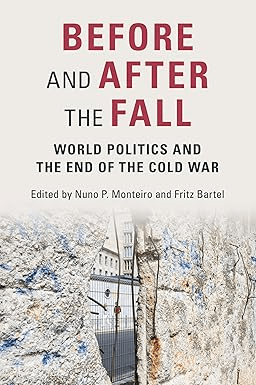
In this volume, Nuno Monteiro and Fritz Bartel bring together a vast array of scholars. They all get to grips with the issue of continuity and change with reference to the 1989-1991 years, that brought about one of the most momentous changes in the recent history of world politics. This was the end of the Cold War between the US and the Soviet Union (USSR), beginning with the fall of the Berlin Wall and concluding with the demise of the USSR. Contrary to other majorly disruptive events which have taken place since then, such as the 9/11 terrorist attacks in New York and the worldwide Coronavirus pandemic of 2020, the end of the Cold War was greeted with a renewed sense of hope for a better future. A great power fell quite quickly without causing a hegemonic war. President George H W Bush declared in September 1990 that a new world order had arrived, one characterised by greater prosperity and increasing harmony.
Nevertheless, what slowly emerges from this volume is a sense of dashed hopes for a world that did not really change that much after all. As the volume unfolds, scholars remind us, that great powers, their
interests, their relative material capability, the nuclear weapons that they possess, all matter. All still matter. And all of them are powerful and visible elements of continuity from the end of the Cold War to the present day.
What went wrong and why do we seem to somehow be back to where we were before the end of the Cold War? The volume stimulates the reader to find an answer to these compelling questions. The late Nuno Monteiro seeks to provide his own answer as his neorealist orientation emerges in its lucidity and clearness. His explanation is parsimonious but far-reaching. The key changes are, firstly, that the US found itself as the unrivalled great power following the end of the Cold War. Secondly, the US had the opportunity to make the so-called ‘liberal international order’ the basic structure of world politics. However, the US has now largely wasted that opportunity, with the future now remaining uncertain as intensifying great power competition unfolds between the US, Russia and China, the latter being the first state that sought to achieve great power status in the nuclear era.
Still, the US, as Monteiro notes (p. 341), still retains the unique position of advantage over other great powers that it had across the 1989/1991 divide. Put differently, as Monteiro puts it ‘we are still in the post-Cold War unipolar era’ (p. 341).
It is often a challenge, when editing a volume, to keep a ‘fil rouge’ running through the chapters. Monteiro and Bartel manage to present a compelling collection of essays that analyse sources of continuity and change via many and varied case studies. Methodologically, most scholars resort to counter-factual analysis such as Fritz Bartel who argues that every Soviet leader believed in the 1980s that the burden of supporting Eastern European states had become too high. Joshua Shifrinson, in chapter 4, shows how American policy-makers were attuned to shifts in the distribution of power and American awareness of American advantages prompted them to exploit Soviet problems. In chapter 14, James Goldgeier and
Shifrinson ask why the United States pushed for NATO enlargement in Eastern Europe after the end of the Cold War. Strategic continuity rather than change prevailed. They assess the merits and drawbacks of the policy chosen of NATO enlargement against the alternatives.
The volume is not entirely US centric or solely committed to balance of power explanations. In chapter 2, Sergey Radchenko, for instance, analyses sources of continuity between Gorbachev and his predecessors such as the importance attached to global leadership as he seeks to uncover the origins of Gorbachev’s new thinking, leading to him being recognised for his moral leadership. In chapter 11, Yafeng Xia assesses Deng’s decision to suppress the students in Tiananmen Square. In chapter 5, Julian B. Gewirtz looks at the end of the Cold War from the point of view of the Chinese Communist Party.
The number of contributors make the volume feel a bit overloaded at times but this is without a doubt a top notch collection of essays that will appeal to students of international relations. It will give them ideas on how to reflect and how to build an argument. It will also show them how to contribute to an academic debate around questions of continuity and change, which are always probing ones for the discipline of international relations. The 2022 Ukraine war makes the engagement with questions of continuity and change in world politics all the timelier.
Lorenzo Cladi
University of Plymouth
Recommended Citation: Cladi, L. (2022) ‘Review of Nuno P. Monteiro and Fritz Bartel, eds., Before and after the fall: world politics and the end of the Cold War, Cambridge: Cambridge University Press, 2021, ISBN 978-1-108-84334-8′, International Affairs. Retrieved from https://pearl.plymouth.ac.uk/sc-research/356
***********************************************************
Arms maker BAE Systems makes record profit amid Ukraine and Israel-Gaza wars
The USA’s role in the Ukraine crisis (2022)
The Mask is Off. After Ukraine, imperialism is now the norm
The Hindu: Gaza and the moral crisis facing us. The Guardian on Gaza: a deepening disaster
My remarks at the Oxford Union debate
President of Refugees International Condemns Biden Admin for Role in Gaza
The billionaire companies behind Israel’s bombs
HOW ISRAEL COMMODIFIES MASS KILLING THROUGH ITS “PALESTINE LABORATORY”
Bombed hospitals, buried children: we have become numb to Gaza’s destruction
Democratic Party Unites Under Banner of Silence on Gaza Genocide
Lancet warns Gaza death toll could be over 186,000
The Brutalization of Israel Is Well Underway. If we do not act, collapse is only a matter of time
 After the truth-shower