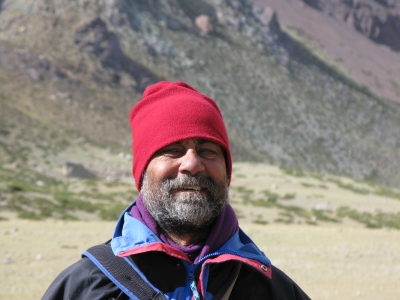
Prominent Islamic scholar Shahab Ahmed, originally from Pakistan, was laid to rest on Saturday morning at the historic Mt. Auburn cemetery in Cambridge, Massachusetts, his adopted home. Born in Singapore on Dec 11, 1966, he passed away on Sept 17, 2015 in Boston.
Dr. Ahmed’s former student Suheil Laher, currently a lecturer on Arabic at Harvard University, led the final prayers at the graveside. The scholars and students who participated in his final rites included men and women, Muslims, Hindus, Christians, Jews, and atheists — appropriate, given Dr. Ahmed’s inter-faith work and inclusive outlook.
Diagnosed with a rare form of leukaemia in June, doctors had planned a transplant for him that his sister Dr. Shahla Ahmed, a gynecologist in London flew in as a potential donor for. However, the transplant option had to be ruled out as his condition deteriorated. Dr. Ahmed’s parents, Razia and Mohammed Mumtazuddin Ahmed, both doctors, had been with him for some days. They returned to Pakistan a week ago, hoping for a miracle.
Also bereaved is his wife Nora Lessersohn, a Ph.D. candidate in History and Middle Eastern Studies at Harvard University. The couple tied the knot on Aug. 1 this year. “I am dumbfounded,” said Prof. Shahla Haeri, an anthropologist at Boston University who has lived and worked in Pakistan. “How could a young intelligent energetic and exciting man like Shahab be dead? I am so sorry to hear that and want to extend my deepest sympathy to his wife, his family, and his friends.”
Shahab Ahmed was considered one of the world’s most promising and exciting new scholars in Islamic studies. Growing up in different countries, he attended primary school in Singapore, and did his GCE “A” and “O” Levels in Surrey, UK. After obtaining a law degree from the International Islamic University, Malaysia he obtained his Bachelors and Masters degrees in Arabic Studies, both from American University in Cairo. He also taught there for a couple of years, 1998-2000.
In 1999, the Department of Near Eastern Studies, Princeton University, awarded him Ph.D. He was a Junior Fellow, Society of Fellows at Harvard University (2000-2003) then returned to Princeton as a Visiting Lecturer and Research Fellow (2004-2005).
In 2005, he returned to Harvard as Associate Professor of Islamic Studies. He also served on the University’s Committee on the Study of Religion. His last academic appointment at Harvard was at the Law School, where he was a Lecturer on Law, and Research Fellow in Islamic Legal Studies (2014-15).
Shahab Ahmed also taught in Pakistan at the Islamic Research Institute, International Islamic University in 2007-2008, on leave from Harvard, and planned to return to Pakistan to teach again. A recipient of several awards, distinctions and fellowships, Prof. Ahmed was looking forward to re-joining Princeton University in the coming academic year.
His much anticipated first book What is ‘Islam’? The Importance of Being Islamic to be published in December this year, has garnered critical acclaim from respected scholars in the fields of law and Islamic scholarship and history. It offers “a new way of looking at Islam,” says Prof. Muhammad Qasim Zaman, Princeton University. Harvard Law School professor Noah Feldman terms the book as “not merely field changing, but the boldest and best thing I have read in any field in years.”
Engseng Ho, Professor of Cultural Anthropology and Professor of History, Duke University has called the work “Strikingly original, wide-ranging in its engagement, subtle in its interpretations, and hard-hitting in its conclusions”, predicting that it will “provoke debate for a number of years”.
Sadly, Shahab Ahmed is no longer around to participate in that debate.
https://beenasarwar.com/2015/09/20/rip-shahab-ahmed-prominent-islamic-scholar-from-pakistan/
+++++++++++++++++++++++++++++++++++++++++++++
What is Islam – Has Islamic Orthodoxy Changed Over Time?
Shahab Ahmed: Before orthodoxy : the Satanic Verses in early Islam (2017)
Tracing the Hard Edges of Religion: On Peter Brown’s “Journeys of the Mind”
Walter Benjamin: Capitalism as Religion (1921)
Homosexuality is wrong because the Bible says so” etc., etc.
The Battle for the Soul of Judaism: Tribalism, Amalek and Axial Age Universalism of Isaiah
 After the truth-shower