
NB: This book changed my life. I read it when I was seventeen. Along with Palestine, Vietnam’s valiant struggle against American imperialism was the epic of our generation. I will salute the Vietnamese people till the end of my days. DS
“There are few parallels with the war in Vietnam. It has lasted nearly two decades; two Western powers of overwhelming might have fought peasant guerrillas… Everything short of nuclear weapons has been employed. Atrocity has characterized the conduct of the war throughout its history…. The war has
had no purpose. Its extension will bring direct conflict between the Cold War powers, with the possible destruction of mankind as the culmination of this folly. The tragedy in Vietnam indicates the extent to which it is possible to hide or disguise terrible crimes, and it is time that people in the West raised their
voices for an end to the bloodshed.” from War Crimes in Vietnam
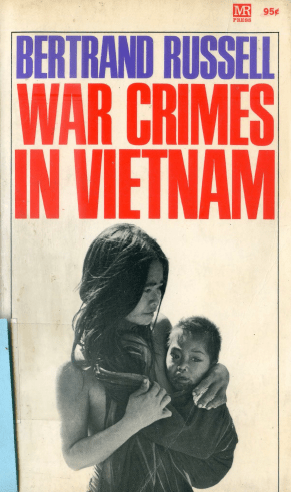
Introduction: The racism of the West, especially that of the United States, has created an atmosphere in which it is extremely difficult to make clear the responsibility of America for problems which are held to be ‘internal’ to the underdeveloped countries. The war in Vietnam is looked upon as the inevitable and tragic product of backwardness, poverty and savagery-supposedly indigenoµs to South East Asia. The roots of the current conflict are sought in the dark past: ancient conflicts between north and south are
dredged up. The American intervention is, on this view, fortuitous. The Vietnamese people are thought to be pitiable creatures, into whose affairs the Americans have reluctantly and unfortunately been invited.
Racism not only confuses the historical origins of the Vietnam war; it also provokes a barbarous, chauvinist outcry when American pilots who have bombed hospitals, schools, dykes and civilian centres are accused of committing war crimes. It is only the racist underpinning of the American world-view which allows the U.S. press, the Senate and many public figures to remain absolutely silent when ‘Vietcong’ prisoners are summarily shot; yet at the same time these bodies demand the levelling of North Vietnamese cities if the pilots are brought to trial for their crimes. American violations of the 1949 Geneva Conventions on the treatment of prisoners of war have long been a matter of public record. It was reported, for example, in the New York Times of December 1, 1965, that ‘the International Committee of the Red Cross in Geneva … complained again that the United States was violating an international accord on the treatment of prisoners.,.’ The indifference shown to this clear indictmentnot to mention the indifference to daily bombardments of civilian populations with napalm and white phosphorus – is
appalling.
The fundamental fact which I wish to establish here is that the Vietnam war is the responsibility of the United States. This elementary truth is central to any understanding of this cruel war. To understand the war, we must understand America, though this is not to ignore the history of the Vietnamese people.
Vietnamese culture is rich and dates from antiquity. Oral legends continue heroic traditions, particularly those which tell of the ancient repulsion of feudal China. But history’s movement ever faster, is such that the Vietnam of today is less connected to her ancient heritage than to her present world. The past hundred years of Vietnam’s national life have brought her on to the world stage. To understand Vietnam and the agony of her struggle, we must see Vietnam amidst the constellation of anticolonial forces which are transforming the Third World and, less dramatically, the West itself. Vietnam will not be understood,
no matter how deeply we probe her past, unless we cease to isolate her meaning. It is America that has given Vietnam an international significance.
While the beginnings of the American role in Vietnam precede the notorious involvement with Ngo Dinh Diem, it must be noted that France deserves the credit for nearly obliterating the Vietnamese cultural heritage. Before the Second World War, France managed her own colonial affairs with arrogant selfreliance. A rival to Britain, she probed Vietnam in the nineteenth century while seeking new access to China. On the pretext of protecting French missionaries from the reprisals of the savages they sought to Christianize, French naval vessels sailed into South Vietnam in the I84os. The colonial conquest was begun in earnest. Within a matter of decades, not only the whole of Vietnam but also Laos and Cambodia had been brought under French colonial rule. Although each region of the vast amalgam, ‘Indo-China,’ had a different de jure status and governmental structure, everywhere the French were ruthless in securing the submission of the native population. Their rule was not to be disputed, and it was their arbitrary right to determine the laws and regulations of every part of the colony. Sporadic, disorganized guerrilla resistance opposed the French and continued into the twentieth century.
It is the totalitarian process of colonization which destroyed Vietnamese society and severed the ties between a people and its past…. Download the PDF
+++++++++++++++++++++++++++++++++++++++++++++++++++++++++++
‘No innocent civilians’: the Violent Legacies of the U.S. War in Vietnam
Kill Anything That Moves: The Real American War in Vietnam
Lying and history: Hannah Arendt and the Viet Nam war (2009)
Biden Is the Latest President to Tout the Vietnam War as Proud History
The US left Vietnam 50 years ago today. The media hasn’t learned its lesson
Vietnam’s Village of Moroccan Defectors
Henry Kissinger was the definition of elite impunity
Roaming Charges: Kissinger – the Dr. Caligari of American Empire
How the Vietnam and Gaza Wars Shattered Young Illusions About US Leaders
The US left Vietnam 50 years ago today. The media hasn’t learned its lesson
Vietnam’s Village of Moroccan Defectors
How the trauma of the Vietnam War led to the age of “alternative facts”
Seymour Hersh on Witnessing American War Crimes in Vietnam
‘I sent them a good boy and they made him a murderer’The Last Child of My Lai
Joe Biden, the National Security State, and Arms Sales
Nouriel Roubini: The US is now the focus of global instability
Norman Solomon: How the Warfare State Paved the Way for a Trumpist Autocracy
Seyla Benhabib: Breaking Silence, Hannah Arendt, and Martin Luther King
TOM ENGELHARDT: The American Century Ends Early
Arms maker BAE Systems makes record profit amid Ukraine and Israel-Gaza wars
 After the truth-shower