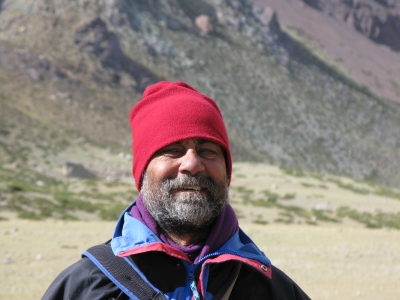
London-based Israeli researcher Ayala Panievsky has been studying war coverage in Israel. Her findings explain why the country now seems out of touch with the rest of the world…‘People who view themselves as serious journalists have, for two years now, been accepting and repeating the notion that there are no innocents in Gaza, that all Palestinians are the same – I cannot understand or process this. It’s as cruel as it is dumb.’
When Ayala Panievsky observes Israeli media during the October 7 war, she compares it to a negligent oncologist – and the Israeli public to a terminal patient.
“The media is behaving like a doctor who hides the true severity of his patient’s condition so they can die happy and in good spirits. But the cancer isn’t going anywhere. If we learn about it early enough, and if we have all the information and data we need to fight the disease, perhaps we could save our lives,” she writes in a report published to mark the war’s second anniversary, appearing today in full on the Molad website.
The report was written by Panievsky, a political media researcher, and former Army Radio political correspondent Ido Benbaji, both research fellows at the liberal Molad think tank.
The report’s title, another analogy, comes from the movie world: “Eyes Wide Shut: When the War on the Media Met the War in Gaza.” The indictment outlined in the report is just as harsh as its metaphors, arguing that Israel’s broadcast media took part in efforts to conceal from the public the extent of destruction and suffering in Gaza.
- ‘The world is against us’: How Israel’s media is censoring the horrors of Gaza | Anat Saragusti
- Hasbara at home: When Israel’s Gaza carnage can’t be defended, propaganda fills the void | Naomi Beyth-Zoran
- 64% of Israelis see no need for more reporting on Gazans’ sufferings | Ido David Cohen
“Instead of journalists – some of whom I admire greatly – doing their job, it feels like they’ve been covering the public’s eyes, which is a tragedy to me,” says Panievsky in an interview with Haaretz from her London home, where she is about to complete her post-doctorate studies at City University, which co-funded the study with Molad.
“Everyone I’ve spoken to outside Israel over the past two years looks at what’s been happening and can’t understand how their Israeli friends – people they could always talk to, even when they disagreed – now sound as if they’re living in another reality,” she says. “People from the outside feel as if we Israelis have gone off on a spaceship and lost touch. This is a dangerous situation that could cost us dearly. It will be hard to turn back the wheel.”
Panievsky, 39, began working on the study six months after the war started – a point in time which, she believed, would be close to its end. “We assumed it would soon be over, and that we’d be looking at the war – or at least most of it – retrospectively. It’s hard to remember now, but there were good reasons to think that with headlines about a ‘deal being pushed forward any moment,’ many of which, as we now know, were spins.”
The war may soon be over, but the research – parts of which, including some initial findings, were published in the Sukkot edition of Haaretz’s Galleria section a year ago – was based on a sample analysis of Channel 12’s newscasts over those six months, a period she believes was formative. Fifty 8 P.M. broadcasts were picked at random, including 721 news items (reports, interviews and panel discussions), of which 522 directly addressed the war. “As someone who’s been watching the news every day for the last couple of years, which my partner often complains about, I can say that the framing and willful blindness that took shape at the time as the media’s main wartime narrative haven’t changed after two years.”
Why wasn’t the report published sooner?
“It should have been published much sooner, in all honesty, which is also why it was important for me to talk about it before the work was completed. But it took time to collate the data, find funding, analyze it and figure out how to frame and write it. Because of life – and because these have been two cursed, complicated years for everybody – there was a delay. The advantage in having the report come out now is that we can already see how things have changed over time.”
Is Channel 12 responsible for all the problems?
“There are several reasons for focusing on them. Channel 12 is the undisputed ruler of Israeli media – the most watched, with no real competition, and also the most influential. This is the newscast that all decision-makers watch, in the political, military and financial elite. They set the agenda for other media outlets too. With great power comes great responsibility.”
Why did you choose television media, rather than comparing, for example, N12 with Ynet [news websites] or Kan public broadcaster?
“I was in Tel Aviv for much of the war, and my sense was that the public’s detachment from the world had a lot to do with the horrific images broadcast on foreign newscasts 24/7 which received no exposure in Israel. It’s hard to analyze video materials – a complex process. It’s quite a nightmare to conduct this kind of research. If I had an unlimited budget, I would have loved to analyze all media outlets.”
According to the study, the humanitarian catastrophe in Gaza has been almost completely absent from Israeli media coverage. Only 3 percent of war-related items addressed the civilian situation in Gaza. Of hundreds of items sampled, only four mentioned Palestinian casualties in Gaza who were not involved in terrorism. The study supported Paneivsky’s impression that the discrepancy between Israeli and international coverage is evident in the visual realm: videos and images from Gaza that appeared on Israeli newscasts focused on combat, soldiers or destroyed buildings and deserted cities – rather than human suffering or the cost of war.
According to the study, the humanitarian catastrophe in Gaza has been almost completely absent from Israeli media coverage. Only 3 percent of war-related items addressed the civilian situation in Gaza.
“In the first six months, more than 31,000 people were killed in Gaza, including 9,000 women and 13,000 children,” Panievsky notes. These figures were released by the United Nations and rely on data from the Hamas-controlled Gaza Health Ministry. The state of Israel has yet to release data about Gazan casualties of war.
“Since then, dozens of people have been dying in Gaza every day, and even the Israel Defense Forces doesn’t claim they’re all terrorists. This fact doesn’t appear in even a single sentence on any of the major channels’ newscasts. How are Israeli citizens expected to make informed decisions about their future without the most basic information, such as who died when? This is a deranged situation.”
Ilana Dayan said early in the war that the nation was too broken to address the other side’s pain and told CNN a year ago that more coverage was needed. But Channel 12 News didn’t really try to respond to criticism throughout the war that it wasn’t showing enough of the suffering in Gaza.
“Many excuses that may have been acceptable during the shock stage, early on, apply much less now. The fact that something is painful is no reason not to show it on the news. People who want to know reality are no less patriotic. Hiding information from the public is unpatriotic. ‘The notion promoted by Israeli media, that Palestinian and Israeli pain and suffering come at each other’s expense, is bullshit. If Israel now erases Gaza City, both hostages and innocent Palestinians will die.”
Channel 12 has preserved – even increased – its lead in the ratings, meaning it didn’t pay a price for the decisions you point out here. Polls from recent months, such as one by the aChord Institute, confirmed that most of the Israeli public doesn’t want more coverage of suffering in Gaza.
“What the public wants or doesn’t want to know is irrelevant. I’m happy for them about their high ratings, but you know, if Yonit Levy presented the news naked, ratings could get even higher. You can make easy profits if your goal isn’t journalism. A popularity contest is part of the essence of commercial media, but if that becomes the entire story, then give it up – cancel the news. Put on another reality program at 8 P.M. and get better ratings. Why even play this game?”
About three months ago, a leaked internal chat published on Ynet revealed that there were voices in Channel 12 News who’ve been protesting behind the scenes against the “mobilized media” line that ignored Gaza – such as reporters Ilan Lukatch, Michal Peylan and Mohammad Magadli, who’s been taken off the air. Did you approach people from Channel 12 News about the study?
“I’m in touch with many journalists. I didn’t approach them. I suppose I’m going to hear from them. It was important to me to get the job done first. I realize many journalists in Israel are feeling some distress – they realize that something isn’t working right, and they don’t always know how to get out of this tangle. I hope this report will give them a push in the right direction.”
Other findings in the study indicate that during the first six months of the war, opposition representatives received one-tenth the exposure given to coalition representatives, while civil society representatives received less than a tenth of the exposure given to security establishment officials. Israel’s Arab citizens have almost completely disappeared from newscasts – only six items of the 720 sampled featured Israeli Arab speakers– even though they, too, have suffered casualties and abductions in Hamas’ October 7 massacre.
The killing of journalists in Gaza, by now considered unprecedented by press organizations around the world, was met with indifference or active denial. Palestinians voices from the West Bank and Gaza – particularly supporters of the Palestinian Authority – have been almost entirely absent from the screen.
“The ability to see people from the other side of the border as people has disappeared. This is an infantile approach. If ‘everything is due to the October 7 trauma,’ as some excuses we’ve heard suggest, then why do we hear hardly anything about the crazed settler violence in the West Bank, which has spun out of control?” Panievsky asks. “Apparently this isn’t as exciting as some car that somebody set a garbage bin next to on fire (near the prime minister’s residence last month, I.D.C.), which got a three-day media carnival.
“People in the West Bank are dying left and right. Is this not newsworthy? Do I need to hear Idan Raichel [Israeli singer-songwriter] talk about his life again for 20 minutes, while not a single minute is found to talk about these things? You only hear about West Bank violence if it happens to target the IDF. You cannot blame October 7 for that.”
‘Many people in the media are critical of Netanyahu, but they have to prove they’re not the traitors he says they are. Their way of doing that is to embrace the IDF – ignoring the fact that it, too, has its own ‘Ben-Gvirs and Smotrichs,’ people doing things that deserve to be investigated, questioned and doubted’ – Ayala Panievsky.’
The report doesn’t use the word “racism,” but I’m going to ask you to what extent, in your opinion, that’s really the core of all this.
“In terms of results, coverage is very racist – also about Israel’s attitude toward the world, and in all those ‘they’re all antisemites’ stories. Once you choose to see only those parts of reality that are convenient to you, the theme that emerges clearly is ‘a Jew is a good soul, an Arab is a son of a bitch.’ [a slogan often chanted by far-right extremists] Whether this is racist at heart or from fear of appearing left-wing, I don’t know.”
One interesting claim made by the study is that Channel 12 – and in many ways its competitors in Channel 13 and Kan as well – has made the IDF a sacred cow, rallying around it, and that this was also a reaction to Channel 14 and its ilk, for which Netanyahu is the sacred cow. This brings to mind two incidents from last December – Yaron Avraham’s interview during which he demanded that Moshe Ya’alon apologize for saying that the IDF has been perpetrating ethnic cleansing in Gaza; and another broadcast where Nitzan Shapira mentioned, in a sentence, Yaniv Kubovich’s Haaretz investigation into the carnage on the Netzarim Route, only to dismiss it as nonsense.
“The story many people in the media have been telling themselves is that they need to find a way to preserve the public’s trust and attention,” Panievsky says. “They’re critical of Netanyahu, but they have to prove they’re not the traitors he says they are. Their way of doing that is to embrace the IDF – ignoring the fact that it, too, has its own ‘Ben-Gvirs and Smotrichs,’ people doing things that deserve to be investigated, questioned and doubted. I don’t think any IDF soldier is served by us not knowing what’s been happening in Gaza.”
Manners and etiquette
The report also sought to identify instances when the media, particularly Channel 12, did appear critical. “Despite the methodological difficulty,” it states, “we also sought to decode instances of criticism that appeared in the sample. We found 260 items out of 720 in which clear criticism was expressed toward any element, in Israel or abroad. The most common criticism was directed at the government’s and official figures’ attitude toward the hostages’ families and bereaved families, followed by criticism about inadequate preparedness ahead of October 7.”
Panievsky was unimpressed by this either – neither by the scope nor by the substance. “When I talk to people in Israel about the media, I hear them say ‘But Channel 12 keeps going after Bibi.’ To them, I reply – ‘True, but what are they saying?’ the boundaries of debate have been reshaped between the pro-Bibi right and the anything-but-Bibi right. If you criticize Netanyahu from the right – welcome. If your criticism is about ‘manners and etiquette’ – why government officials don’t call hostages, why they don’t speak politely in Knesset committees – that’s also fine.”
But, Panievsky continues, “The assumptions of the extreme right currently leading the country are never questioned. No one asks the questions that are at the core of Israeli and Palestinian citizens’ lives, such as – what are the strategic assets for Israel’s security? Are they the peace treaties with Egypt and Jordan, and the Palestian Authority, or the ability to use more and more force? There’s no debate about the cost of Israel’s actions. I’m not even speaking of war crimes.”
‘If Yonit Levy presented the news naked, ratings could get even higher. You can make easy profits if your goal isn’t journalism. If that becomes the entire story, then give it up – cancel the news.’
Ayala Panievsky
As for Channel 14, she says, “They’re Israel’s Radio Rwanda [the broadcaster that incited genocide in Rwanda in 1994, I.D.C.]. I believe and hope they’ll one day stand trial for their incitement to violence and genocide. But I have no expectations of them. The fact that people who view themselves as serious journalists have, for two years now, been accepting and repeating the notion that there are no innocents in Gaza, that all Palestinians are the same – I cannot understand or process this. It’s as cruel as it is dumb.”
What doesn’t appear in the study are the alleged manipulations of the media by Netanyahu – from reports citing ‘a senior diplomatic source’ and “Sinwar’s note,” [referring to reports of handwritten notes allegedly sent by Hamas leader Yahya Sinwar to mediators] to distressing suspicions about the Prime Minister’s Bureau’s ties with Qatar. Why is that?
“Some things require behind-the-scenes journalistic investigation. Undoubtedly, there’s a sense that journalists have been serving senior officials hiding behind a cloak of anonymity, but that’s not your ‘forte’ when you’re examining a product. That’s not where the focus is. I mostly think, for journalists, that at some point you must feel pretty stupid, after saying for the thousandth time, ‘There’s great optimism in the negotiations.’ They’ve fallen for plenty of manipulations. This, too, calls for some soul searching.”
Channel 12 has not interviewed Netanyahu. He refuses to appear there, while Channels 11 and 13 have recently ‘broken the fast’ after years (“Seven P.M. With Ayala Hasson” and Moriah Asraf’s TV documentary about the Iran war, respectively). How do you view this?
“This is an indication that part of Netanyahu’s effort to plant like-minded or loyalist people in major media outlets has worked. At Kan he wouldn’t have given interviews to Michael Shemesh or Roy Sharon. As for Channel 13, they let him speak only about Iran – which is a journalistic foul as well as cutting off the branch they’re sitting on, because if he can pose his own conditions when appearing there, why should he ever answer difficult questions?
“Allowing a prime minister who’s spent years undermining and attacking the media to speak only on the issues he wants credit for – this doesn’t seem to me like some great achievement to boast about. Questions about the Iran operation aren’t the most urgent ones he should be asked. This precedent, to me, is neither smart nor useful to the public. What’s the value in things said by a source who’s been lying to the media for years, as naturally as he breathes?”
It’s about the process
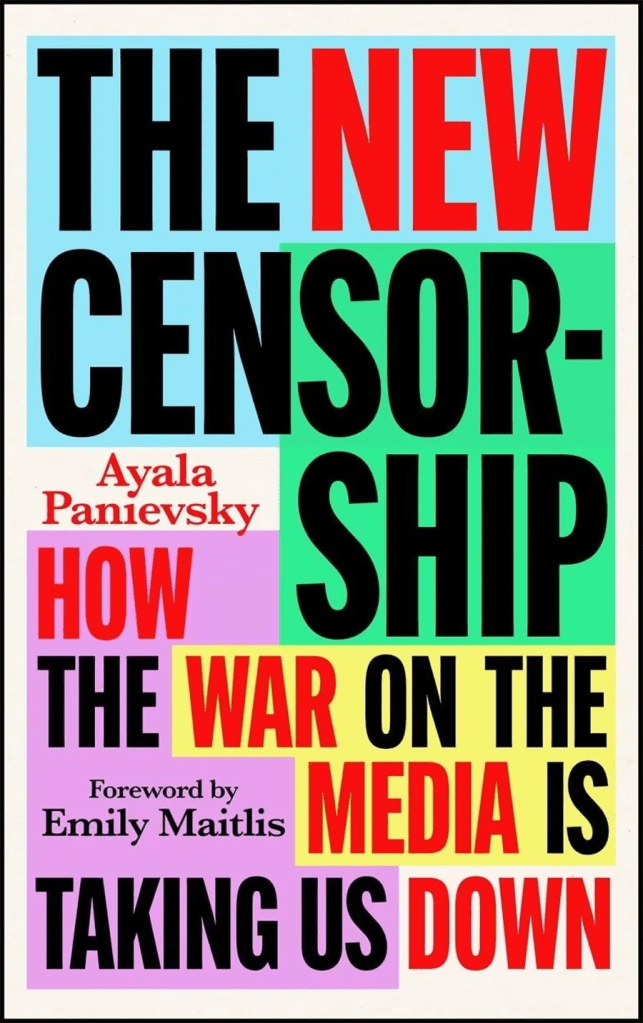
Panievsky’s work over the last decade has spanned the axis of academia, journalism and civil society. She’s been London-based since 2016. Her doctorate thesis at Cambridge University examined how Israeli journalists have been coping with attacks against the media, mainly by Netanyahu and his supporters. As a direct continuation of this, last month she published a book in the United Kingdom titled “The New Censorship.”
“It will come out in the United States in January 2026, and, inshallah, in Hebrew in Israel at the same time,” she says. “It’s about the process by which political movements use sophisticated, elusive ways to control what citizens in various countries know about the world. The populist right, and Netanyahu’s war on the media, take up a large part of this book, including some mention of the war.”
‘The truth will eventually come to light, and there’s going to be a difficult moment when people will have to say: ‘How did I live next to this thing, and where was the media? Didn’t they know? Did they know and hide it from us?’ There’s something heartbreaking about this.’
Ayala Panievsky
What did you think of the BBC’s coverage of the war?
“They’re an interesting case because they’ve taken a lot of criticism from both sides. In Israel, people stress and highlight every claim of anti-Israeli bias and antisemitism, but there are just as many allegations of anti-Palestinian bias and Islamophobia. As an Israeli living in London who’s watched hours of BBC broadcasts, I can say they gave me a much more complete and credible picture of the situation than the one I got from Israeli media outlets. There was comprehensive, empathic coverage of Israeli hostages, murder victims and of the families and their struggle, alongside coverage of the horrors in Gaza.”
In this year’s World Press Freedom Index, published by Reporters Without Borders, Israel dropped to the 112th place, of 180 countries and territories. However, Panievsky takes this ranking with a grain of salt. If one seeks to find some cause for optimism in her remarks, it may be in the following.
“It’s very hard to make these comparisons, particularly in Israel, because there’s the question of how to treat the territories that are seemingly part of Israel but really aren’t, such as the West Bank. I’m thinking of my friends in Iran, who actually had to go into exile to keep doing journalism. I’ve recently met a Georgian journalist who was just released from prison and went back to Georgia, knowing he’s going to be imprisoned again. We’re not there,” she says.
“There’s self-censorship in Israel, due to conceptions that can be dissected, not due to somebody threatening you with a gun or actually shooting at you, as they do in Mexico. No journalist has been thrown in prison yet, though you hear threats from politicians. You could say we still have a long way to fall – but, on the other hand, we still have a lot of power. People can protest in the streets. A protester sometimes get beat up by police, but they’re not shot down on the street – unless they’re a Palestinian.”
Aren’t we one step away from Netanyahu’s total victory – over the media?
“The danger is clear and present – especially in times of emergency, as in the past two years. It’s much easier for the government, in such circumstances, to take over media outlets, shut them down and bend them to its will. The same law used to shut down Al Jazeera could easily be applied to other media outlets. But you don’t need to shut down media outlets for citizens not to know anything – which is part of what this report demonstrates. As far as the populist right is concerned, the ideal situation is for media outlets to remain open but afraid of the sword above their heads.”
Panievsky points to the media’s under-coverage of moves to harm it throughout the war – efforts to take over the Kan public broadcaster, political interference in Channel 13’s management, benefits granted to Channel 14 and so on. “Journalists have an instinct that says, ‘we don’t cover ourselves and our competitors,’ and I think that’s a mistake,” she says.
“Because while it’s true that you’re not the story – we, the public, are very much the story. There’s a systematic political attempt, some of it quite successful, to take over the consciousness of Israeli citizens and reshape the media into complete loyalty to the regime. It doesn’t require some extreme situation where Netanyahu controls every media outlet for the public to start to become aware of the details of what’s happening. Without a free press, there will be no democracy, even if there are free elections.”
Panievsky demands answers from the media, and believes that the public at large will also one day demand them. Even about what has been happening in Gaza. “The truth will eventually come to light, and there’s going to be a difficult moment when people will have to say: ‘How did I live next to this thing, and where was the media? Didn’t they know? Did they know and hide it from us?’
“There’s something heartbreaking about this. It’s directly tied to Netanyahu’s ‘Sparta’ speech and his attempt to transform Israeli society into an isolated bubble. If we’re not on our way to becoming a third world country, an autocracy that will slowly collapse – if we succeed in reviving ourselves from this terrible catastrophe – eventually, these questions will come.”
Source: HAARETZ
++++++++++++++++++++++++++++++++++++++++++++++++++
Peter Beinart: ‘What Israel Is Doing in the Name of the Jewish People Is a Desecration’
“Write my name on my leg, Mama”
‘The Children Haunt Me at Night’: The Protest That’s Forcing Israelis to Face Kids Killed in Gaza
Netanyahu’s UN Speech to empty hall on September 7, 2025
Gaza and the Death of Conscience
Pankaj Mishra: The Shoah after Gaza
Israel’s War in Gaza Is Nothing but a War of Annihilation
Nation-states as national homes; and Sir Edwin Montagu’s views on Zionism (1917)
 After the truth-shower