As the actor approaches his 90th year and publishes an autobiography, he reflects on his early years on stage, being inspired by Laurence Olivier, becoming a Hollywood star and conquering his demons
‘What’s the weather like over there?” asks Anthony Hopkins as soon as our video call begins. He may have lived in California for decades but some Welshness remains, in his distinctive, mellifluous voice – perhaps a little hoarser than it once was – and his preoccupation with the climate. It’s a dark evening in London but a bright, sunny morning in Los Angeles, and Hopkins is equally bright in demeanour and attire, sporting a turquoise and green shirt. “I came here 50 years ago. Somebody said: ‘Are you selling out?’ I said: ‘No, I just like the climate and to get a suntan.’ But I like Los Angeles. I’ve had a great life here.”
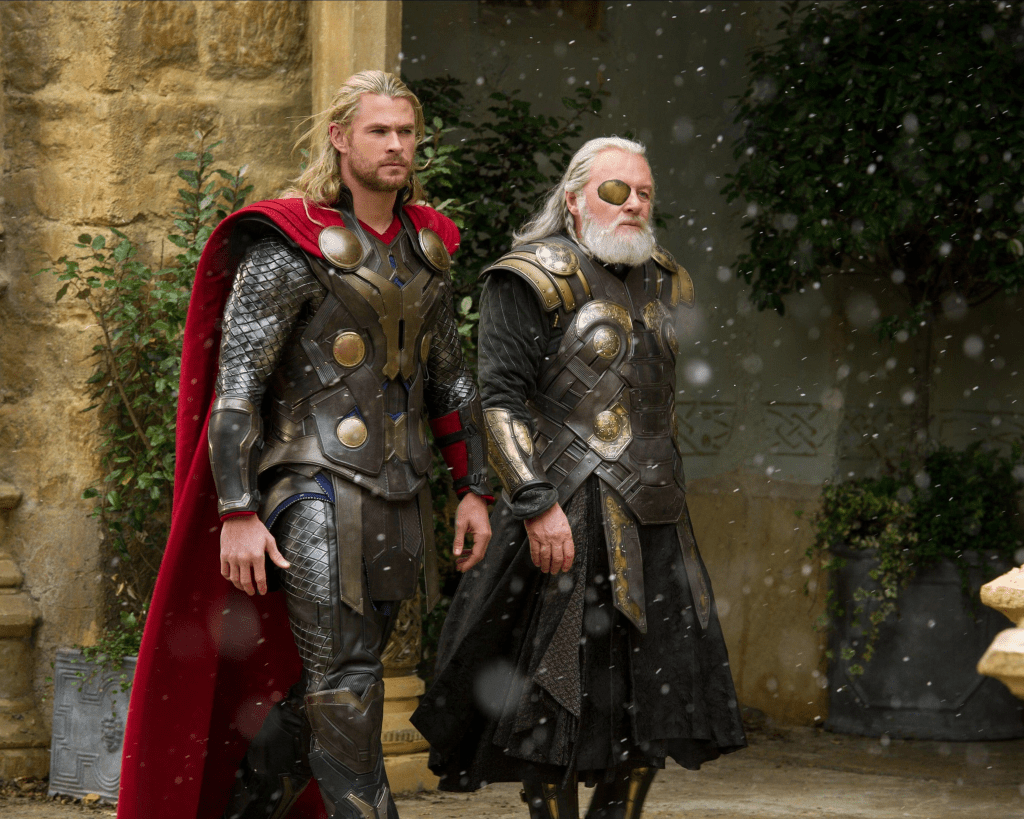
Hopkins as Odin alongside Chris Hemsworth as Thor in Thor: The Dark World. Photo: Cinematic/Alamy
It hasn’t been all that great recently, actually. In January this year, Hopkins’ house in Pacific Palisades was destroyed by the wildfires. “It was a bit of a calamity,” he says, with almost cheerful understatement. “We’re thankful that no one was hurt, and we got our cats and our little family into the clear.” He wasn’t there at the time; he and his wife, Stella, were in Saudi Arabia, where he was hosting a concert of his own music played by the Royal Philharmonic Orchestra. They’re now in a rented house in the nearby neighbourhood of Brentwood. “We lost everything, but you think: ‘Oh well, at least we are alive.’ I feel sorry for the thousands of people who have been really affected. People who were way past retirement age, and had worked hard over the years and now … nothing.”
Hopkins will be 88 this December, but clearly doesn’t consider himself past retirement age. As a two-time Oscar-winner, a knight of the realm, a fixture of pop culture and one of the most revered actors alive, he has an embarrassment of laurels to rest on, but there’s still plenty on his schedule. He’s just finished a movie with Guy Ritchie, for whom he has a newfound admiration – “He’s precise in what he wants to see” – and he’s coming back to Britain soon, he says, to make a new movie with Richard Eyre (The Housekeeper, about Daphne du Maurier), then another one in Wales.
Nor is he too old to move with the times. On a recent Instagram video, he put on one of Kim Kardashian’s much-ridiculed Skims face wraps and channelled Hannibal Lecter. “Hello, Kim. I’m already feeling 10 years younger,” he announces to the camera, followed by Lecter’s trademark sinister lisping-slurping action. “Fun, wasn’t it?” he says, laughing. Kardashian told him she thought it was hilarious, he says.
But recently Hopkins has also been looking back, too – at his whole life. His new memoir, We Did OK, Kid, is far from your stereotypical luvvie memoir, partly because Hopkins is far from your typical luvvie – even if he does cross paths with past greats such as Laurence Olivier, Peter O’Toole, Katharine Hepburn and Richard Burton – but mainly because he’s surprisingly upfront about his often troubled early life. When he describes his childhood in the Welsh town of Port Talbot, the only son of a family of bakers, it feels like a different planet. “My father had that attitude: stop whining, stop complaining, you don’t know what you’re talking about, stand up straight, get on with it!” His father was also prone to depression and anxiety, Hopkins says. It was wartime and postwar Britain; life was just like that.
By his own account, the young Hopkins comes across as a bit of a loner and an oddball. He had few friends, was frequently bullied and wouldn’t even go to his own birthday parties. He showed so little promise at school, one teacher told him he was “a brainless carthorse”. “I was living in my imagination, my dream world, I suppose,” he says. “I couldn’t understand anything intellectually or academically and that drove me into a kind of loneliness and resentment.” He retreated behind a mask of insolence, “a tough stance and a cold remoteness”, and that became his identity. Perhaps, in a way, he was already acting?…
++++++++++++++++++++++++++++++++++++++++++++++
George Orwell Explains in a Revealing 1944 Letter Why He’d Write 1984
The Dawn Watch: Joseph Conrad in a Global World
For 95 Minutes, the BBC Brings George Orwell to Life
Milan Kundera: The Unbearable Lightness of Being author dies aged 94
Orwellian nightmares: What I learned about today’s rage culture from rewriting 1984
George Orwell Reviews Mein Kampf: “He Envisages a Horrible Brainless Empire” (1940)
George Orwell: Literature and Totalitarianism (1941)
George Orwell in an age of moralists
Fear and Loathing: Closer to the Edge
Politics and the English Language (1946)
Reflections on ideology, morality and conscience
Ignorance is Strength; Freedom is Slavery; War is Peace
Sanskrit translation of Don Quixote rescued from oblivion
Andha Yug (Dharamvir Bharati, 1953) / धर्मवीर भारती लिखित नाटक ‘अन्धा युग’
Andha Yug by Dharamvir Bharati (1953): Theatre of Roots
Kabir and the Question of Modernity
The True Story of Ah-Q – By Lu Xun
Simon Leys: AN EMPIRE OF UGLINESS (extract from The Hall of Uselessness, 2013)
Two Strangers Who Meet Five Times. By Marcus Markou
“Papa old-age home se bhaag gaye. Mrs Sharma ke saath”
A Glimpse: award-winning short film about the price of love
Haruki Murakami: On seeing the 100% perfect girl one beautiful April morning
History’s Fool by Thomas Meaney
A Critic, His Life, His Age: A Tribute to Joseph Frank (1918-2013)
 After the truth-shower