
The Mohana of Pakistan’s Sindh province once thrived on the lake but pollution and drought have caused the fragile ecosystem to collapse, along with their way of life
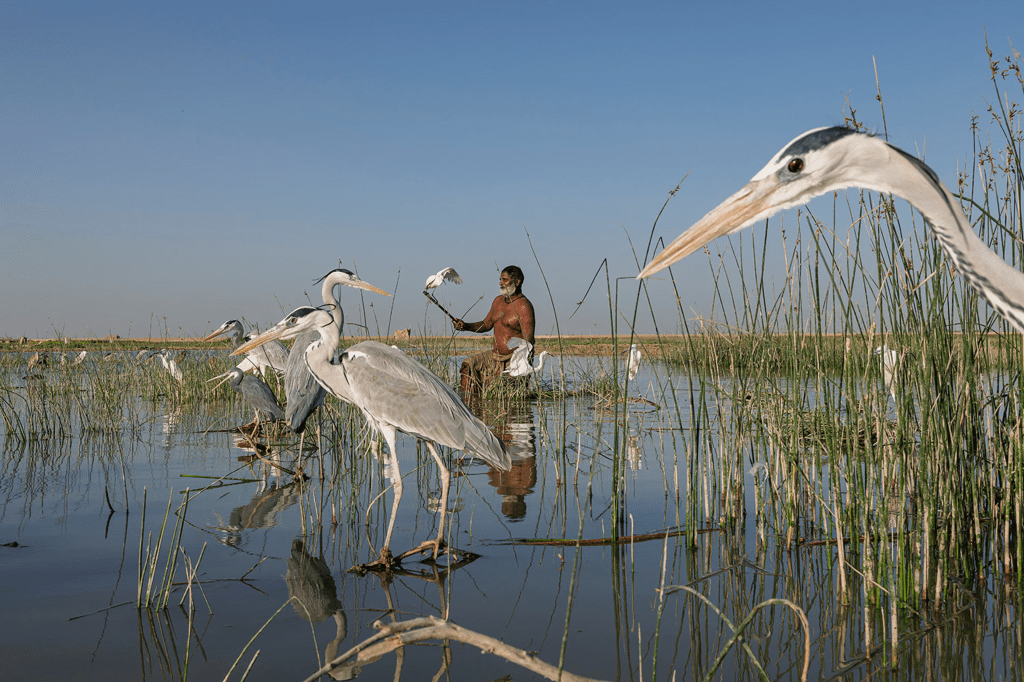
A Mohana hunter holds a thin branch with a living bird tethered to the end, which he uses as a decoy to trap wild birds
By Guillaume Petermann
At the mouth of Lake Manchar, gentle lapping disturbs the silence. A small boat cuts through the water, propelled by a bamboo pole scraping the muddy bottom of the canal.
Bashir Ahmed manoeuvres his frail craft with agility. His slender boat is more than just a means of transport. It is the legacy of a people who live to the rhythm of water: the Mohana. They have lived for generations on the waters of Lake Manchar in Sindh province, a vast freshwater mirror covering nearly 250 sq km. The lake, once the largest in Pakistan, was long an oasis of life. Now, it is dying.
On the opposite shore, Bashir’s father, Mohamed, the head of this community of about 50 people, waits for him. The two men settle in the shade. “We were the lords of the lake,” Mohamed says. “This water was full of fish. Our boats were our homes. We thought they would never sink. But look now … the lake has turned to poison.”
For us, leaving the lake was like asking the birds to stop flying: Ali Kasghar
That poison has flowed through a specific channel: the right bank outfall drain, or RBOD. Built in the 1990s, the canal was meant to make the salty soils of western Sindh fit for cultivation. In reality, it rerouted agricultural wastewater laden with fertilisers and pesticides, along with industrial effluent and sewage from several cities, directly into Lake Manchar. In just a few decades, the lake’s salinity has soared, oxygen has dropped, algae have proliferated, and the lake’s fragile ecosystem has collapsed. Climate breakdown has only hastened the disaster. A decrease in rainfall, combined with the construction of two upstream dams on the River Indus, has significantly reduced the flow of fresh water….
*********************
 After the truth-shower