This is no book; who touches this touches a man: Walt Whitman
Zweig and his second wife, Charlotte Elisabeth Altmann, committed suicide on February 22, 1942; the day after he submitted the manuscript of this book to the publisher. His farewell message read: I think it better to conclude in good time and in erect bearing a life in which intellectual labour meant the purest joy and personal freedom the highest good on Earth: Stefan Zweig (1881-1942)
And meet the time as it seeks us : SHAKESPEARE: Cymbeline
Not until our time has mankind as a whole behaved so infernally, and never before has it accomplished so much that is godlike… All the bridges between our today and our yesterday and our yesteryears have been burnt… And today we again stand at a turning point, an end and a new beginning. It is not without deliberation that I make this retrospect of my life end with a definite date. For that day of September 1939 wrote the final flourish to the epoch which formed and educated us who are in our sixties. But if we with our evidence can transmit out of the decaying structure only one grain of truth to the next generation, we shall not have labored entirely in vain...
From the Preface to Stefan Zweig’s: The World of Yesterday <— this is a link to a publicly available PDF
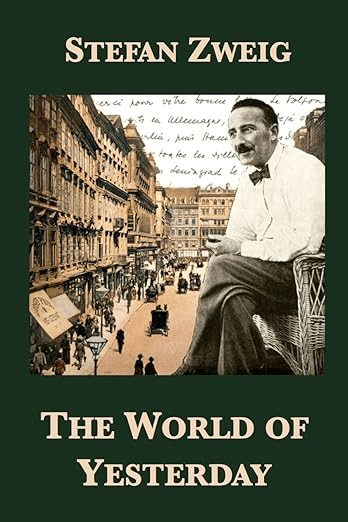
The World of Yesterday, Today
The relevance of Stefan Zweig’s 1942 autobiography for our own authoritarian times.
By Tim Brinkhof – April 29, 2025
STEFAN ZWEIG’S posthumously published autobiography The World of Yesterday: Memoirs of a European (1942), sketches a portrait of someone swept aside by the brutal march of history. With the present world order on the brink of collapse, his story has never been more relevant, saddening, or strangely comforting.
“What’s wrong?” my grandmother asked as I stared at my plate of kale, mashed potatoes, and smoked sausage—a traditional Dutch dish (and a childhood favorite) she prepares whenever I visit her home in the Netherlands. “Nothing,” I said.
I lied. Donald Trump’s inaugural address was on TV, and hearing him talk about America’s imminent “golden age” made me feel like I had just been diagnosed with a terminal illness. Throughout Trump’s first term, which began during my freshman year studying history at New York University, I found comfort in the notion that his electoral victory had been some sort of mistake or accident, and that the chaos and damage he caused in office would prevent him from successfully running again. Now that he had found his way back into the White House, what at first appeared an embarrassing footnote in American history seemed more like the start of its final chapter.
When I shared my fears and frustrations with friends later that week, they treated me as if I was the problem. “Stop doomscrolling,” one urged, having just read a popular self-help book on the subject. “Stay positive,” another offered. While they were no fans of Trump themselves, they told me—in so many words—that I was losing my grip on reality, ruminating on an as-yet-unmanifested future when I should be focused on the far-from-ideal but by-no-means-apocalyptic present. Although the increasingly alarming headlines that have emerged from the United States since then—about tariffs imposed on the world, deportations to El Salvador, a possible attack on Greenland, the imminent abandonment of Ukraine—made them slightly more sympathetic to my point of view, I still get the impression that their concern for my personal well-being is disconnected from any concern they might have for the world at-large.
Feeling alone, I turned to Zweig’s autobiography, in which the Austrian author reframes his life and career as a prelude to the rise of Adolf Hitler and the outbreak of World War II. I had skimmed the book once before, for a course on the politics of Weimar Germany. This time, however, I read it to understand not the war itself but Zweig’s emotional response to it—one that struck me as similar to my own reaction to Trump’s reelection.
Though rarely mentioned outside of academic circles today, Zweig was one of the most popular and successful authors of the previous century. A prolific novelist, playwright, and literary critic of Jewish descent, he is best known for his biographies, which—in the spirit of the fin de siècle Belle Epoque in which he grew up—lauded the achievements of humanity’s best and brightest, from fellow writers such as Honoré de Balzac and Fyodor Dostoevsky to Erasmus, Nietzsche, Freud, and more. Like many of his contemporaries, Zweig believed in linear progress: that today’s societies were better than yesterday’s, and tomorrow’s would be better still. It was a belief not unlike the one that swept the Western world after the collapse of the USSR, when political scientist Francis Fukuyama famously proclaimed liberal democracy’s definitive triumph over left- and right-wing dictatorships, and thus “the end of history.”
Just as modern-day researchers have probed the recent past to explain the appeal of Trump and other authoritarian leaders, so does The World of Yesterday search Zweig’s upbringing for warning signs of the rise of National Socialism. In hindsight, those signs were everywhere, from the way people celebrated the outbreak of World War I to Europe’s highly patriotic education system, which taught students to look at armed conflict as something necessary and noble, as opposed to barbaric and senselessly destructive.
“The way they had presented the history of the world to such unsophisticated, unquestioning young men!” Zweig opined at a 1939 lecture in the United States, recalling how—while preparing to cross the Atlantic—he had stumbled upon one of his old textbooks:
[A]rtfully prepared, deformed, coloured, falsified, and all with clear, deliberate intention. It was obvious that this book, printed in Austria and destined for Austrian schools, must have rooted in the minds of young men the idea that the spirit of the world and its thousand outpourings had only one objective in mind: the greatness of Austria and its empire.
To say Zweig made it out of war-torn Europe alive would be only partly true. In addition to robbing him of his loved ones (his mother, refusing to leave Vienna, died alone) and his cherished possessions (he had to leave behind his vast collection of scholarly memorabilia, which included Mozart’s marriage certificate and a lock of Goethe’s hair), the Third Reich represented the end of everything he stood for and held dear. Borders were closed, travel prohibited, and cultures pitted against one another in pointless, existential competition. Publishers were shut down, university professors arrested, books—including Zweig’s own—banned and burned. Individuality, creativity, critical thinking, and intellectual curiosity—the core themes of his expansive oeuvre—had no place in the totalitarian state, which required loyal, unquestioning subjects to ensure its survival. “[F]reedom in what you did or did not do in private life was taken for granted,” he wrote (in Anthea Bell’s translation) of the Europe of his youth, the lost, rose-tinted World of Yesterday, “and toleration was not, as it is today, deplored as weakness and debility, but was praised as an ethical force.”
For a while, Zweig tried to follow the same advice my friends had given me. He told himself that even a time as dreadful and disheartening as his could prove worthwhile for a writer such as himself, who was interested in exploring the depths of the human condition. “[O]nly those who have known the light and the dark, have seen war and peace, rise and fall, have truly lived their lives,” he mused. But as the warmongering turned into all-out war, that silver lining faded. The further the conflict escalated in both scope and cruelty, the more he feared that there was nothing to be gained or gleaned from it. “Every one of us,” he wrote, “knows a thousand times more about reality today than the wisest of our forebears.” It was not, however, a productive type of knowledge, capable of inspiring art and writing; instead, it was a corrosive knowledge that ate away at you, spoiling your appetite for life.
The German journalist Ernst Feder, who met Zweig after the latter had moved from the United States to Petrópolis, Brazil, near Rio de Janeiro, suggests his mood was even darker than his autobiography leads one to believe. In his essay “My Last Conversations with Stefan Zweig,” Feder describes how “the spectacle of the nations of Europe tearing each other to pieces with steadily increasing brutality” was “visibly weighing him down,” and how Zweig struggled “in vain against his growing depression and melancholia, which he had made no attempt to conceal.”
These feelings ran counter to Zweig’s natural disposition, which now only occasionally managed to obtain the upper hand. The Brazilian Carnival, a festival he had read and written about but had never before seen, brought back glimpses of his old self. Walking through the busy streets of Rio, he soaked in the sights, took vigorous (though regrettably lost) notes, and exclaimed, according to Feder—“with boyish enthusiasm” and the hint of a smile—“Now, isn’t that pretty?”
But Zweig was fighting an uphill battle, and he was tired. During their last meeting, Feder recalls how the author emerged from his study looking “completely crushed”—a strange occurrence, Feder thought, as Zweig was not in the habit of working late at night. Other uncharacteristic interactions followed: Zweig returned a book he had not yet finished, declined an invitation from the Colombian minister of education to visit him in Bogotá, and—finally—admitted that he no longer derived satisfaction from putting pen to paper. “Forgive me for being such a kill-joy,” he told Feder when the two parted ways. “I’m having one of my bad days today.”
It proved to be one of his last. On February 22, 1942, a gardener and housekeeper discovered the bodies of Zweig and his wife Lotte in their bed, where they had lain down together after overdosing on barbiturates. Hearing the news, Feder realized that, when Zweig had come out to greet him that recent night, he had been working not on one of his many unfinished projects, but on his suicide note.
“[T]o start everything anew after a man’s 60th year requires special powers,” the note read, “and my own power has been expended after years of wandering homeless. I thus prefer to end my life at the right time, upright, as a man for whom cultural work has always been his purest happiness and personal freedom.”
The note, particularly the word “homeless,” speaks volumes as to the sources of Zweig’s suffering. Though a proud cosmopolitan, he was firmly rooted in his native soil, and while he loved to travel, his enjoyment had always been contingent on the reassurance that his journeys would end back home. “Master and lover of the German tongue,” Feder wrote, “he was an exile in a country which spoke another language.” Feder likened Zweig’s experience to that of Heinrich Heine, a German poet from a previous generation, who had been exiled to Paris: “You may have some conception of material exile, but the completeness of spiritual exile can be known only by a German poet who is compelled to speak and write French all day long.”
Zweig’s relationship to Germany and Austria was complicated and—as long as the Nazis remained in power—irresolvable. On one hand, he stood by his renunciation of the Third Reich, telling guests at a 1941 American PEN Club banquet: “Our books were the first to be cast onto the pyres. […] But today we have no regrets over this enforced exile. […] Our conscience feels that much more liberated, having made a clean break from those who have plunged this world into the greatest catastrophe in all history.” On the other hand, he could never cut his ties completely, noting in the same speech that one “cannot wrench himself from the language in which he creates and thinks.”
As much as Zweig considered the Third Reich an affront to his most basic values, part of him could not help but feel responsible for its creation—insofar as he was, in the broader sense of the word, not only a German but also a German-speaking intellectual who spent much of his career glorifying Germanic culture and history without fully realizing what such glorification could ultimately lead to. Furthermore, he understood that the artistic and intellectual milieu to which he had belonged rested on the same idealist traditions as the Reich itself—an understanding hammered home by the fact that many of his former acquaintances actively lent their talents to the Nazi cause:
Most of our Austrian writers, who had little European experience and saw life entirely from the German point of view, thought their best course was to reinforce the enthusiasm of the masses, promoting the alleged glories of war with literary calls to arms or scholarly ideologies. Almost all the German writers, headed by Hauptmann and Dehmel, thought it their duty to imitate the bards of ancient Germanic times and inspire the advancing warriors, by singing lays and casting runes, to go willingly to their death. Poems rhyming Krieg—war—with Sieg—victory—and Not—necessity—with Tod—death—came thick and fast. Writers swore to have nothing to do culturally with a Frenchman or an Englishman ever again. Indeed, overnight they took to denying that there had ever been any such thing as British or French culture. It was all slight and worthless, they said, by comparison with German art and the German nature. […]
***
But the worst of this madness was that the majority of its proponents were honest men. Most of them were too old to do military service, or physically incapable of it, but felt it was their right and proper duty to make some kind of helpful contribution to the war. They owed what they had done in life to their language and their country, so now they wished to serve the country with its language. They would tell people what they wanted to hear—that right was entirely on one side in this conflict and wrong entirely on the other; Germany would triumph and the enemy be shamefully defeated—with no idea that they were betraying the writer’s true mission of preserving and defending values in common to all humanity.
Contrary to popular belief, Zweig did not take his own life because he believed the Germans couldn’t be defeated. Although he feared the war would spread to the Americas, Feder insists that Zweig “never said a word that implied doubt of our final victory.” He was, however, “sure that the war would be long and devastating.” More importantly, he believed that the “wave of hatred which he felt breaking over the world” would deal lasting, unhealable damage. It certainly had damaged him. “Now and then,” Feder writes, “he used the phrase ‘die of war,’ as one dies of disease.”
Although Zweig clearly displayed symptoms associated with depression, his ultimate fate should not be attributed to mental illness alone, as such a diagnosis would diminish not only his qualities as a writer and thinker but also the gravity of the events that so disturbed him. Far from distorting reality, his knowledgeable mind and fortuitous spirit allowed him to grasp the full ramifications of the war, from its earliest causes to its farthest consequences. As a direct result of his lifelong studies, he understood to his own detriment that past, present, and future were inextricably linked, and that tomorrow—however difficult to predict in exact terms—would inevitably be a product of today, just as today had been a product of yesterday.
Feder appears to have agreed. “Why did he leave us so?” he concludes.
These demons which with his nervous, miraculous pen he had so often been able to exorcise […] were not the mere creations of an artist’s imagination or an irritated nervous system. They were the real demons of the insane destruction which had descended on our wretched earth, crueler than the Four Horsemen of the Apocalypse, and he saw them in their true proportions while the rest of us belittle and evade them so as to manage to live a little longer.
https://lareviewofbooks.org/article/the-world-of-yesterday-today/
+++++++++++++
The Dawn Watch: Joseph Conrad in a Global World
The Concrete Possibility of Total Nihilism: Günther Anders and the Atomic Bomb
Ignorance and Bliss: On Wanting Not to Know
Hans Magnus Enzensberger: The Industrialization of the Mind
The Supreme Contradictions of Simone Weil
Evil: The Crime against Humanity. Hannah Arendt’s confrontation with totalitarianism
Alexandre Koyré: The Political Function of the Modern Lie (1943)
Lying and history: Hannah Arendt and the Viet Nam war (2009)
Seyla Benhabib: Breaking Silence, Hannah Arendt, and Martin Luther King
Pratap Bhanu Mehta: Reading 1919 in 2019
Where The Mind Is Without Fear
John Sanbonmatsu: Postmodernism and the corruption of the academic intelligentsia (2006)
The zeitgeist is changing. A strange, romantic backlash to the tech era looms
Mario Praz: The Romantic Agony (1933)
Leon Wieseltier: ‘The Wise, Too, Shed Tears’
Nietzsche and Lou Andreas-Salomé: Chronicle of a Relationship 1882
 After the truth-shower