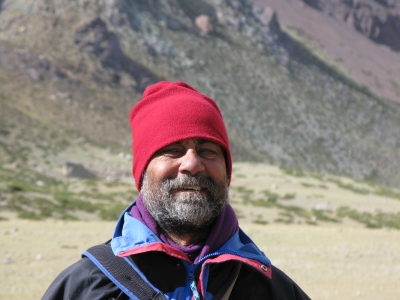
The Colombian novelist on Trump’s new doctrine and the long shadow of US aggression in Latin America
Intervention and imperialism: that’s what the new world looks like. It will take many shapes. One of them is what we saw in Venezuela, but other processes are at work. I’ve been worried for a long time about the perverse alliance between Trump and the tech oligarchs, the Musks and Zuckerbergs. Latin America will be no stranger to this. The tech oligarchs offer Trump a truth-free world, a confused people over which it is easier to rule; Trump offers them deregulation and impunity. This is what he tried to do in Brazil and this is what he will achieve in Milei’s libertarian government. The consequences for democracy are dreadful.
Juan Gabriel Vásquez
Few novelists today approach the convergence of politics, history and literature with such delicate artistry as Juan Gabriel Vásquez. Born in Bogota, and living now in Madrid after stints in Paris and Barcelona, he has imagined, in one ambitiously conceived novel after another, the passionate struggles of the Spanish-speaking peoples against their circumstances.
Preternaturally alert to the impact of ideas and ideology on private lives, and to politics as irresistible yet treacherous temptation, his work keeps miraculously alive in the 21st century the tradition of the Euro-American novel that began in the 19th with Stendhal and Turgenev, and was adapted to the more turbulent 20th by Joseph Conrad, VS Naipaul, Doris Lessing and Nadine Gordimer. The rare virtues of his fiction are present, too, in the following interview about Donald Trump’s brutalisation of Venezuela: an outraged moral conscience that sees political action as necessary, while acknowledging multiple ideas and passions in their seemingly antagonistic but profoundly interdependent relationship. – Pankaj Mishra
****
Equator: In your El Pais column this week, you note that regime change by force “has never turned out well”. You describe the removal of Nicolas Maduro as “far more serious” than previous acts of American aggression in Latin America. What makes it far more serious?
Juan Gabriel Vásquez: Two things: first, its blatant greed and lack of excuses for the illegality of the intervention; second, the use of the Monroe doctrine, which will have an immediate impact in the world.
First, Trump has been almost cartoonish in his open avowal that this is all about controlling Venezuela’s natural resources. In his (already infamous) press conference, he pronounced the word “oil” at least 25 times. (I lost count.) The words “democracy” or “dictatorship” or “freedom” or “political prisoners”? Almost non-existent. American governments have in the past sought to disguise their imperialist intent behind respectable or palatable causes: the fight against the spread of communism, for instance, or the fight for freedom against its enemies. Not anymore.
Secondly, the Monroe doctrine redux. Latin America has suffered American aggressions since the 1840s, when the US stole a huge part of Mexico’s territory. But this new doctrine – that he has taken to calling, with characteristic narcissism, “Donroe” – is essentially a new division of the world into spheres of influence. And we all know who’s listening: Russia and China, who will feel authorised to pursue their own imperial aspirations. Why not? Might makes right in the new world created by Trump and his thugs. Israel is taking notes as well: the road to genocide in Gaza has even fewer obstacles now. In other words, the world is today a more dangerous place than it was before. And that’s saying something.
One strand of continuity with America’s older aggressions is a throwback to the Cold War: the purported fight against socialism. Why do we see this still being used as an instrument or disguise in the 21st century?
Venezuela was one of three or four Latin American countries where the US had not intervened militarily either to fight communism, to protect a fascist military dictatorship, or to defend its economic interests. A similar disguise justified the unconditional support that the US gave to General Anastasio Somoza, first occupying Nicaragua and then protecting his dictatorship; the same disguise justified the intervention in Guatemala and the overthrow of Jacobo Árbenz, whose agrarian reforms had touched the interests of the United Fruit Company. (This is discussed marvellously in Mario Vargas Llosa’s novel Harsh Times.)
What happened this week is different, however. You ask: why do we still see this being used? One reason is evident: it is popular with Trump voters, many of whom are the Latin American exiles of socialist failures like Cuba, Nicaragua and Venezuela. And these are real failures, guilty of much pain and suffering, guilty of broken lives. Let me be clear: as somebody coming from what you may call social democracy, I’ve always been very critical of the Maduro regime and the Chavez regime before that, even when it was popular in Latin America (or among certain European politicians) to overlook the authoritarian excesses, the persecution of journalists, the impoverishment of a country. These regimes have destroyed Venezuela and driven eight million people into exile; they have been corrupt to the bone and increasingly repressive, with hundreds of political prisoners. Opponents are kidnapped, tortured and murdered in Venezuela.
So let me, again, be clear: it’s always good when there’s one less dictatorship in the world. But to think this was really about the liberation of an oppressed people is beyond naive. Just look at who’s in power now: Trump has taken a corrupt Chavista leader and put other corrupt Chavista leaders in his place. Before we learned this, I wrote that Trump was a thug and his government of thugs may be useful in bringing down Maduro’s dictatorship, but it would come at a very high price in terms of sovereignty. Now we know it has. No, it’s not about fighting an authoritarian (socialist) regime. It’s about the colonisation and the exploitation of another country’s resources, and that is why it is likely that Greenland comes next.
Greenland aside, Trump has threatened Colombia as well. How seriously do you sense his threats towards Colombia are being taken by Colombians?
Quite seriously, I think. There’s ample precedent to believe that Trump may carry out his threats for reasons that were unthinkable in politics before this generation of narcissists came to power. A show of force is always a good reason to do things. Not looking for an outcome, even disregarding possible outcomes, but just to hurt because they can get away with it. Make others fall in line, etc. This is what America is under Trump: an international thug, a government of bullies no better than Putin’s Russia.
In that frame of mind, it’s easy to see how Trump’s personal confrontation with President Gustavo Petro might lead to aggression: he has to prove that his threats were not empty. You don’t have to know your Shakespeare to realise how deep personal feelings – a wounded masculinity, an outsized ego, a profound insecurity – can shape political decisions. Right now, respectable pundits are seriously discussing how what happened in Venezuela was in part a response to Maduro making fun of Trump; they’re discussing if María Corina Machado should share her Nobel peace prize to get Trump to let her take power in Venezuela. It’s all puerile and ridiculous, but that’s Trump’s world. But maybe your question was pointing elsewhere.
It was, in part, an attempt to gauge what memories this stirs for Colombians of your generation who came of age during the violence of the 1980s and 1990s, and who’ve lived through failed peace processes and US-backed military operations. Does this moment feel like a return or like something qualitatively new?
I’ve never seen anything like this. We lived through the years of the drug wars with an awareness of American hypocrisy: a war against cartels that wasn’t there to be won, but so that the US had a pretext to politically control Colombia.
But Colombia has also been the United States’s most dependable partner in the region, and successive US governments have understood this. American aid was crucial in weakening the FARC guerrillas and forcing them to sit down and negotiate an end to the conflict. Later, the Obama administration supported the resulting peace agreements, which I still consider a great achievement.
So the magnitude of this American hostility, with Trump threatening the Colombian president like a school bully, is unheard of. I may be wrong, but I think American prestige or soft power have all but disappeared in Colombia. Yes, there are a few imbeciles in the Colombian congress calling for an American invasion. But most people, even if they are deeply critical of president Petro, realise this rhetoric is unacceptable.
People have been asking me about a novel of mine that’s very critical of American hypocrisy regarding the war on drugs. But I’ve been thinking about an older novel which explores the year 1903, when an American-backed revolution allowed Panama to separate from Colombia (and effectively own the Panama Canal for decades). We’d have to go back to those years, I think, to find such a strong anti-American feeling as we are witnessing.
What is the history of the lie that is the war against drugs, and of its utility to the US? It was cited in the case of Venezuela and Maduro, of course.
On some level, this aggression is just one more instance of the old manipulation of drugs to justify political and economic intervention in and domination of Latin American countries. What has happened recently in the Caribbean – the extrajudicial killings of 100 South American citizens that might have been carrying drugs – was a pretext for bringing aircraft carriers closer to the Venezuelan coast. The designation of Maduro and his gang as drug dealers is not false, but it would be too naive to believe that Trump really cares about the drugs crisis: just a few months ago he pardoned an Honduran ex-president who was serving time in an American prison for having smuggled tons of cocaine into the US.
We must remember that drug trafficking is a crime invented by the US in the early 1970s. Turning vices into crimes, as Nixon did, was a political strategy, used originally to slander and persecute the internal opposition to the Vietnam War – associating them with drugs and then persecuting them with the full force of American puritanism was Nixon’s way to recover control over the narrative, as we would say now. (If anybody’s interested, there’s a wonderful interview given by John Ehrlichman, one of Nixon’s closest advisors, to journalist Dan Baum.)
Since then, the war on drugs has been a very useful way of applying pressure to Latin American governments. This is how the mechanism of certification and de-certification works: if the US doesn’t judge a Latin-American country is doing the necessary, it uses sanctions and other forms of punishment… for a crime invented in the US.
The solution to the drug problem would be legalisation, of course. The war on drugs has failed, but it goes on because legalisation would put an end to the cartels and the mafias, just as it happened with alcohol in the 1920s, and would therefore take away the political influence that the US has over Latin America. This power allows them, among many other things, to do what they did in Venezuela.
We’ve been talking for a while now about the dawning of a post-American world – not necessarily a world after American power, or even an American-dominated global order, but a world where America is no longer seen as a model or a leader or an authority. Many people seem to recognise this event as a kind of final demonstration that this American world is gone. What are the likely consequences of this development, in your view?
It’s definitely a change of paradigm. What it will bring for the US remains to be seen, but I don’t see anything good coming from the damage done by all this to the image of America in the world: to the American brand, to speak in terms that they will understand.
Let me speak briefly in personal terms, just by way of telling you where I’m coming from. I’ve never been guilty of the anti-American feeling that became so prevalent in Latin America during the Cold War, and that remains in many shapes and forms. American culture has always been a sizable part of my intellectual and emotional life: American fiction has shaped the way I write, American political philosophers have shaped the way I think, and I dare say I know American history better than many Americans.
Now, to go beyond the creative energy in American culture: I’ve always detected the clear divorce between the better angels of American life – those ideals of democracy, freedom, equality – and their subversion or defeat at the hand of the worst angels, which have always existed. It’s a country that has never been able to live up to “the true meaning of its creed”, as Martin Luther King Jr said. But the creed has been there, and it has moved things forward, and it has been a model for movements all over the world.
What we see now, tragically, is a politics of deliberate cruelty, racism, misogyny and xenophobia that is not only unashamed, but proud to promote this worldview. Freedom of expression no longer exists. Freedom of thought is being persecuted. Dissenters or even outspoken critics are being jailed, deported or rejected at the border. American leadership and authority came in part from these freedoms which no longer exist. The former ‘leader of the free world‘ is now a fascist rogue state siding with authoritarians and dictators like Putin, Netanyahu and Mohammed bin Salman. Who’s America’s enemy? Europe.
The good thing is that a kind of resistance is growing inside the US. In the media, in civil society, in politics, enough people are realising they are about to lose their democracy. I do hope they can do something about it in the next elections. We in the rest of the world are looking at them, and trying to help however we can.
From the vantage point of someone living in Latin America, what does the new world order look like for Colombians and others after this US action in Venezuela?
The world order, or at least that system we call the world order, born after the Second World War, is effectively dead. The US action in Venezuela kills the United Nations charter and creates a world in which power allows the powerful to do what they want. The unravelling of the world and its descent into chaos are right around the corner, and believe me, I’m not the dramatic type.
Intervention and imperialism: that’s what the new world looks like. It will take many shapes. One of them is what we saw in Venezuela, but other processes are at work. I’ve been worried for a long time about the perverse alliance between Trump and the tech oligarchs, the Musks and Zuckerbergs. Latin America will be no stranger to this. The tech oligarchs offer Trump a truth-free world, a confused people over which it is easier to rule; Trump offers them deregulation and impunity. This is what he tried to do in Brazil and this is what he will achieve in Milei’s libertarian government. The consequences for democracy are dreadful.
→Juan Gabriel Vásquez’s books have been published in twenty-eight languages worldwide.
*************
 After the truth-shower