
DANIEL A. MÉTRAUX
Tora! Tora! Tora! provides a powerful visual image of the Pearl Harbor crisis. We are given a highly unique presence in Tokyo as the Japanese plan their mode of attack, but unfortunately, the movie’s attention is focused almost exclusively on the attack on Pearl Harbor. The truth is that Pearl Harbor was only one part of a coordinated Japanese attack not only on Hawai`i, but also on Manila, Singapore, Hong Kong, the Dutch East Indies, and elsewhere. Oddly, the film makes no mention at all of the military operations in Southeast Asia and never tells us why these attacks occurred. In this sense, the movie’s focus is too narrow… despite these faults, the film does a most memorable job in portraying the whole Pearl Harbor experience.
Tora Tora Tora was the Japanese code for the signal to begin the attack on Pearl Harbor on December 7, 1941. Tora means “tiger,” but the phrase is considered an abbreviation for totsugeki raigeki, which implies lightning attack
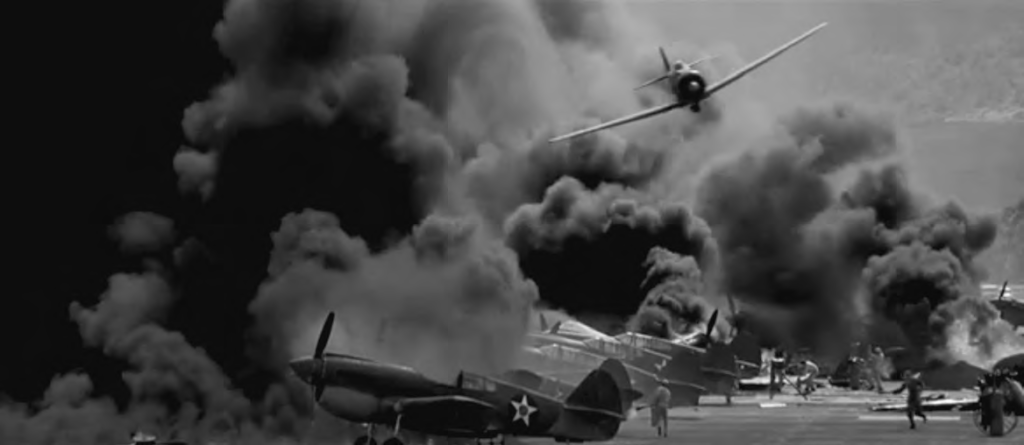
The attack began at 7:55 am Hawaiian time, and lasted for 2 hours and 22 minutes. Over 300 aircraft were destroyed or damaged at 5 air stations: Source: NPR website at https://tinyurl.com/zwen428w.
TORA! TORA! TORA!
BY RICHARD FLEISCHER, TOSHIO MASUDA, AND KINJI FUKASAKU
TWENTIETH CENTURY FOX, 1970
How the Film Tora! Tora! Tora! May Be Utilized as a Teaching Tool About Pearl Harbor (PDF link)
The use of film in a history class can be an important learning tool for students. The traditional method of instruction based on pure lecturing can inform students of the basic facts, but the use of film can substantially enhance the learning experience. When I was a Professor of Asian Studies at a small women’s college in Virginia, I often used films as a way of enhancing my lectures. When teaching about modern Chinese history and culture, I would show such movies as Raise the Red Lantern (1991) and the Last Emperor (1987), for India under British rule Gandhi (1982), and the Japanese film Nana for a course on modern East Asian women. But when teaching about the “road to Pearl Harbor,” there is no better film than Tora! Tora! Tora! (1970).
I am a baby boomer, born in 1948, and World War II was still very much alive in the minds of my father, uncle, and brother who had fought in the war. But today’s college students, born in the late 1990s and early 2000s, often regard World War II as long-forgotten history. When I last taught my Modern Japan course in 2015, one of my brightest students, who had earlier traveled with me on a study trip to Japan, was jolted out of her complacency when I told the class we were now going to study about the Pacific War: “How could the US go to war against Japan, as we are such great friends today and the Japanese are so nice to us?” This particular response is far from simply anecdotal: a 2018 poll of 1,000 American citizens indicated that 60 percent of respondents could not name the nations that the US fought in World War II; when this question and similar ones were analyzed by age group, less than 20 percent of respondents under forty-five could answer this question or similar ones in the American history survey. My lectures gave her some background on what happened, but it took a careful viewing of Tora! Tora! Tora! to better understand the full ferocity of the violence of the Pearl Harbor attack.
The movie Tora! Tora! Tora! (directed by American Richard Fleischer and Japanese Kinji Fukasaku and Toshio Masuda, and including well-known actors from both countries) is important as a learning tool because it shows both sides prepare for war without glorifying one side and condemning the other. We see the earnest debates that occurred on both sides: hotheads in Japan claim that Americans are too fat and lazy to fight wars both in Europe and the Pacific, while Admiral Isoroku Yamamoto, the highly accomplished Imperial Navy strategist who had spent extensive time in the US, cautions against waking up the “sleeping tiger.” American military leaders discount the audacity of a Japanese attack on Pearl Harbor….
+++++++++++++++
Julián Casanova: The Spanish Civil War, 80 years after
Sam Jones: From Che Guevara to lockdown: photo book tells story of Madrid
Rare colour photographs from London in World War Two / The Second World War in Colour – in pictures
A New History of the Second World War
Was Vichy France a Puppet Government or a Willing Nazi Collaborator?
Remember this lady. In memory of Irena Sendler
Sophie Scholl and the White Rose
Clara Zetkin: Fascism must be defeated (1932)
Traute Lafrenz, the last of the White Rose anti-Nazi resistance, dies aged 103
In Memory of Johann Georg Elser, the carpenter who nearly prevented the Second World War
 After the truth-shower