There are some who are in darkness / And the others are in light
And you see the ones in brightness / Those in darkness drop from sight.
(Bertold Brecht, The Threepenny Opera)
People in the West seem naïve to us because they don’t suffer like we do, they have a remedy for every little pimple. We’re the ones who went to the camps, who piled up the corpses during the war, who dug through the nuclear waste in Chernobyl with our bare hands. We sit atop the ruins of socialism like it’s the aftermath of a war...
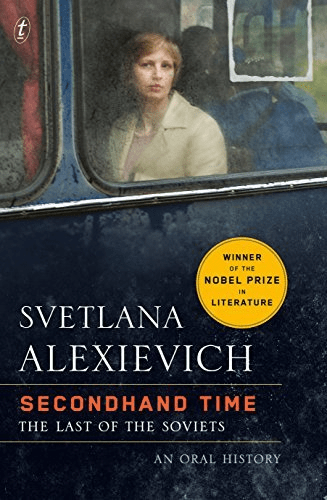
Second-Hand Time, which deals with the period 1991-2012, seamlessly dovetails Revolutionary Russia, which covers the 1891-1991 period. Featured are respectively the Yeltsin (1991-2001) and the Putin (2002-2012) decades.
The approach and perspective taken by the Belarusian investigative journalist couldn’t be more different from Figes’s broad-scoped traditional historiography ‘from above’ which focusses on the great outlines and the leaders of the land. Not just an observer or analyst – quite on the contrary, no analysis, personal comment or judgement is to be found, – she yields the floor to the men and women living in the post-Soviet era like herself, to the Homo sovieticus, who experienced History and the breakdown of the Soviet system and civilization personally. She registers and recounts a myriad of her fellow travelers’ often deeply tragic stories, collaging their striking first-hand testimonials in which they look back on who and what they were and are before and after 1991, judging, contemplating and commenting themselves their former and present lives, opinions, identities, hopes and ideals, dreams and illusions.
‘Everyone is terribly lonely. Life has completely transformed. The world is now divided into new categories, no longer ‘white’ and ‘red’ or those who did time and the ones who threw them in jail, those who’ve read Solzhenitsyn and those who haven’t. Now it’s just the haves and the have-nots.
In 2015 The Nobel Prize committee awarded the prize to Alexievich ‘for her Polyphonic writings, a monument to suffering and courage in our time’. Alexievich’s documentary approach airs a polyphonic, at times dissonant and jarring multitude of voices, collected during conversations throughout the country, amongst a cross section of the Russian population: veterans from the Afghanistan and Chechen wars, former apparatchiks, directors, a writer, a musician, entrepreneurs, technicians, teachers, family members of the CCCP elite, retired factory workers and students, emigrants. Alexievich alternates the poignant testimonials of victims, executioners, obdurate Stalinists, supporters and opponents of Perestroika and Gorbachev (“the great Gorby”, “traitor of the Motherland”, “the prophet”, “the perfect German”). She demonstrating the successive generations’ diverging perception of the present and the past and how differently all those former soviet citizens experience their country and its current state. The mutual incomprehension between the subsequent generations is harrowing:
“(…)the young who will never understand their parents because they didn’t spend a single day of his life in the Soviet Union – my mother, my son – me…we all live in different countries, even though they’re all Russia.
Her writing-style immerses the reader into the lives of her interlocutors, involving the reader irresistibly into the haunting conversations. Like in genuine ‘people’s history’ or ‘history from below’, Alexievich’s primary focus is not on the facts and figures, the leaders, the new class of rulers or the oligarchs. Almost like a contemporary historical anthropologist she elucidates the attitudes, hearts and mindsets of the post-Soviet citizens, many of her own generation – of which so many got adrift psychologically and professionally, when the system imploded. Left behind again by History like human flotsam and jetsam, they voice their despair, their anger, their cynicism and sorrow.
Nearly overnight they woke up in world totally alien to them, a world indifferent to their suffering and sacrifices – when all they had was their suffering: (”Where is our capital? All we have is our suffering, everything that we went through (…). We’re always talking about suffering. That’s our path to wisdom. People in the West seem naïve to us because they don’t suffer like we do, they have a remedy for every little pimple. We’re the ones who went to the camps, who piled up the corpses during the war, who dug through the nuclear waste in Chernobyl with our bare hands. We sit atop the ruins of socialism like it’s the aftermath of a war. We’re all run down and defeated. Our language is the language of suffering.”). Their former lives, their nation, smashed to smithereens, not a single stone left standing:
Does anyone care about any of this anymore? Our country doesn’t exist anymore, and it never will, but here we are…old and disgusting…with our terrifying memories and poisoned eyes.
They were fooled by the shiny wrappers. Now our stores are filled with all sorts of stuff. An abundance. But heaps of salami have nothing to do with happiness. Or glory. We used to be a great nation! Now we’re nothing but peddlers and looters….Grain merchants and managers…..
And instead of the ‘socialism with a human face’ and the mature democracy many hoped for, the former Soviet citizens got a new tsar and the most virulent and harsh predatory capitalism:
The thing is, you can’t buy democracy with oil and gas; you can’t import it like bananas or Swiss chocolate. A presidential decree won’t institute it….you need free people, and we didn’t have them.
What did we get? On the streets, it’s bloodthirsty capitalism. Shooting. Showdowns. The gangsters have risen to the top. Black marketeers and money changers have taken power. Jackals!…Source: Ilse’s review: https://www.goodreads.com/book/show/30200112-secondhand-time?ref=rae_0
************************************************
‘Only love can save those who are infected with anger.’ Svetlana Alexievich speaks to Staffan Julén
Svetlana Alexievich’s Nobel Lecture (2015)
Russia targets its oldest human rights group, Memorial
The Gulag Archipelago: An Epic of True Evil
 After the truth-shower