
The following are excerpts from The Dismantling of India’s Democracy: 1947 to 2025 by Prem Shankar Jha; reproduced with permission from the publisher, Speaking Tiger.
Over the decade since Narendra Modi has been the prime minister of India, at the head of a BJP government supported by a few local allies in the states of northern India, he has worked diligently to complete the conversion of India into a fascist nation-state—a process that began during his tenure as chief minister of Gujarat in 2002.
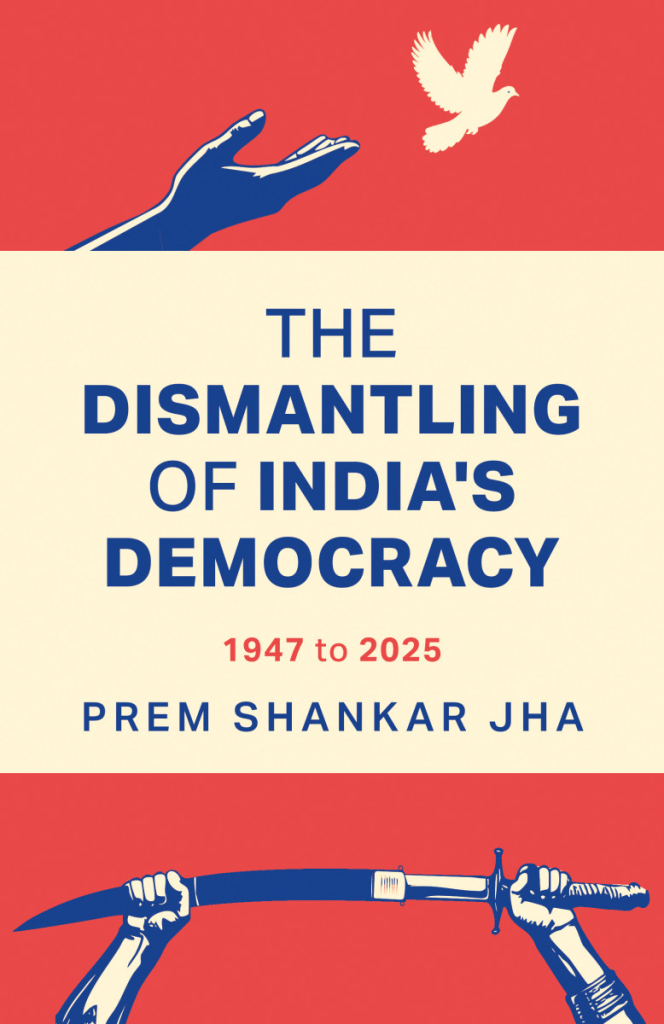
The history of this transformation has been written in painstaking detail by scores of academics, journalists and defenders of civil rights and democracy, several of whom have been languishing in prison without bail, but also without having been charged with any specific crime, for years. How Modi has completed the journey to fascism is described in broad brush strokes below:
***
Modi took the first step towards dismantling the pluralist, ethnically diverse democracy that his predecessor, Atal Bihari Vajpayee, had taken so much pride in, within weeks of coming to power. His first step in this direction was seemingly innocuous: this was to instal TV cameras at the entrance to every ministry, and withdraw the PIB (Press Information Bureau) card which allowed special correspondents and other senior journalists to visit ministries and talk to civil servants without having to reveal their own, or their hosts’, identity.
The PIB card had been created deliberately by India’s first prime minister, Pandit Jawaharlal Nehru, to encourage public debate within an infant democracy by allowing senior journalists to explore different views on impending policy decisions within the government, at a time when there was virtually no opposition to the Congress in parliament. The Modi government destroyed this freedom barely a fortnight after it came to power. A further amendment during his second term, that required the officer to also come to the reception desk and sign his or her visitor in, ended all communication between government and the public except what Modi wanted the latter to hear.
Modi’s second step towards the centralisation of power was to create a system of monthly meetings between his departmental ministers and senior officers, and nominees of the BJP, in which the party would ‘oversee’ the functioning of the ministry. This transferred much of the decision-making power of government from the ministries to the party.
Modi’s next target was the audio-visual media, which he tamed by using every instrument at his command, from the denial of advertisements to selected print and TV channels, to the framing of never-proved charges of tax evasion and money laundering against their promoters, under which it ‘attached’ (seized) their passports, and all their property till as long as the case lasted. Prannoy and Radhika Roy, the founders of NDTV, India’s first commercial TV channel, were his first targets. Despite this, NDTV retained its independence till November 2022, but succumbed because by then all advertisers had deserted it, presumably under government pressure. Faced with imminent bankruptcy and the loss of the hundreds of jobs of its technical staff, the Roys resigned from the board of the company in November 2022, and allowed NDTV to be purchased by the Adani Group, Modi’s principal financial supporters ever since his days in Gujarat. Since then, NDTV too has become a mouthpiece of Modi’s budding fascist regime.
Modi’s third target was the judiciary, which he corrupted through the offer of lucrative post-retirement appointments to High Court and Supreme Court judges. These ranged from the unprecedented appointment of a former chief justice of the Supreme Court of India, P. Sathasivam, to the governorship of Kerala, which we discussed in Chapter 12, to the appointment of former Supreme Court judge A.M. Khanwilkar to the post of India’s Lokpal, its chief vigilance officer. Other judges of the Supreme Court whom Modi similarly rewarded with post-retirement elevations and appointments are Chief Justices of the Supreme Court Ranjan Gogoi and Sharad Bobde, and Justice Arun Mishra.
Modi also made three other, more insidious and—over the long run—even more destructive moves, one deliberate and two defined by sustained avoidance. But all were expressly designed to undermine India’s infinitely varied ethno-national, federal democracy. The first was that in all his years in power, Modi never held a single press conference. The second was that in those years, Modi also never held a meeting of the National Development Council, a council of state chief ministers that had become the main forum for coordinating central and state policies after the Congress lost its dominant party status in 1989. During Modi’s decade, communication between the people and their government, and between the central and state governments on policy issues became strictly one-way.
But his most insidious assault on India’s federal structure was his replacement of the Planning Commission with the NITI (National Institution for Transforming India) Aayog. On the face of it, nothing changed: NITI Aayog continued to work from the same building as the Planning Commission; none of its staff were dismissed and no new staff was added. The change of name therefore looked like no more than another, petty, manifestation of the BJP’s obsession with ‘Hinduizing’ India….
https://thewire.in/books/narendra-modis-step-by-step-journey-towards-creating-fascism-in-india
+++++++++++++++++++++++++++++++++++++++
Apoorva Mandhani: Judge Loya’s Confidants Died Mysterious Deaths
Tell me why; and how to read a sentence
The Bihar Electoral Roll Investigation
Gujarat court acquits former IPS officer Sanjiv Bhatt in custodial torture case
Rahul Pandita: What I learned from G. N. Saibaba
Constitutional principles go for a toss in the criminal law of search and seizure
Father Stan Swamy To Posthumously Receive Human Rights Honorary Award At Geneva Today
Patricia Mukhim: Nagaland’s people deserve neither AFSPA nor gun culture
Naxalites should lay down their arms and challenge the ruling class to abide by the Constitution
A Hard Rain Falling: on the death of T. P. Chandrasekharan (EPW, June 2012)
Permanent Spring: Indian Maoism and the Philosophy of Insurrection
 After the truth-shower