Since 2014, this has been the RSS–BJP’s consistent strategy: criminalize dissent, discredit activists, and rewrite constitutional morality. They know that a large-scale civil war is impossible in a subcontinent as vast and diverse as India. What they fear are small, localized movements, like Ladakh’s, that cannot be militarily conquered, but only silenced with force. The assault extends to the judiciary itself. As the era of honest and courageous Supreme Court judges like Justice B. Nagaratnam is drawing to a close, the RSS appears intent on remoulding the Supreme Court in its own ideological image. The rise of Justice Vipul Manubhai Pancholi, elevated over seniors to Chief Justice of Patna and then to the apex court, marks this pattern. As legal thinker Mohan Gopal in his interview with veteran journalist Karan Thapar, warned in 2023, the Supreme Court is becoming “Hindutva in spirit.”
In the high desert of Ladakh, where the mountains meet the sky, a quiet war is being waged; not with guns, but with laws, bulldozers, and ideologies. Once a symbol of India’s ecological harmony and cultural pluralism, Ladakh has become a testing ground for the RSS’s vision of a homogenous nation ruled from Delhi and driven by corporate greed. As promises of autonomy turn into instruments of control, and ancient ties between people and land are severed, the unmaking of Ladakh reveals something larger, the unmaking of India’s plural soul, K. Aravindakshan writes.
The centenary celebrations of the RSS may well have been inaugurated by the Prime Minister himself when, from the Red Fort on Independence Day 2025, he described the RSS as his parent organization. This symbolic declaration, more than any speech, marked how deeply the Sangh’s ideology now defines India’s political and cultural life.
Ladakh, today a Union Territory directly ruled from Delhi, is a striking example of this ideological takeover. When the Modi government abrogated Article 370 in 2019, it promised Ladakh statehood and administrative autonomy. Six years later, neither promise has been fulfilled.
Recruitment through the erstwhile Jammu and Kashmir State Board has vanished. Ladakhi youth are now hired only on exploitative contracts, without security or benefits, often treated as bonded labourers by middlemen. The Union Territory administration employs virtually no locals in its secretariat, and no Public Service Commission or local cadre exists. Even Class IV and district-level appointments once made through the Ladakh Autonomous Hill Development Council are now frozen.
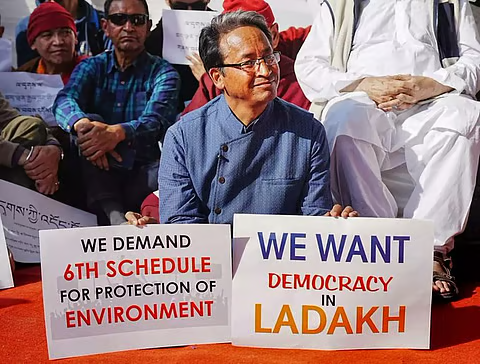
A file photo of protests in Leh, Ladakh led by Sonuam Wangchuk in support of Sixth Schedule status for Ladakh. Photo/Sonuam Wangchuk X
This new order has bred corruption: even school teachers are appointed through contractors who skim their wages. Land rights have been eroded as well. Laws once dating back to Maharaja Hari Singh, which allowed cultivators to lease and later own fallow land (Ailan No. 38), have been nullified. Locals are now denied permission to build homes or guesthouses, while powerful hotel chains from outside erect massive resorts near wildlife sanctuaries.
The irony is cruel. The government claims development, yet Ladakh has no elected government, no legislature, and no representation except one member of Parliament. The Lieutenant Governor and Delhi-appointed bureaucrats rule as colonial administrators. Ladakhis had not asked merely for UT status, but for UT with legislative powers and financial autonomy.
Before 2019, many Ladakhis had criticized Article 370, believing it blocked their progress. Now they realize it protected them, especially from land alienation. Once, even residents of Jammu and Kashmir could not buy land there. Today, outsiders and corporations are rapidly acquiring it. The new roads that the government boasts of building serve mostly the army, not the people. Why, then, does the BJP government resist Ladakh’s demand for employment, land rights, and self-governance? These may seem administrative concerns, yet beneath them runs a living connection, biological, spiritual, civilizational, that binds the people to their land.
The Sixth Schedule of the Constitution once allowed indigenous communities to govern themselves through traditional councils and customary laws. Even the old Kashmir administration respected this autonomy. Village heads, custodians of ritual and order, were guided by ancestral wisdom and modestly compensated. Today, they can be dismissed at will by Delhi’s bureaucracy. A centuries-old organic system of governance has been uprooted in the name of “national integration.”
Ladakh, perched between ecological fragility and geopolitical tension, embodies both the Himalaya’s beauty and its vulnerability. Yet India’s self-satisfied middle class, especially the complacent Malayali, remains blind to this truth.
For centuries, Ladakh and other indigenous societies nurtured ways of living that respected both earth and spirit. Colonial modernity, however, built upon the arrogance of domination, has turned land and culture into instruments of profit. The world now pays the price: heatwaves, droughts, floods, displacement, and extinction—signs of a planet in distress.
Diversity, dialogue, and democracy are the lifelines of this earth. The RSS is methodically poisoning all three. Its project is to replace plurality with a suffocating uniformity of religion, language, and culture, mirroring its attempt to subdue India’s natural diversity. If German Nazism endured only a decade, RSS chief Mohan Bhagwat boasts that transforming the Indian subcontinent needs another thirty years to complete the mission, that means destruction of the Indian subcontinet would not end in hundred years.
This ideological intent is not lost on Ladakh’s leaders. In an interview with The Indian Express and The Wire (29 September 2025), Tsering Dorje Lakruk, Apex Co-Chairman of the Ladakh Buddhist Association, declared: “That is the ideology of the BJP—it stands for homogeneity. They dislike empowering local communities. The Sixth Schedule empowers the local people.”
The spectacle of Swayamsevaks marching across India with swords and sticks is not a celebration of discipline; it is the choreography of fear. Would it not be cruel if an entire nation were reduced to identical ranks of such marchers?
Since 2014, the RSS–BJP alliance has weaponized every arm of the state to suppress dissent whether in Manipur, Kashmir, Assam, Delhi, Chhattisgarh, or among protesting farmers. Their methods echo lessons drawn from Mussolini’s Italy and Hitler’s Germany: the manipulation of law, propaganda, and violence to crush democratic resistance.
Amid this, new non-violent movements have emerged. Among them, Sonam Wangchuk stands out—a Gandhian activist whose satyagrahas have inspired youth across Ladakh. Since 2019, he has demanded statehood and inclusion under the Sixth Schedule. Though an agreement seemed near in May 2025, it never came. His peaceful protests turned tragic when violence erupted on 24 September 2025, claiming lives, including that of a former Kargil soldier. Wangchuk, like Gandhi after Chauri Chaura, immediately halted the movement. Yet, in a grim echo of colonial injustice, he was blamed and jailed in Jodhpur.
Since 2014, this has been the RSS–BJP’s consistent strategy: criminalize dissent, discredit activists, and rewrite constitutional morality. They know that a large-scale civil war is impossible in a subcontinent as vast and diverse as India. What they fear are small, localized movements, like Ladakh’s, that cannot be militarily conquered, but only silenced with force.
The assault extends to the judiciary itself. As the era of honest and courageous Supreme Court judges like Justice B. Nagaratnam is drawing to a close, the RSS appears intent on remoulding the Supreme Court in its own ideological image. The rise of Justice Vipul Manubhai Pancholi, elevated over seniors to Chief Justice of Patna and then to the apex court, marks this pattern. As legal thinker Mohan Gopal in his interview with veteran journalist Karan Thapar, warned in 2023, the Supreme Court is becoming “Hindutva in spirit.” The Sangh need not amend the Constitution; it is already being silently rewritten.
Ladakh’s struggle, therefore, is not a regional grievance but a mirror of India’s democratic crisis. It speaks of a deeper wound—the unmaking of a civilization rooted in diversity and dialogue.
Peter Matthiessen, in The Snow Leopard, wrote of the animal’s spectral solitude: “Of all the great cats, the snow leopard is the most mysterious and the least known; it is almost always seen alone… it may be a ghost, unworldly, solitary, like the true cat.”
Like the snow leopard, Ladakh’s culture lives in a realm of silence and resilience—spiritual, ecological, and deeply human. It belongs to a moral imagination that the bulldozing violence of the RSS can neither see nor comprehend.
For what does the RSS know of communion, except the rigidity of command? What does it know of the sacred, except its weaponised imitation? It knows only the fangs of hatred and the cold machinery of control. And yet, within the vast stillness of the Himalayas, the spirit of Ladakh endures—its people, its mountains, its snow leopards—bearing silent witness to India’s fading plural soul.
Featured Image: Ladakh protests against the Centre’s undue control of the region, demanding constitutional safeguards under the Sixth Schedule and statehood for Ladakh. Photo credit -The Wire
The article was originally published in Malayalam on Keraleeyam Web
K. Aravindakshan is a prominent contemporary writer from Kerala, known for works including the novel Gopa, which won the 2024 Odakkuzhal Award. He is recognized for his diverse literary contributions in Malayalam, with works spanning novels, short stories, and essays.
View All Articles by K Aravindakshan
https://panthi.in/the-unmaking-of-ladakh-rss-corporate-power-and-the-war-on-indias-plural-soul/
*****************************************************************
Art of extracting money from loss-making firms, and more electoral bond stories
Day 18 of Climate fast / Sonam Wangchuk on YouTube / Assam in solidarity with Ladakh
GSI’s Handbook on Northeast India Masks Extraction Behind Technicalities
A LEGACY THAT IS BEST FORGOTTEN
Misusing a judicial observation to unearth temples under mosques will lead to disaster
Four years and counting, Umar Khalid languishes in jail without bail or trial
Gauri Lankesh, Dr Umar Khalid… For the state, Umar Khalid & others are worse than heinous criminals
Book Review: ‘Who Killed Justice Loya’ Delves Into The Many Unanswered Questions
Apoorva Mandhani: Judge Loya’s Confidants Died Mysterious Deaths
Constitutional principles go for a toss in the criminal law of search and seizure
Book Review: ‘Who Killed Justice Loya’ Delves into Many Unanswered Questions
Tell me why; and how to read a sentence
Gujarat court acquits former IPS officer Sanjiv Bhatt in custodial torture case
Rahul Pandita: What I learned from G. N. Saibaba
The idea of Ram and the idea of India
 After the truth-shower