Beneath English trees I meditated on that lost maze: I imagined it inviolate and perfect at the secret crest of a mountain; I imagined it erased by rice fields or beneath the water; I imagined it infinite, no longer composed of octagonal kiosks and returning paths, but of rivers and provinces and kingdoms . . . I thought of a labyrinth of labyrinths, of one sinuous spreading labyrinth that would encompass the past and the future and in some way involve the stars. Absorbed in these illusory images, I forgot my destiny of one pursued. I felt myself to be, for an unknown period of time, an abstract perceiver of the world. The vague, living countryside, the moon, the remains of the day worked on me, as well as the slope of the road which eliminated any possibility of weariness. The afternoon was intimate, infinite. The road descended and forked among the now confused meadows.
“Time forks perpetually toward innumerable futures. In one of them I am your enemy.”
Jorge Luis Borges’ The Garden of Forking Paths (1941). Republished in Labyrinths, (1962)
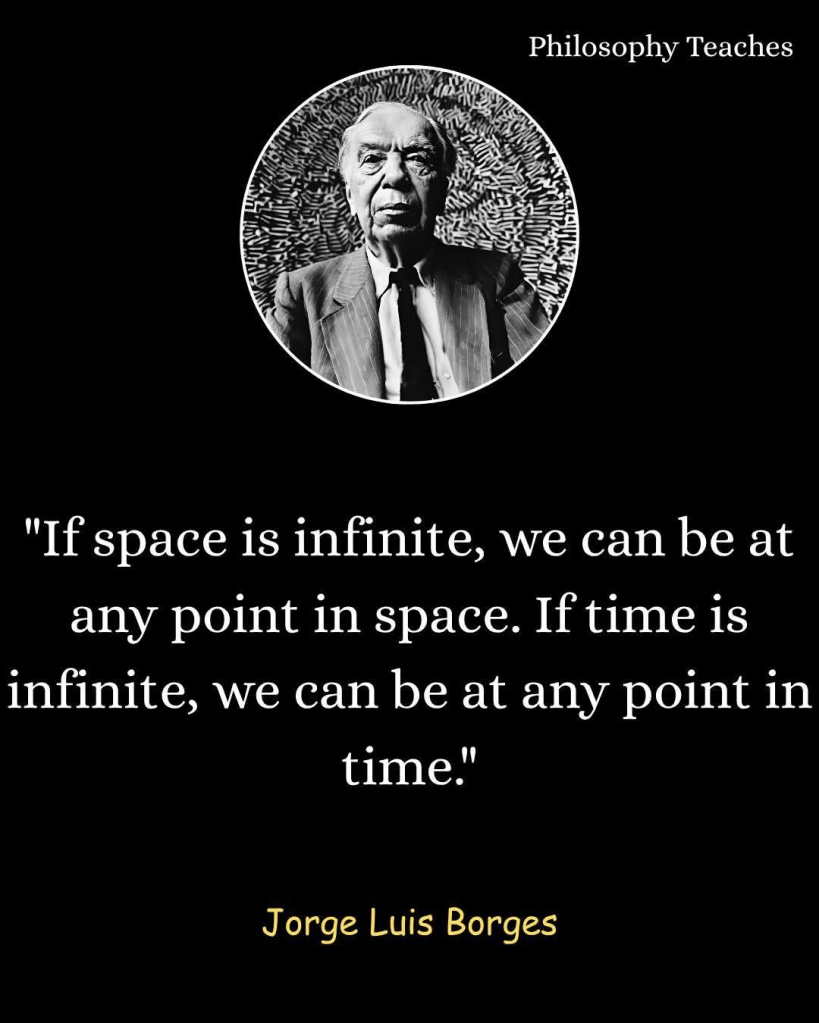
Jorge Luis Borges “If space is infinite, we can be at any point in space. If time is infinite, we can be at any point in time.” Here, Borges blends science and philosophy. If infinity exists, then our presence and potential are boundless. It’s a meditation on the limitless nature of existence.

https://www.facebook.com/groups/202563272468271/posts/589423200448941
++++++++++++
Harry V. Jaffa: Macbeth and the Moral Universe
Happiness. By Jorge Luis Borges
The Just. By Jorge Luis Borges
Jorge Luis Borges’ ‘The Secret Miracle’ (1943)
Jorge Luis Borges – Deutsches Requiem: a short story (1946)
Quantum poetics: Borges and Heisenberg on language and reality
Everything and Nothing by Jorge Luis Borges / “Borges and I”
Three Versions of Judas: Jorge Luis Borges
J. L. Borges: A New Refutation of Time
The Tremendous World I Have Inside My Head: Franz Kafka: A Biographical Essay
Before the Law. A parable by Franz Kafka
 After the truth-shower