
By Maria Popova
“Day by day I am approaching the goal which I apprehend but cannot describe,” Ludwig van Beethoven (December 16, 1770–March 26, 1827) wrote to his boyhood friend, rallying his own resilience as he began losing his hearing. A year later, shortly after completing his Second Symphony, he sent his brothers a stunning letter about the joy of suffering overcome, in which he resolved:
Ah! how could I possibly quit the world before bringing forth all that I felt it was my vocation to produce?
That year, he began — though he did not yet know it, as we never do — the long gestation of what would become not only his greatest creative and spiritual triumph, not only a turning point in the history of music that revolutionized the symphony and planted the seed of the pop song, but an eternal masterwork of the supreme human art: making meaning out of chaos, beauty out of sorrow.
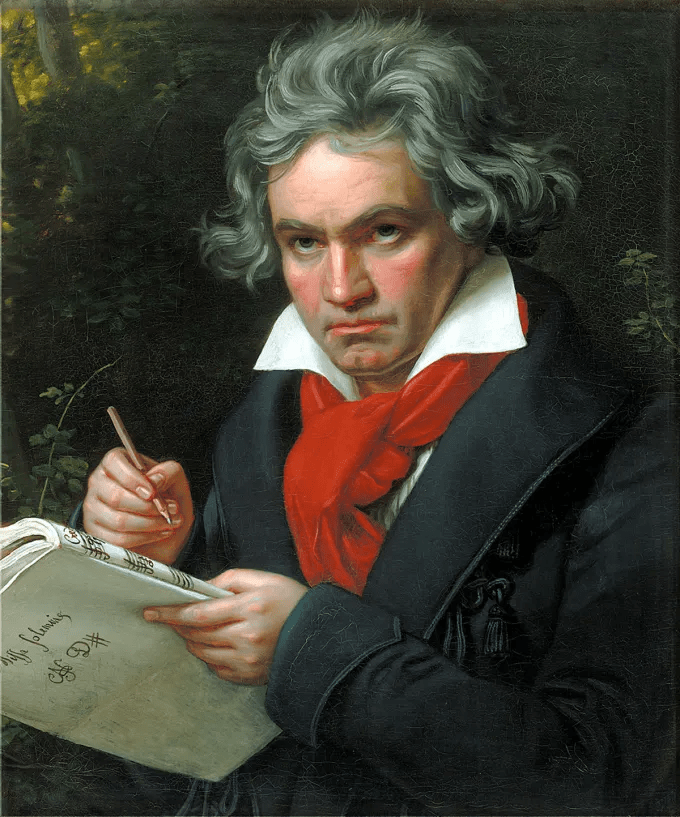
Beethoven by Joseph Karl Stieler
Across the epochs, “Ode to Joy” rises vast and eternal, transcending all of spacetime and at the same time compacting it into something so intimate, so immediate, that nothing seems to exist outside this singularity of all-pervading possibility. Inside its total drama, a total tranquility; inside its revolt, an oasis of refuge. The story of its making is as vitalizing as the masterpiece itself — or, rather, its story is the very reason for its vitality.
As a teenager, while auditing Kant’s lectures at the University of Bonn, Beethoven had fallen under the spell of transcendental idealism and the ideas of the Enlightenment — ideas permeating the poetry of Friedrich Schiller. A volume of it became the young Beethoven’s most cherished book and so began the dream of setting it to music. (There is singular magic in a timeless poem set to music.)
One particular poem especially entranced him: Written when Beethoven was fifteen and the electric spirit of revolution saturated Europe’s atmosphere, Schiller’s “Ode to Joy” was at heart an ode to freedom — a blazing manifesto for the Enlightenment ethos that if freedom, justice, and human happiness are placed at the center of life and made its primary devotion, politically and personally, then peace and kindness would envelop humankind as an inevitable consequence. A “kiss for the whole world,” Schiller had written, and the teenage Beethoven longed to be lips of the possible.
This Elysian dream ended not even a decade later as the Reign of Terror dropped the blade of the guillotine upon Marie Antoinette, then upon ten thousand other heads and the dreams they carried. Schiller died considering his “Ode to Joy” a failure — an idealist’s fantasy unmoored from reality, a work of art that might have been of service perhaps for him, perhaps for a handful of others, “but not for the world.”
The young Beethoven was among those few it touched, and this was enough, more than enough — he took Schiller’s bright beam of possibility and magnified it through the lens of his own genius to illuminate all of humanity for all of time. Epochs later, in the savage century of the World Wars and the Holocaust, Rebecca West — another uncommon visionary, who understood that “art is not a plaything, but a necessity” — would contemplate how those rare few help the rest of humanity endure, observing that “if during the next million generations there is but one human being born in every generation who will not cease to inquire into the nature of his fate, even while it strips and bludgeons him, some day we shall read the riddle of our universe.”
While Schiller’s poem was ripening in Beethoven’s imagination, the decade-long Napoleonic Wars stripped and bludgeoned Europe. When Napoleon’s armies invaded and occupied Vienna — where Beethoven had moved at twenty-one to study with his great musical hero, Haydn — most of the wealthy fled to the country. He took refuge with his brother, sister-in-law, and young nephew in the city. Thirty-nine and almost entirely deaf, Beethoven found himself “suffering misery in a most concentrated form” — misery that “affected both body and soul” so profoundly that he produced “very little coherent work.” From inside the vortex of uncertainty and suffering, he wrote:
As a teenager, while auditing Kant’s lectures at the University of Bonn, Beethoven had fallen under the spell of transcendental idealism and the ideas of the Enlightenment — ideas permeating the poetry of Friedrich Schiller. A volume of it became the young Beethoven’s most cherished book and so began the dream of setting it to music. (There is singular magic in a timeless poem set to music.)
One particular poem especially entranced him: Written when Beethoven was fifteen and the electric spirit of revolution saturated Europe’s atmosphere, Schiller’s “Ode to Joy” was at heart an ode to freedom — a blazing manifesto for the Enlightenment ethos that if freedom, justice, and human happiness are placed at the center of life and made its primary devotion, politically and personally, then peace and kindness would envelop humankind as an inevitable consequence. A “kiss for the whole world,” Schiller had written, and the teenage Beethoven longed to be lips of the possible.
This Elysian dream ended not even a decade later as the Reign of Terror dropped the blade of the guillotine upon Marie Antoinette, then upon ten thousand other heads and the dreams they carried. Schiller died considering his “Ode to Joy” a failure — an idealist’s fantasy unmoored from reality, a work of art that might have been of service perhaps for him, perhaps for a handful of others, “but not for the world.”
The young Beethoven was among those few it touched, and this was enough, more than enough — he took Schiller’s bright beam of possibility and magnified it through the lens of his own genius to illuminate all of humanity for all of time. Epochs later, in the savage century of the World Wars and the Holocaust, Rebecca West — another uncommon visionary, who understood that “art is not a plaything, but a necessity” — would contemplate how those rare few help the rest of humanity endure, observing that “if during the next million generations there is but one human being born in every generation who will not cease to inquire into the nature of his fate, even while it strips and bludgeons him, some day we shall read the riddle of our universe.”
While Schiller’s poem was ripening in Beethoven’s imagination, the decade-long Napoleonic Wars stripped and bludgeoned Europe. When Napoleon’s armies invaded and occupied Vienna — where Beethoven had moved at twenty-one to study with his great musical hero, Haydn — most of the wealthy fled to the country. He took refuge with his brother, sister-in-law, and young nephew in the city. Thirty-nine and almost entirely deaf, Beethoven found himself “suffering misery in a most concentrated form” — misery that “affected both body and soul” so profoundly that he produced “very little coherent work.” From inside the vortex of uncertainty and suffering, he wrote:
The existence I had built up only a short time ago rests on shaky foundations. What a destructive, disorderly life I see and hear around me: nothing but drums, cannons, and human misery in every form.
That spring, Haydn’s death only deepened his despair at life. The next six years were an unremitting heartache. His love went unreturned. He grew estranged from one of his brothers, who married a woman Beethoven disliked. His other brother died. He entered an endless legal combat over guardianship of his young nephew. He spent a year bedridden with a mysterious illness he called “an inflammatory fever,” riddled with skull-splitting headaches. His hearing almost completely deteriorated. He grew repulsed by the trendy mysticism of new musical developments, which made no room for the raw human emotion that was to him both the truest material and truest product of art.
Somehow, he kept composing, the act itself becoming the fulcrum by which Beethoven lifted himself out of the black hole to perch on the event horizon of a new period of great creative fertility. While Blake — his twin in the tragic genius of outsiderdom — was painting the music of the heavens, Beethoven was grounding a possible heaven onto a disillusioned earth with music.And then he ended up in jail.
One autumn day in 1822, the fifty-two-year-old composer put on his moth-eaten coat and set out for what he intended as a short morning walk in the city, his mind a tempest of ideas. Walking had always been his primary laboratory for creative problem-solving, so the morning stroll unspooled into a long half-conscious walk along the Danube. In a classic manifestation of the self-forgetting that marks the intense creative state now known as “flow,” Beethoven lost track of time, of distance, of the demands of his own body….
https://www.themarginalian.org/2026/04/11/beethoven-ode-to-joy/
+++++++++++++++++++++++++++++++++++++++++++++
2006 performance, conducted by Daniel Barenboim. The chorale begins at about the 56th minute:
Beethoven’s 9th, is the final complete symphony by Ludwig van Beethoven, composed between 1822 and 1824. It was first performed in Vienna on 7 May 1824. One of the best-known works in common practice music, it is regarded by many critics and musicologists as one of Beethoven’s greatest works and one of the supreme achievements in the history of western music. In the 2010s, it stands as one of the most performed symphonies in the world. The symphony was the first example of a major composer using voices in a symphony (thus making it a choral symphony).
The words are sung during the final (4th) movement of the symphony by four vocal soloists and a chorus. They were taken from the “Ode to Joy“, a poem written by Friedrich Schiller in 1785 and revised in 1803, with text additions made by Beethoven. (He was nearly totally deaf when he composed this)
https://en.wikipedia.org/wiki/Ode_to_Joy : Over the years, Beethoven’s “Ode to Joy” has remained a protest anthem and a celebration of music. From demonstrators in Chile singing during demonstration against the Pinochet dictatorship, Chinese student broadcast at Tiananmen Square, the concert conducted by Leonard Bernstein after the fall of the Berlin Wall and Daiku (Number Nine) concerts in Japan every December and one after the 2011 tsunami. It has recently inspired impromptu performances at public spaces by musicians in many countries worldwide, including Choir Without Borders’s 2009 performance at a railway station in Leipzig, to mark the 20th and 25th anniversary of the Fall of the Berlin Wall..
10,000 Japanese singing Beethoven’s Ode to Joy in perfect German
Heavenly One, thy sanctuary!
Your magic binds again
What custom strictly divided;*
All people become brothers,*
Where your gentle wing abides.Be embraced, Millions!
This kiss to all the world!
Brothers, above the starry canopy
There must dwell a loving Father.
Are you collapsing, millions?
Do you sense the creator, world?
Seek him above the starry canopy!
Above stars must He dwell.

