NB: A gripping and very informative account of the intertwined crises that led to war and global confrontation in 1970-1971. I was a small witness to it from the Indian side of the border; and was caught up in the political cyclone which became the central theme for my novel Revolution Highway. Indeed, it was a personal turning point which led me away from Naxalite politics. Vortex is a fascinating description of the cascading events in East Pakistan, which was to become Bangladesh. Over and beyond our ethnic and political identities, this is a book worth reading for everyone interested in the human cost of that catastrophe. DS
In November 1970, a storm set a collision course with the most densely populated coastline on Earth. Over the course of just a few hours, the Great Bhola Cyclone would kill 500,000 people and begin a chain reaction of turmoil, genocide, and war. The Vortex is the dramatic story of how that storm sparked a country to revolution—and how those events brought the cold war powers to the brink of nuclear war.
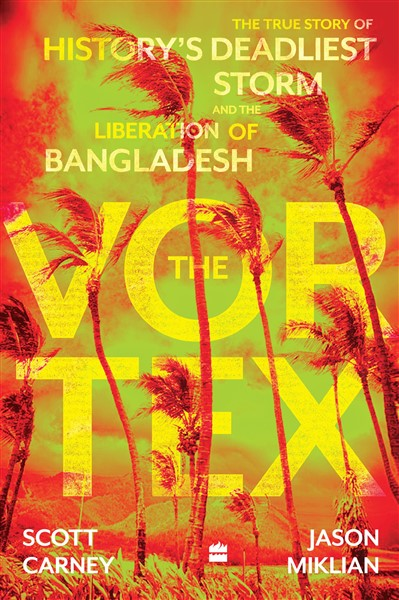
Bhola made landfall during a fragile time, when Pakistan was on the brink of a historic election. The fallout ignited a conflagration of political intrigue, corruption, violence, idealism, and bravery that played out in the lives of tens of millions of Bangladeshis. Authors Scott Carney and Jason Miklian take us deep into the story of the cyclone and its aftermath, told through the eyes of the men and women who lived through it, including the infamous president of Pakistan, General Yahya Khan, and his close friend Richard Nixon; American expats Jon and Candy Rhode; soccer star-turned-soldier Hafiz Uddin Ahmad; and a young Bengali revolutionary, Mohammed Hai.
Thrillingly paced and written with incredible detail, The Vortex is not just a story about the painful birth of a new nation but also a universal tale of resilience and liberation in the face of climate emergency that affects every single person on the planet.
‘The Vortex’ details a cyclone that divided Pakistan and almost led to a nuclear war
To understand what a storm can do to an unstable political situation, Carney and a co-author reached into the past. For a book called “The Vortex,” they interviewed survivors of a calamity in 1970. A cyclone, a hurricane, came ashore out of the Bay of Bengal, and a British TV crew filmed the wreckage afterward…
Amid the enduring climate crisis and shifting geopolitics across South Asia, Scott Carney and Jason Miklian’s The Vortex: A True Story of History’s Deadliest Storm, an Unspeakable War, and Liberation comes at a critical moment. On the brink of a historical election in Pakistan, the November 1970 Great Bhola Cyclone landed to inflict significant damages and take the lives of 500,000 individuals, yet this was only the beginning. Soon, an amalgamation of factors—corruption, violence, and idealism, among others—sparked a chain reaction of turmoil, genocide, and war that influenced millions of Bangladeshis. What lessons can we learn from the Great Bhola Cyclone? How do global warming and geopolitical turmoil influence each other?
++++++++++++++++
Permanent Spring: Indian Maoism and the Philosophy of Insurrection
Glory Days, or remembering how Indians love(d) China
Closing the Circle (Frontier, August 2012)
Annihilation – 50 years of Naxalbari
In Naxalbari, forty-eight years later
Yesterday once more – 50 years after Naxalbari
An Open Letter to the world on the Bangladesh crisis of 1971
Achintya Barua remembers Ranajit Guha
Ajay Singh: Fiji – A Love Story
Memoir: Prahlad Kakar and Dilip Simeon: A Friendship in the Shadow of the Naxals
Bangladesh: Students Stand Guard Outside Temples and Churches in Wake of Attacks
Silences within silences: excavating the hidden history of Bengalis interned in Pakistan after 1971
State terror in Bangladesh / Informal reports on the ground situation
Bangladesh: Students Have Often Led Protests That Have Transformed the Country
105 people killed; national curfew imposed in Bangladesh after student protesters storm prison
An Open Letter to the world on the Bangladesh crisis of 1971
Deb Mukharji: For Indian Diplomats in Pakistan, the Run up To the 1971 War Was a Very Tense Time

