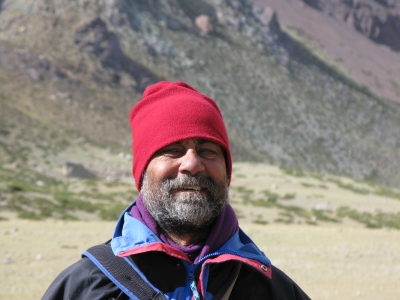
Surviving torture and brutality inside Israel’s prisons
By Nasser Abu Srour
1.
I woke to the breaking news on 7 October 2023. The television in our cell showed footage of the Hamas attacks and the fighting around Gaza. We watched for an hour before the cable was cut and the screen turned blue. Those were the first and last images I saw of the war.
The next thing we knew, guards were pouring into our block with firearms, something they had never done before – guns were kept out of prison buildings. They aggressively bound our hands and feet and then marched us to the yard. When we returned to our cells, they were so empty that our voices echoed. All our belongings were gone: clothes and bedding, cooking appliances and cleaning supplies, mirrors and shaving razors. Our toothbrushes had been replaced with smaller ones, about five centimetres long. Window coverings had been removed, exposing us to the cold air and, in time, the rain. We were each left with two shirts, a single blanket and a set of plastic cutlery. Even wheelchairs were confiscated; disabled prisoners would thereafter have to be carried everywhere.
“We are in a state of war.” The announcement was made to us by the Israeli prison authorities on 7 October. At some point during that first week, our block officer went from cell to cell and read out the wartime regulations.
There were new proscriptions: prisoners were forbidden from speaking loudly inside their cells; from speaking with inmates in neighbouring cells; from praying audibly or collectively; from stepping within one-and-a-half metres of their cell door. Our domestic privileges were drastically curtailed: yard time was reduced from six hours to 10 minutes per day; hot water was restricted to 45 minutes per day; family visits were indefinitely suspended; the medical clinic and the library were out of bounds. Perhaps most significantly, the electricity supply was scaled back to six hours per day – on a rotating schedule. Some days it was available from noon to 6 PM; on others, from 6 PM to midnight; eventually they settled on 2 PM to 8 PM.
For 33 years I had endured a grinding, if unchanging routine in various Israeli jails. Every day felt like a repeat of the last, no matter where I found myself. Now, everything utterly changed. It was no longer possible to predict what might happen. Every hour brought a thousand possibilities, all bad.
The new regime might have been imposed by Itamar Ben-Gvir, the national security minister. But the prison authorities also acted on their own initiative. Their transformation was more shocking – and perhaps more consequential.
Before the war, guards and prisoners had coexisted – if not amicably, then at least nonviolently. This equilibrium was the result of decades of organising. In the face of repeated protests and hunger strikes, the Israel Prison Service had granted concessions – visits from relatives, sports in the morning, long-distance education, a canteen – if only to make their own jobs easier. You could describe our arrangement as another “calm in exchange for calm”. I myself was friendly with some guards.
All this history was forgotten overnight. Any sense of familiarity between us disappeared. Our jailers stopped speaking to us, save for barking orders. Human expressions disappeared from their faces, which turned cold and stonelike. It was as if they put on new faces. When I asked one guard, a Druze man, why his colleagues were behaving strangely, he replied: “Do as we say! From now, we are not going to apologise! No more mercy!”
It used to be that guards limited themselves to monitoring prisoners and ferrying information back to the block officer. Now they took matters into their own hands. One evening, to punish us for praying audibly, a guard simply cut the electricity to our cell. As for the block officer, we were forbidden to look at him, and had to lower our heads during conversations. The prison director had turned into a God, everywhere and nowhere.
If the indifference was distressing, the violence was terrifying. Three months into the war, the identification “guard” was unstitched from the front of uniforms and replaced with “warrior” – in large letters. This new persona had an immediate effect; the warriors behaved as if assigned to lethal missions on the front line.
They attacked prisoners for the slightest infraction, real or imagined. They targeted us everywhere – in the head, legs, chest, face – and they assaulted us with everything: canes, truncheons, tear gas, electric shocks, rubber bullets and live ammunition. Sometimes they rushed into cells, beat prisoners, bound them in chains – and then dragged them into the prison yard for a repeat beating. Often, they were accompanied by an enormous dog that would attack chained prisoners and leave bleeding wounds on their bodies (as happened to me multiple times).
A guard once opened the grille of my cell and demanded that I hand over my hidden radio. I told him the truth: I did not have one. When he repeated the order, I repeated my answer, perhaps at a louder volume. He again summoned me to the grille opening – and unleashed pepper spray in my face. There was no rationale linking error and punishment. Even the cleverest among us were unable to interpret these new practices. Any appeal for explanation resulted only in an extra measure of violence.
In breaking our bodies, the prison authorities also broke our spirits. Through the new regime of continuous violence and arbitrary punishment, they instilled in us an overwhelming and stupefying fear. Entirely focused on our own survival, we became isolated from each other, a tattered group of individuals who were only biologically alive. They also cut us off entirely from the outside world: no television or newspapers. It was as though we were living on a remote island. Time did not move forward, but accumulated, piled up, until it was transformed into a heavy mass that crushed our bodies under its weight.
Though we fitfully followed the news on a few hidden radios, we could not grasp the magnitude and horror of the genocide. We only began to understand one morning, six months into the war, when prison officers in each block hung up a large banner, perhaps 18 feet long, with a picture of the Gaza Strip, burned and demolished. The words “The New Gaza” were printed above the image.
2.
Ofer Prison sits on the site of a former military camp, around half an hour’s drive from Ramallah. Its 15 blocks held some 700 prisoners when the war began. God only knows what that number is now. Mass arrests began more-or-less immediately, and never let up. There were once seven of us in a cell; it was eventually 14. We took turns sleeping on the floor.
One of the new detainees was my cousin, Mohammad Raafat Abu Srour. When taking part in a civil demonstration in Bethlehem against the war, he was shot in the knee by an IDF soldier. That evening, his friends took him to the hospital, where he underwent surgery. After being discharged three days later, he returned home. The police arrested him that very night and sent him to Ofer, where he ended up in my block. Even though he could not support himself on both feet, they did not provide him with crutches. For weeks, he hopped everywhere on one foot, wrapped in bandages. Helpless, I used to watch him cross the corridor in this way.
Mohammad received almost no medical attention, not even for changing his bandages. We used to hear him screaming for help. “Please do something,” he would shout. “The pain is awful, it’s unbearable.” Once, a paramedic came to his cell and told him: “Shut up. You can die. Why don’t you just die?” Other injured and ill prisoners suffered similarly. The authorities cancelled all operations that had been scheduled prior to the war, even for those who needed critical surgical intervention. They also refused medication to anyone who came down with a new illness (though luckily I kept receiving my cholesterol pills).
One prisoner fell so sick that he was unable to walk, or even get out of bed. When the guards demanded he show up for yard time, his cellmates carried him out in a blanket and laid him on the ground. An exceptionally cruel guard demanded that he walk, despite pleading from other prisoners. The man somehow got to his feet, staggered around for a minute or two, and then collapsed. Within a week, he was dead.
Even healthy prisoners soon became infirm because of the food. Before the war, we had something approximating a balanced diet. They served us three meals a day, with protein (either fish or meat), carbohydrates (rice or bread) and fruit. It wasn’t enough, but we made up for the shortage by cooking for ourselves on hotplates. Each month our families could send us up to 1,200 shekels, which we spent at a canteen that sold basic groceries, chocolates and soft drinks.
Now the canteen was closed, and our meals were scaled back to a level that barely kept us from starving. The daily menu was wretched and unchanging: small amounts of marmalade and bread for breakfast; rice and labneh for lunch and dinner. No fish, meat or fruit. To drink: tea without sugar, anathema to Arabs.
Each cell volunteered one person to divide the serving of marmalade 14 ways – an extremely stressful task. Thirteen sets of eyes were fixed on him, to ensure he did not commit an injustice towards anyone. Rice at least was provided individually, in minuscule quantities, enough maybe to fill a paper teacup. It was often filthy. I saw prisoners remove bird droppings before eating the rest.
Hunger became a part of my being. I was never not hungry. My weight eventually fell to 52 kilograms; you could have broken my bones with a punch.
As much as for my body, I feared for my sanity. Before the war, I had a full cultural life. Each prisoner was allowed to receive two books a month from the outside. In this way we had accumulated a small library; I was always reading: fiction, history, philosophy, in Arabic and English. I completed a BA in literature and an MA in political science. I had even composed an entire book in jail, recording myself on a smuggled phone. When it was published in 2022, the prison authorities were upset – but they did not punish me.
Overnight, all this was taken away. No books to read, no pen and paper with which to write. With nothing else to do, I began walking up and down the space between the beds in our cell. I performed these ‘laps’ for eight hours, sometimes 10, sometimes even 12. A version of the line from that Hollywood film ran through my mind: “Walk, Nasser, Walk!” Eventually, my cellmates saw the merit of this practice and adopted it as well. We took shifts walking.
Our block shared a few radios – prized contraband. On days when our cell had use of one, I made sure to tune in to the 3:30 PM broadcast of Radio Monte Carlo Doualiya, an Arabic-language station that broadcasts from France, which at that hour often played the angelic Lebanese singer Abeer Nehme. If I listened to her for even three or four minutes, I was able to touch the disappeared human within me. These were the only minutes of the day when I felt like a person.
Two years into the war, and 33 into my life sentence, I was abruptly released in the prisoner swap of October 2025. I should have felt elated, but instead I felt numb. In the first days of my liberation, I began to discover what had been done to Gaza. I saw the pictures, including those of dead children. I heard voices coming from under the rubble of houses, of people with no shelter in the bitter cold. The scale of destruction and killing seemed inconceivable, yet this was reality. Sitting in a luxury hotel room in Cairo, surrounded by new gadgets I did not know how to operate, I was unable to provide explanations for the state of the world around me, and for everything that had happened during the war. It surpassed the barbaric scenes inside the prisons and denied any meaning to my freedom.
How can a person be free but in exile, outside the borders of their homeland? What can liberation possibly mean amid a genocide? After what Israel did to Gaza, which is harder: death or survival? Those questions stood alongside many others. I had to recover my use of language in order to have any chance at answering them.
3.
After I was arrested in 1993, the conditions of my life did not significantly change. The refugee camp I grew up in was poor, overcrowded and violent.
At my birth in 1969, I inherited both a material and spiritual legacy from my father. The former was a tiny home in a cramped spot of geography, Camp Ayda, which was set up in 1950 between Jerusalem and Bethlehem. The latter was the story of the Nakba, when his family were expelled from their village of Bayt Nattif, and walked barefoot to the camp, where they would subsequently live. Together, these burdens shaped my consciousness and refined my character, impelling me to plunge into political activities. Like many boys in the camp, I joined the Palestinian National Liberation Movement (Fatah) in my teens. By then I was familiar with the sight of Israeli occupation soldiers patrolling our streets, as well as with their favoured actions: detaining and killing Palestinians and destroying our homes.
The refugee camps were much more exposed to the violence of the occupation than other places in the West Bank and Gaza. Israel’s colonial policies had orphaned us twice over: both from our homeland and from the ‘greenliners’ who had remained in Israeli towns and cities. We were primed to join the Intifada of Stones, which erupted in 1987. For the youth in the refugee camps, who had grown up knowing only political defeat, it was an electric moment that marked our arrival on the political stage. We threw rocks at soldiers and participated in nonviolent marches. Israel responded by shutting down universities, conducting mass arrests, demolishing more houses – and killing more Palestinians. Many of my friends were martyred during the intifada. In 1993 I was arrested and found guilty of murdering a Shin Bet agent; the officers elicited a confession from me through force.
My detention began at Khalil Prison, which was known as “the slaughterhouse” because of the torture methods practiced by intelligence officers – methods that I learned about firsthand. During nearly two months in the interrogation unit, I variously suffered vicious beatings, was hung from the wall, chained for hours in a seated position on a narrow stool, exposed to extreme cold until I lost consciousness, and threatened with rape. Thereafter, I was transferred from one prison to another, and often kept in solitary confinement.
If the jails were relatively habitable by the time of my arrest, it is only because of a long history of Palestinian prisoner activism, going back to 1967. Prison was an extremely politicised environment – perhaps even more so than the occupied territories outside. Detainees of more than 10 parties – nationalist, communist and Islamist – were present when I arrived, the vast majority from Fatah. This diversity of affiliation was mixed together in the same blocks but sorted into separate rooms. Despite their ideological disagreements, they worked together to take on the prison authorities.
Like many inmates, I considered detention a stage in the struggle. I participated in five major hunger strikes, starting in 1995, when more than 1,000 of us fasted for 18 days to protest the Oslo Accords, which did not include a meaningful settlement for prisoners. The largest strike, in 2017, lasted 41 days. I was one of the organisers in Hadarim Prison. We asked the Red Cross to reverse its decision to cut its funding of family visits from twice to once a month – in vain.
We might not have won our political demands, but we achieved a state of dignity and togetherness. Our solidarity was our greatest asset – which is why the authorities targeted it once the war began. Any display of collective action was met with an overwhelming flood of violence. If a prisoner was being beaten and his cellmates tried to intervene, they were likewise attacked. (Cellmates huddled around my slim body when the guards beat us, until the retribution became too much.) Because the merest sound or gesture could be interpreted as a protest, we soon took to remaining silent as atrocities were committed within earshot or before our eyes. Survival became our only watchword. Every prisoner had to protect himself constantly, in whatever way possible. Forced to save ourselves as individuals, we lost our collective bonds.
Worse, we turned on each other. One night, around 3 AM, I was woken by the sound of my roommate shuffling about. He retrieved the two pieces of bread I had hidden under my bed and ate them. I was powerless to act. A tall and stocky guy, he could have easily overpowered me.
4.
I was reading Blindness when 7 October happened. José Saramago’s novel is set in an overcrowded, filthy asylum during an epidemic in which everyone mysteriously loses their eyesight. He depicts how social hierarchy and the lust for power assert themselves, to a perverse degree, when people are crammed together in total isolation. I experienced that process firsthand in the months that followed. I saw how people were transformed by extreme oppression and fear, to the point where they behaved in ways that left them unrecognisable.
The wartime regimen rendered all our actions and reactions mechanical. When guards entered the block, we remained silent and motionless, acting collectively but without coordination. As soon as we heard our cell door open, we tried to find places to hide. Those lucky enough to be on beds, covered themselves with blankets; those sleeping on the floor jumped to their feet and tried to find a corner; some even tried to sneak under the beds. We ate our meals quickly in case there was a sudden raid, which might result in our food being thrown into the trash. We slept wearing all the clothes we possessed, fearing they would be confiscated in a surprise inspection.
Fights became regular. They broke out over minor disagreements: a serving of marmalade not divided properly, a shower that went on for longer than four minutes (which would prevent other prisoners from getting their turn), a loud prayer that might attract the guard’s wrath. Initially, I tried defusing altercations, because they inevitably resulted in collective punishment. As one of the older and more respected prisoners, my cellmates tended to listen to me. Until one day I tried to physically separate two men who were beating each other in a wild frenzy. I caught a stray punch to the face, and was knocked out by the force. When I came to, my slippers were torn. A disaster. Slippers were very precious in jail: without a pair, you cannot walk through the filthy toilets. I had to wait for months before securing a replacement, from a prisoner who was about to be released.
The yard was a site of frequent conflict. A yellow line was drawn in parallel with its four walls, cutting off one-third of the total area. If anyone crossed the line, everyone was punished: we were either sent back to our cells or made to lie with our noses placed firmly to the ground. If you turned your face even slightly, in an attempt to touch your cheek to the ground and relieve the pressure, a beating would follow.
So you had to navigate the yard responsibly. But there was a prisoner – we called him “troublemaker” – who refused to do so. Three times he deliberately crossed the yellow line. The first time, luckily, a guard did not see him; back in the block, we warned him not to repeat the error. The second time, however, a guard spotted him and forced us to lie on the ground for two hours. This time his cellmates gave him a stern warning: “Don’t do it! We will all be punished!” The third time, he was caught again, but before the guard could act, a group of prisoners grabbed troublemaker and began roughing him up. For this mistake, we were all tear gassed and then sent back to our cells. That night his cellmates beat him mercilessly till he bled.
You could not do the same with the dozens of mentally ill prisoners, who were simply unable to comprehend the new state of affairs. The endless beatings and punishments disturbed them so much that some cried and shouted all day – bringing further trouble for their cellmates.
*
The guards were all we saw and heard; their threatening presence was the only sign that we existed in time and space. If they departed for a few moments, we lost our bearings. It was as though we disappeared when not under their gaze, as if we evaporated when not being hit by them.
The prison authorities stripped us of our humanity, and treated us like animals – specifically, like animals in a scientific experiment. We were mere biological creatures, no longer permitted to participate in human culture, which might have strengthened our resolve. They kept us famished, violated our sleep with inspections, exposed our bodies to the cold. They controlled our emotions by ensuring that we had nothing to feel happy about. They managed our physical recovery by keeping our wounds open and bleeding. They divided night from day by confusing our circadian rhythms. They determined who lived and who died – and they killed any desire for life.
Their ambitions were totalising. They aimed to monitor and punish us all the time, in every place. Even the ostensible arenas of justice were turned into torture chambers. Before trials – which were relocated from courthouses to a room adjacent to the prison – the warriors would divide detainees into groups of 20, chain their hands and feet, cover their heads with black bags or blindfolds, and tie them together with a white firehose. The men were then marched through the prison building, under insults and abuses, beatings and blows, sometimes forced to make animal noises: the barking of dogs or the braying of donkeys. At the end of their arraignment, they were thrown into waiting rooms designed for four people, and kept there, chained and manacled, until the last man was tried.
Once a month I was taken to meet my lawyer, Nadia, who was working to appeal my life sentence. It was a roughly 150-metre journey from my cell to the room where we spoke. They would cuff my wrists and ankle so tight that by the time I got there I was inevitably bleeding. (The marks are still on my body.) All along, I suffered constant blows. Once, they forgot to stop hitting me before we entered the room. Nadia was distraught. “Why are you beating him?” she screamed.
“Forget it,” I whispered to her as soon as I sat down. “Do not say a word. You are here now, so they will not do anything. But once you leave, they will not spare me.”
5.
In April 2024 I was transferred to Ganot Prison, a larger facility in the Negev desert, where scabies had broken out. There was at least one patient in each cell. Five of my 14 cellmates were infected.
I saw the disease eat through flesh and expose bones. If I did not contract scabies, it is perhaps only because, out of deference to my age, they let me occupy a top bunk and not rotate positions. The prison authorities ignored the outbreak for over a year, allowing it to spread and mutate, until a few warriors fell prey to it.
This kind of neglect has caused the death of close to 100 Palestinian prisoners in Israel since 7 October. (That number does not include Gazans who were seized during the war and killed in temporary detention facilities, such as Sde Teiman Camp.) Dozens of prisoners, both male and female, were raped or sexually assaulted, though a vast majority of those crimes have gone unreported, because the victims were afraid of being tainted by dishonour.
These conditions still hold within Israel’s jails. I am among the first prisoners to be able to write about them. The reason for my release remains a mystery to me. In late 2025, when we began to hear from lawyers that “something was going on” – that liberty might be on the horizon – my first instinct was self-protective denial. I repeated to myself and to anyone who would listen that they would never release me. They had not done so in 2005, when some 500 prisoners were set free as part of a deal between Ariel Sharon and Mahmoud Abbas. Nor in 2011, when Hamas freed twice that number in exchange for Gilad Shalit. In their eyes, my purported crime was too serious: Israel cannot tolerate the death of a Shin Bet officer. “Stay strong”, I told myself. “Accept that you are not going anywhere.” The greater the expectation, the greater the disappointment.
I was totally unprepared when a guard showed up at my cell with the news. “Abu Srour, you are about to be released,” he said. “Get ready. You have two minutes to gather your things.” My response was dull and mechanical. In hindsight, I envy the prisoners who became elated upon learning of their freedom. As I silently gathered my few belongings, my cellmates leapt for joy, praised Allah, kissed me on the cheeks. Then the entreaties began: Nasser, can I take your slippers? Nasser, please, I need a towel. They almost came to blows over my shirts. It was always like this when a prisoner was released: another mark of how the survival instinct had transformed us.
I still could not shake off the feeling that it was all a cruel joke. My suspicion was reinforced by the final beatings, handed to us as we were marched to the prison bus, which took us to Ktzi’ot Prison and from there to the Rafah crossing. I sat by the window and pulled aside the curtain, which brought the tires screeching to a halt. A soldier threatened to shoot me if I tried that again. They only allowed us to look outside once we reached Egypt.
“My God, there’s a sky!” – this was the first sentence to pass my lips on the other side. The land, the trees, the birds, the cars, the houses – they were all so big and filled me with such wonder, as though I had never seen them before. Looking in the large mirror that the driver uses to monitor the passengers, I saw my own face for the first time in 18 months.
I had to deploy all five senses to take in the profusion of details around me. During my three decades in prison, I had abandoned my senses, which were like chains that kept me from giving new and different meanings to my circumscribed existence. Imagination became the sixth and most important sense – the one that made the pain of imprisonment bearable, and that enabled the act of writing. The sensory details that returned me to the wider world interrupted my recovery of language, in a new way. I was again unable to assign a meaning to my existence, to time and space.
In a twisted replay of our prison life, we were transferred from one hotel to the next, for arbitrary reasons. We were kicked out of the first, a five-star in Cairo, when a British newspaper published an article warning about the dangers of housing Palestinian criminals alongside foreign tourists. We only lasted two weeks at the second, a resort in the desert, before they removed us on the pretence that an international sports tournament was soon to take place nearby. Both times I felt the need to vomit, which always came over me when I was moved from one jail to another. Maybe this was how my body protested against its lack of agency.
I have decided to write because things do not find existence outside the borders of language, not even genocide. I must write about the slaughter in Gaza; about its famished men, women and children; about its drowned sea and about its ability to rise again; about the world’s indifference to what has happened there and what is still happening there; about how the major powers barely even acknowledge this crime. I must write about Palestinian prisoners, because a war is still being waged against them; the Israeli prison authorities have not yet declared a ‘ceasefire’.
I must write to confess my desire to stop apologising to Gaza and to the Palestinian prisoners for every breath I take, for every thread of light that touches my face, and for all the space that has opened up to me. That is what I’ve been doing for the past seven months. I have never stopped apologising to Gaza and to the Palestinian prisoners for my survival.
Source: EQUATOR
**********************
Gaza and the End of Western Fantasy
Filmmakers, Activists, Israelis, Indians Condemn ‘Unlawful’ Ban on ‘The Voice of Hind Rajab’
Imperial Decline in the Straits of Hormuz
Natalia Ginzburg: Our Monstrous Ideas
Biblical Archaeology and the Judeo-Christian legends / The Deconstruction of the Walls of Jericho
Gaza and the Death of Conscience
Pankaj Mishra: The Shoah after Gaza
Israel’s War in Gaza Is Nothing but a War of Annihilation
Arab Failures: The Unspoken Complicity in Israel’s Genocide
Chris Hedges: The Gaza Riviera
Fear and Loathing: Closer to the Edge
Israel’s killing of paramedics: a new atrocity in an unending conflict
It’s Time to Confront Israel’s Version of “From the River to the Sea”

