
Review by Patrick Malcolmson
“In a time when tyranny is resurgent all over the globe, in a bewildering variety of forms – military and civilian, theocratic and kleptocratic, ideological and tribal – this book provides a synoptic historical and philosophic perspective that does full justice to the manifold phenomenon in all its range and complexity.” – Thomas L. Pangle, University of Texas, Austin
“Tyranny remains the oldest and most durable political phenomenon. Tyrants provides a stunning refutation of those who still believe that the historical process or the logic of the market will bring about a more peaceful democratic world. This book is a must-read for any serious student of political science.” – Steven B. Smith, Yale University
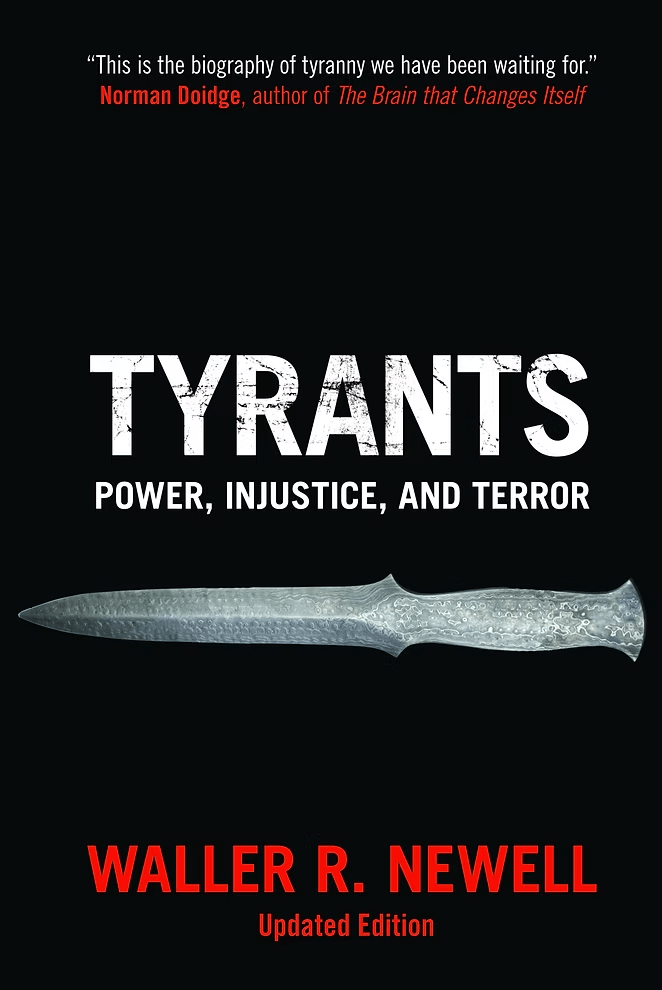
Tyrants is the third book by Waller Newell dealing specifically with the subject of tyranny. As such, it is the product of lengthy, thoughtful, and careful scholarly study spanning a number of decades. Newell’s work as a whole has been the study of the statesman and the tyrant, and the essential difference between the two.[1] Needless to say, he does not agree with Hobbes that the difference is one based simply on the emotional disposition of the ruled towards their ruler. I think Tyrants may therefore best be viewed as the third volume of one extended study on tyranny. It is an excellent book, and one is hard put to describe briefly the richness Newell’s history brings to his ever-deepening study of the nature of the tyrant and the political phenomenon of tyranny.
The first of these three books, Ruling Passion (2000), is a study of the phenomenon of tyranny as elucidated in crucial works of Plato: the Gorgias, Symposium, and Republic. Its focus is on the Platonic psychology of tyranny by way of an analysis of the interwoven and complex elements of eros and thumos as they transform the soul’s characteristics. His distinction between primordial and transcendent longing and the relationship between the former and thumos goes a long way to explaining tyranny at its most fundamental psychological level.
The second book, Tyranny: A New Interpretation (2013), is a study of the most important elements distinguishing the modern from the ancient understanding of tyranny, and of the way in which tyranny takes on a new character in modernity. Machiavelli is at the heart of this book. A new understanding of human nature and hence politics gives rise to a new kind of tyranny as we seek to impose our will upon the world. One wonders, for example, how the view that we should strive to become the masters and possessors of nature could lead to anything but a dangerous temptation towards tyranny.
In his latest book, Tyrants, Newell builds upon and extends his earlier analyses of tyranny in three important respects. First, he further develops his three-fold typology of tyrants and tyranny that spans human history, albeit focussing on the West.[2] Secondly, he extends and deepens the earlier analysis in Tyranny of the specifically modern kind of tyranny, showing how modern political philosophy gives rise to a fundamentally new form of tyranny: the millenarian. Thirdly, Tyrants opens a new chapter in his study of tyranny by elaborating the connection between millenarian tyranny and contemporary terrorism.
Newell has thus written a thought-provoking intellectual history of tyranny, interwoven with a historical analysis of “the strange career of tyranny from Achilles to Al Qaeda” (210). His argument is persuasive, and the book succeeds nicely in illuminating the disturbing millenarian character of Islamist terrorism. He demonstrates the connection between the ideas of the great modern thinkers, particularly Rousseau and his historicist step-nephew Marx, and the ideologies that form as a result. The book is thus a fine combination of political philosophy and political history. As it powerfully demonstrates, ideas have consequences…..
https://voegelinview.com/tyrants-history-power-injustice-terror/
++++++++++++++

