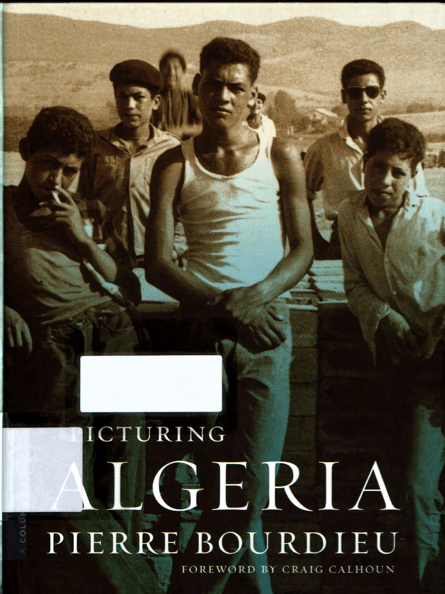
In this book, we are introduced to Pierre Bourdieu at the beginning of his career, and through photographs more than words. The photographs come from Bourdieu’s years in Algeria during what became in the end the successful struggle for independence from French colonial rule. They are accompanied by passages from his texts about Algeria, but the images command the book. These images take us to a time of great social drama amid wrenching social change. Many are memorable simply as photographs. But they are also valuable as a source of insight into the formation of Bourdieu’s very distinctive and powerful intellectual perspective. They are not mere illustrations but occasions for further thought.” —FROM THE FOREWORD BY CRAIG CALHOUN
“Community” man is giving way to “herd” man who has been deprived of the organic and spiritual realities in and through which he had previously existed. Cut off from his social and geographical origins, his circumstances are often such that he cannot recall even the most ancient ideals of honor and dignity. The war and its aftermath, resettlements and rural exodus, have simply reinforced and accelerated the tendency to cultural disintegration that had been set in motion by contact with “civilization” and the colonial situation. And the movement is now extending to areas that had previously been spared because they had not been directly targeted by the colonialist enterprise, but also because they consisted of small, close-knit rural communities, obstinately faithful to their past and their traditions, which had been able to preserve the essential traits of a civilization that may now be spoken of only in the past tense. A network of small, highly structured communities has given way to a congeries of individuals without attachments or certainties.
Time-honored values of honor have crumbled on contact with the brutalities and atrocities of war. As one old Kabyle said, “There isn’t a man who, at the end of all this, will be able to say, ‘I’m a man.’” The ideal image of the self, and the values associated with it, are put to the crudest of tests. Women are raped and abducted. Husbands are interrogated and beaten up in front of their wives. I have been told about a village in Greater Kabylia where soldiers accompanied the women to the fountain just outside the settlement, for their protection. On their return, some of the women drank coffee with the soldiers, or even invited them into their houses. “The young soldier enters the house. The old man, the defender of honor, who has been charged with watching over the wife or the daughter of an exile, knows he can say nothing. He suffers, and remains silent in his corner. One day, the soldier brings food. The old man accepts his share, and is silent. He is ruined.”
The war, like a bomb, devastates sociological realities. It crushes, grinds down, and disperses traditional communities—village, clan, family. Thousands of men are in hiding, in internment camps or in prison, or have taken refuge in Tunisia or Morocco. Some are living in towns, in Algeria or France, having left their families behind in their villages, or in resettlement centers. Others are in the French army. Still others are dead, or have simply disappeared. Families have been dismembered and scattered to the four winds. Entire regions, in Kabylia, for example, have been emptied of their menfolk. For the last few months, the clinic run by nuns near Chabet El Ameur has seen no births….
The rural masses, obstinately conservative in their rejection of every innovation proposed by the West, are being swept up in the whirlwind of violence that is in the process of obliterating the past. Even Islam, having been mobilized (more or less consciously) as a revolutionary ideology, has progressively changed its function and signification. The nature, duration, and amplitude of the war have spawned a radical revolution. And it may be supposed that the return of peace will usher in a very different Algeria from the one in which the war began—an Algeria that will be profoundly revolutionary, because it will have been profoundly revolutionized. pp 58 to 61
++++++++++++++++++
Resistance, Rebellion, & Writing – Albert Camus’s dispatches on the Algerian crisis
Invincible Summer – Albert Camus

