
What Gaza reveals about the ideology that shaped the modern West
NB: Since October 2023, at least 20,179 Palestinian children have been killed; and 44,143 injured.
58,000 children have been orphaned. Palestine has the largest concentration of child amputees in the world.
This is the blood soaked memorial of so-called western civilisation. And our cowardly government cannot even express sorrow for this unutterable tragedy. We should hang our heads in shame
Pravin Sawhney: India Is No Longer Useful For America Geopolitically, Strategically & Militarily
The ‘Gaza genocide’ claim is a blood libel, says historian Simon Schama
Raghav Kesavan. July 1; 2026
THE WAR IN IRAN is the inaugural act of a new world order. We know this because it began without the usual prelude to war. In October 2023, there was a rush to manufacture consent for Israel’s brutal campaign in Gaza. The United States’ president at the time, Joe Biden, said he had seen pictures of beheaded Israeli babies—comments later walked back by the White House. The soon-to-be-elected British prime minister went on radio to reassure conscience-stricken Britons that Israel could legally cut off water, food and electricity to Gaza. When Israel bombed Gaza’s hospitals, newly minted open-source intelligence experts emerged to read rocket fumes and declare, predictably, that Hamas did it. No such effort was made to justify the bombing of Iran.
The rules-based international order once required the West to justify its use of force in terms of human rights, democracy and international law. It was a liberal project that rested its authority on a claim to moral universalism, on the equal worth of people and their equal claim to human rights. Liberalism has been the dominant political tradition of the West for the best part of two hundred years. As the animating ideology of the free world, it was inseparable from the West’s sense of itself as a civilisation apart. In the effort to square the imperatives of power with their moral commitments, liberals cultivated a distinctive historical sensibility, which deferred ethical judgment with the faith that the violence of the present could be redeemed by the progress it made possible. This sensibility is what the historian Priya Satia calls the management of conscience.
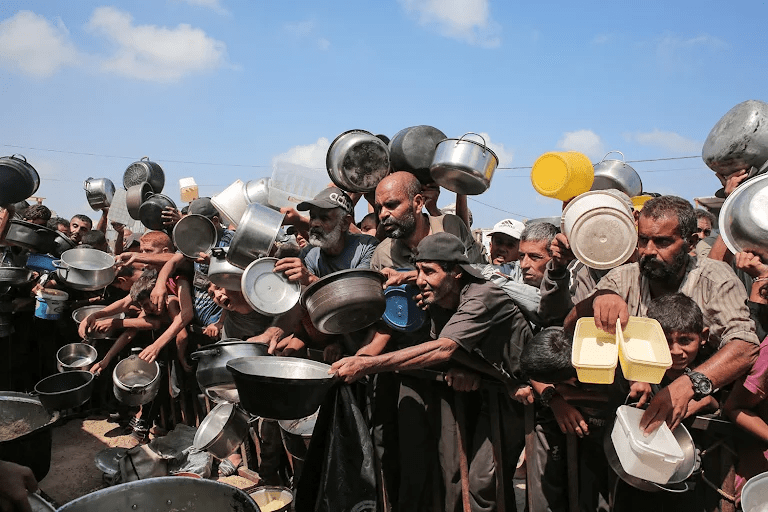
Palestinian men hold out their empty pots in front of a charity kitchen in Khan Yunis in the southern Gaza Strip on 21 August 2025. Amnesty International earlier that week accused Israel of enacting a “deliberate policy” of starvation in Gaza. AFP / GETTY IMAGES
The West’s support for Israel’s war in Gaza—and the ability of Palestinians to document their own destruction and broadcast it to the world—made a mockery of that project. With the US abduction of Venezuelan President Nicolás Maduro and the bombing of Iran, Donald Trump has taken a hammer to that order’s decaying edifice. For good or for ill, threats of power have replaced the rhetoric of universalism. The death of this liberal common sense demands an autopsy.
The atrocities sanctioned in Gaza by the West and its liberal opinion-makers were not a historical aberration. Three bodies of thought—on intention, on genocide and on aerial bombardment—made the annihilation of Gaza possible.
Liberalism is notoriously difficult to define, but tracing its historical development in the West might draw out elements of the tradition most relevant to the question of Gaza. The political upheaval of the American and French revolutions and the dynamism of industrial capitalism created the conditions for a range of Enlightenment ideas to find consolidated political expression. As the historian Alexander Zevin has argued, liberalism found its fullest expression in mid-nineteenth century Britain, through a “totalising fusion” of civil liberties with free markets and free trade now considered the classical form of the doctrine.
Liberal advocacy expanded the franchise, spurred economic growth and drove social reform. At the turn of the twentieth century, as Britain confronted growing inequality, poverty and a restive labour movement, a new liberalism that conceived of the state as the guarantor of both individual freedom and social justice, helped lay the foundations of the modern welfare state.
While it drove progressive reform at home, it was in the colonies that the shape-shifting suppleness that made liberalism successful as the ideology of capitalist modernity, helped produce an early accommodation with authoritarianism. One of the great ideological achievements of early liberals like Thomas Babington Macaulay and John Stuart Mill was to fit colonial autocracy into a liberal frame. Mill justified British rule in India in both liberal and civilisational terms. He argued that “barbarians have no rights as a nation except a right to such treatment as may, at the earliest possible period, fit them for becoming one.” This would only occur—the principle of liberty would only apply—when these “backward” peoples had “become capable of being improved by free and equal discussion.” This view, as Satia shows, saw “India as Europe’s past” and “depended on the sway of a particular historical sensibility that deferred ethical judgment to an unspecified future time.” In a classic statement of the imperial civilising mission, Mill argued that the condition of Indian society at the time made “a vigorous despotism … the best mode of government for training the people in what is specifically wanting to render them capable of a higher civilisation.”
+++
In the early twentieth century, despite their hostility to mass democracy, liberal politicians made a series of historic accommodations domestically. These reforms enfranchised women, empowered organised labour and gave the vote to working-class men. International politics had its own effect on liberalism’s development. Shocked by the First World War and the collapse of the Weimar experiment, and spurred by the rise of fascism and communism, liberal thinkers began to search for ways to legitimise the doctrine in the face of new threats. Driven by concessions at home and crises abroad, by the 1930s a new coinage gained currency: liberal democracy.
As the historian Duncan Bell has argued, once “liberal democracy” became the label for the parliamentary systems in Britain, France and the United States, advocates for those systems were “conscripted, however reluctantly” into the liberal tradition. This expansion of its remit in space was matched by an extension of liberalism’s scope in time. By concerted intellectual effort, the emergence of liberalism was pushed back in time to the seventeenth century, to coincide with the birth of the early modern English state. The history of liberalism was made coterminous with the history of the modern West at the same time as major Western powers began to refer to themselves as liberal democracies.
At the turn of the twentieth century liberalism had been a successful, party-political movement—one among many positions, like conservatism or socialism. By mid-century, liberalism had transcended this contested position to become “a constitutive feature of the West itself” and the West’s civilisational identity was couched in the language of liberalism and democracy.
The victory of the Allied powers in the Second World War vindicated this civilisational narrative. By the end of the war, liberalism fused two commitments that remain in tension today: a universalist moral claim—that all people possess equal worth and inalienable rights—and an expression of Western civilisational superiority. Only liberalism insists that all human beings are equal and simultaneously contends that some are not yet fit to exercise the freedoms that equality demands. As a consequence, liberalism cannot simply ignore the violence it licenses or the suffering it causes. It must account for them. This is what makes the management of conscience a constitutive feature of liberal governance. After the war, the United Nations and the international legal framework established in the late 1940s formally founded a new world, ordered on liberal principles.
By mid-century, liberalism had transcended this contested position to become “a constitutive feature of the West itself” and the West’s civilisational identity was couched in the language of liberalism and democracy.
The West’s post-war hegemony was founded upon both ideological and military pillars. Victory in the war vindicated the Allied approach to warfare, an approach the historian David Edgerton has called liberal militarism, a resource-intensive mode of warfare which relies on scientific and technological superiority rather than mass conscription. The advantage in material and industrial resources available to Britain and the United States was decisive in their victory over Nazi Germany. The Allies’ aerial superiority and the concomitant advantage in strategic bombing, which the historian the Adam Tooze has termed a “distinctive mode of war-fighting adopted by liberal democracies,” was a key factor in Germany’s defeat.
In the ideological sphere, liberalism became the background condition of politics in the West. The collapse of the Soviet Union removed communism, the last serious challenge to liberalism, as an ideological force in the world. The euphoria of that moment cemented the revisionist history that cast liberalism as the authentic ideology of the modern West and the liberal democratic state as its end goal. The US political scientist Francis Fukuyama made this teleology explicit when he declared that this “triumph of the West, of the Western idea,” presented us with the “end of history as such: that is, the end point of mankind’s ideological evolution and the universalization of Western liberal democracy as the final form of human government.”
The confidence of that moment gave rise to new justifications for war, abetted by new technologies of war-making. The United States assumed its role as a global hegemon armed with precision-bombing technologies and air superiority of a kind not seen before. It deployed these technologies to liberate Kuwait in the Gulf War and on humanitarian grounds in Kosovo and Bosnia and Herzegovina. The doctrine of liberal interventionism was formally codified as the “Responsibility to Protect” and adopted by the United Nations in 2005. Theory followed practice as ventures like the invasion of Iraq had already been dressed up in liberal finery. One of the aims of Operation Iraqi Freedom was to bring democracy to Iraq. Liberal militarism was being put to use to enforce the liberal international order.
+++
In a parallel stream of ideological work a cottage industry had sprung up to study international terrorism in the 1980s. Shorn of its ideological other in Soviet communism, an ascendant liberal order found a perfect foil in terrorism and duly cast the “Islamist terrorist” as the West’s newest bête noire. In this endeavour, liberals were happy to take the lead from their more hawkish colleagues.
In 1986, Benjamin Netanyahu, then Israel’s ambassador to the United Nations, edited a volume on the subject titled Terrorism: How the West Can Win. In it he wrote, “The root cause of terrorism lies not in grievances but in a disposition toward unbridled violence.” As the literary critic Edward Said argued in his review of the book, this conception of terrorism served mainly “to isolate your enemy from time, from causality, from prior action, and thereby to portray him or her as ontologically and gratuitously interested in wreaking havoc for its own sake.” This is the precise inverse of the historical sensibility liberals reserve for themselves, in which present violence is always redeemable by future progress. The terrorist, by definition, has neither past nor future.
THE WAR IN GAZA is best understood against this backdrop. Much has been said about the many vengeful outbursts from senior Israeli officials after 7 October. Less discussed are the rhetorical moves left unchallenged, and the characterisations of the war that found a receptive Western audience. The first such move was to appeal to the civilisational affinity that existed between Israel and the West. In an address on 9 October 2023, Netanyahu said, “In fighting Hamas, Israel is not only fighting for its own people. It is fighting for every country that stands against barbarism. Israel will win this war, and when Israel wins, the entire civilized world wins.” To cement this distinction in the minds of his Western audience, he went on to say, “Hamas is ISIS. And just as the forces of civilization united to defeat ISIS, the forces of civilization must support Israel in defeating Hamas.”
Shorn of its ideological other in Soviet communism, an ascendant liberal order found a perfect foil in terrorism and duly cast the “Islamist terrorist” as the West’s newest bête noire.
This comparison was endorsed by Joe Biden and his secretary of state, Antony Blinken. Blinken said that Hamas’ attacks brought “to mind the worst of ISIS.” Biden echoed him, saying, “Hamas committed atrocities that recall the worst ravages of ISIS, unleashing pure unadulterated evil upon the world.” Liberal publications like The Economist reported on the comparison arguing that Israel viewed Hamas as “akin to IS—an enemy with which compromise is no longer possible.” In a leader published two days later, The Economist adopted this view as its own. It argued that despite the “terrible civilian casualties” Israel was inflicting on Gaza, a ceasefire would be “the enemy of peace, because it would allow Hamas to continue to rule over Gaza.”
Framing the conflict as a war on barbarism helped shore up Israel’s place in the Western imagination as a democratic, first-world country. “Israel is the only democracy in the Middle East” was ritually repeated on news channels, as Western politicians of all stripes pledged their support. It served to guarantee the flow of material and diplomatic support from the West, without which Israel could not have prosecuted the war as it did. Amidst growing unease about civilian deaths in Gaza, the media and diplomatic cover also endowed Israel’s actions with a presumption of legitimacy. The benefit of the doubt, which all nations extend to their militaries, was extended by the West to Israel.
The kind of war Israel waged also lent credence to this framing. The global War on Terror had prepared the ground by getting Western audiences used to the aerial bombardment of Islamist militants and Muslim civilians. Liberal militarism also generated sympathy in the West for Israel, a sister democracy, using overwhelming firepower to safeguard its own soldiers. This is, as Tooze argued, part of the “democratic war bargain”: the very existence of an asymmetry in firepower sets in motion a circular logic which encourages the use of that advantage to its fullest extent. If you believe your victory is the inevitable result of your military superiority, then any resistance takes on an irrational character. Opponents who choose to fight on, “exacting a price from you, long after their defeat is inevitable, are rightly treated as ‘mad dogs’ that demand their own destruction.” Israel ’s prosecution of the war was driven by this logic. In just over three months, the Israel Defense Forces dropped twenty-five thousand tonnes of explosives on the Gaza Strip.
+++
In a parallel stream of ideological work a cottage industry had sprung up to study international terrorism in the 1980s. Shorn of its ideological other in Soviet communism, an ascendant liberal order found a perfect foil in terrorism and duly cast the “Islamist terrorist” as the West’s newest bête noire. In this endeavour, liberals were happy to take the lead from their more hawkish colleagues.
In 1986, Benjamin Netanyahu, then Israel’s ambassador to the United Nations, edited a volume on the subject titled Terrorism: How the West Can Win. In it he wrote, “The root cause of terrorism lies not in grievances but in a disposition toward unbridled violence.” As the literary critic Edward Said argued in his review of the book, this conception of terrorism served mainly “to isolate your enemy from time, from causality, from prior action, and thereby to portray him or her as ontologically and gratuitously interested in wreaking havoc for its own sake.” This is the precise inverse of the historical sensibility liberals reserve for themselves, in which present violence is always redeemable by future progress. The terrorist, by definition, has neither past nor future.
THE WAR IN GAZA is best understood against this backdrop. Much has been said about the many vengeful outbursts from senior Israeli officials after 7 October. Less discussed are the rhetorical moves left unchallenged, and the characterisations of the war that found a receptive Western audience. The first such move was to appeal to the civilisational affinity that existed between Israel and the West. In an address on 9 October 2023, Netanyahu said, “In fighting Hamas, Israel is not only fighting for its own people. It is fighting for every country that stands against barbarism. Israel will win this war, and when Israel wins, the entire civilized world wins.” To cement this distinction in the minds of his Western audience, he went on to say, “Hamas is ISIS. And just as the forces of civilization united to defeat ISIS, the forces of civilization must support Israel in defeating Hamas.”
Shorn of its ideological other in Soviet communism, an ascendant liberal order found a perfect foil in terrorism and duly cast the “Islamist terrorist” as the West’s newest bête noire.
This comparison was endorsed by Joe Biden and his secretary of state, Antony Blinken. Blinken said that Hamas’ attacks brought “to mind the worst of ISIS.” Biden echoed him, saying, “Hamas committed atrocities that recall the worst ravages of ISIS, unleashing pure unadulterated evil upon the world.” Liberal publications like The Economist reported on the comparison arguing that Israel viewed Hamas as “akin to IS—an enemy with which compromise is no longer possible.” In a leader published two days later, The Economist adopted this view as its own. It argued that despite the “terrible civilian casualties” Israel was inflicting on Gaza, a ceasefire would be “the enemy of peace, because it would allow Hamas to continue to rule over Gaza.”
Framing the conflict as a war on barbarism helped shore up Israel’s place in the Western imagination as a democratic, first-world country. “Israel is the only democracy in the Middle East” was ritually repeated on news channels, as Western politicians of all stripes pledged their support. It served to guarantee the flow of material and diplomatic support from the West, without which Israel could not have prosecuted the war as it did. Amidst growing unease about civilian deaths in Gaza, the media and diplomatic cover also endowed Israel’s actions with a presumption of legitimacy. The benefit of the doubt, which all nations extend to their militaries, was extended by the West to Israel.
The kind of war Israel waged also lent credence to this framing. The global War on Terror had prepared the ground by getting Western audiences used to the aerial bombardment of Islamist militants and Muslim civilians. Liberal militarism also generated sympathy in the West for Israel, a sister democracy, using overwhelming firepower to safeguard its own soldiers. This is, as Tooze argued, part of the “democratic war bargain”: the very existence of an asymmetry in firepower sets in motion a circular logic which encourages the use of that advantage to its fullest extent. If you believe your victory is the inevitable result of your military superiority, then any resistance takes on an irrational character. Opponents who choose to fight on, “exacting a price from you, long after their defeat is inevitable, are rightly treated as ‘mad dogs’ that demand their own destruction.” Israel ’s prosecution of the war was driven by this logic. In just over three months, the Israel Defense Forces dropped twenty-five thousand tonnes of explosives on the Gaza Strip.
+++
His career nearly ruined, a suitably chastened Temple was happy to follow the laissez-faire instincts of Edward Bulwer-Lytton, the viceroy of India at the time, when the monsoon next failed in 1876. Lytton fiercely opposed price controls and denounced the “humanitarian hysterics” and “cheap sentiment” of those who wanted to spend more to forestall catastrophe. Over the next three years, between 6 million and 10 million Indians starved to death. In 1882, Temple would write, “Reflection upon the millions sterling spent to avert famine, and yet the millions of lives lost from hunger—fills the minds of administrators with despondency.” Millions more would starve to death before the turn of the century.
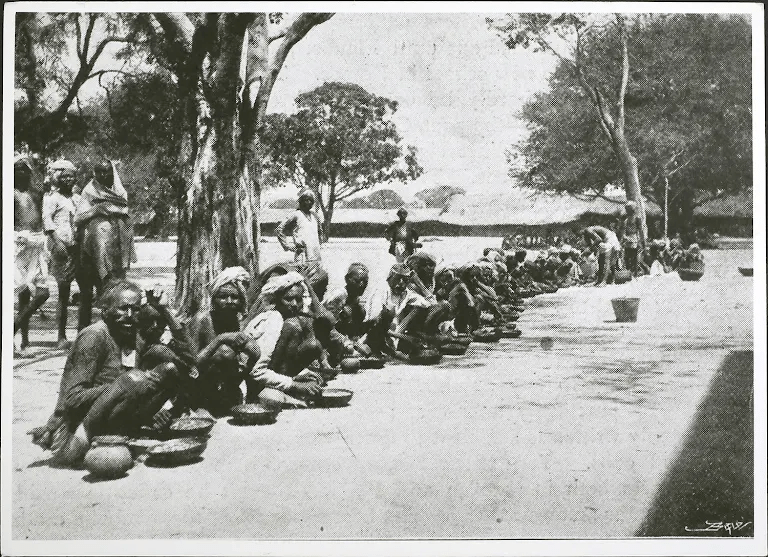
A line of men waiting for food during a famine in India, in 1897. HULTON ARCHIVE / GETTY IMAGES
The near-total absence of this episode in public memory in Britain today is a mark of how lightly the deaths of millions sat on the imperial conscience. The British intended to bring civilisation to India, packaged in new laws and market economics. What they brought was the death of millions, caused, in historian Mike Davis’ words, “by the theological application of the sacred principles of Smith, Bentham and Mill.” Laissez-faire economics, Malthusian justifications, and above all, Britain’s benign intentions, were used to excuse a crime of historic proportions.
Contrasting this with the massacre at Jallianwala Bagh in Amritsar, in 1919, is instructive. Brigadier-General Reginald Dyer ordered infantrymen to open fire when faced with a crowd of people protesting the Rowlatt Act. Estimates vary, but at least 379 people were killed. In 1920, as secretary of state for war at the time, Winston Churchill condemned the incident in the British parliament, where he called it “an episode which appears to me to be without precedent or parallel in the modern history of the British Empire … It is an extraordinary event, a monstrous event, an event which stands in singular and sinister isolation.” What is in fact extraordinary is how powerfully the intention doctrine worked on the imperial conscience to allow Churchill to call the massacre at Jallianwala Bagh a “singular and sinister” event in the history of the British Empire. To set the death of millions against the murder of some hundreds and have the scale tip towards the hundreds is an ideological feat par excellence.
This feat was repeated over the course of imperial misadventures for the next hundred years—think of the massacre of My Lai in Vietnam or the torture site at Abu Ghraib in Iraq. The acknowledgement of isolated episodes of intentional violence within wider projects of domination paradoxically serves to buttress the idea that intention is the critical determinant of moral culpability.
To set the death of millions against the murder of some hundreds and have the scale tip towards the hundreds is an ideological feat par excellence.
The post-war order that would govern accountability for mass atrocity was built by men with colonial interests to protect. The UN Charter’s preamble was drafted by Jan Smuts, theorist of white civilisational superiority. Great power interests prevailed at the United Nations’ founding conference in San Francisco in 1945 in the face of anti-colonial discontent. Smuts revived the liberal imperial principle of tutelage when he said of the UN project that “Men and women everywhere, including dependent peoples, still unable to look after themselves, are thus drawn into the vast plan to prevent war.” To raise these facts is not to discredit the project but to indicate the continuing relevance and power of an imperial sensibility which still sought to shape the world. That same sensibility shaped the definition of genocide in 1948.
+++
AS DEFINED IN THE 1948 Convention, genocide consists of acts “committed with intent to destroy, in whole or in part, a national, ethnical, racial or religious group, as such.” To make a finding of genocide, an international court must establish the “specific intent” on the part of the perpetrator. That is, the perpetrator must intend to commit genocide. This can be established through explicit statements or plans declaring this intention or by inferring such intent from a pattern of conduct. Since the Holocaust, plans to commit genocide are rarely written down or recorded, so the second, inferential path to establishing genocidal intent is crucial. The evidentiary bar set by the International Court of Justice for this inference is extraordinarily high: “for a pattern of conduct to be accepted as evidence of its existence, it would have to be such that it could only point to the existence of such intent.”
Experts interpret this standard in different ways. Adil Haque, a professor of law, argued that “if the pattern of conduct can be fully explained by a non-genocidal intent, then the standard of proof is not satisfied. But if the pattern of conduct can be fully explained only by a combination of genocidal intent and non-genocidal intent, then the standard of proof is satisfied.” The Israeli academics Amichai Cohen and Yuval Shany provided the opposing view, arguing that “for the purposes of inferring intent from circumstantial evidence—a pattern of conduct—the Court insisted that genocidal intent would be the only reasonable inference, and if the evidence reasonably points to alternative possible intentions, the standard simply cannot be met.”
Legal scholars have suggested that the evidentiary bar is set too high and that future jurisprudence should move away from such a narrow interpretation of intent. Indeed, the original formulation of the concept, as it was conceived by the Polish lawyer Raphael Lemkin in his 1944 book Axis Rule in Occupied Europe, did not define or prioritise intention in this way. Lemkin defined genocide as “a coordinated plan of different actions aiming at the destruction of essential foundations of the life of national groups, with the aim of annihilating the groups themselves.” He campaigned to have genocide included as a charge during the Nuremberg Trials, and though prosecutors deployed the term, it was absent in the verdict handed down by the tribunal on what Lemkin referred to as the “blackest day” of his life. After the trial, however, the United Nations declared that genocide was a crime under international law, and Lemkin set about drafting a convention on genocide. In 1948, after two years of debate, the UN General Assembly adopted the Convention on the Prevention and Punishment of the Crime of Genocide.
The scope of Lemkin’s concept was narrowed. The great powers all had cause to be nervous about the adoption of too broad a definition and how it might reflect on their own histories. For the United States, their treatment of Native Americans and the Black population was a cause for concern. The British feared its application to their colonies, and the Soviets insisted on removing political groups as a protected category from the final definition.
As the writer Phillipe Sands points out, Lemkin knew he would have to make concessions for his idea of genocide to be given institutional teeth, and he accepted the narrower definition and a higher evidentiary bar as the price. The bar was first raised during the convention, and then again by judges on subsequent tribunals created to deal with the crimes committed in Rwanda and the former Yugoslavia. The privileging of intention, which allowed the British Empire to escape culpability for famines, now structures international law in ways that make genocide charges extraordinarily difficult to prove. The result, as Sands points out, is that we now have a “gap between what ordinary folk think of as genocide, which is much closer to what Lemkin imagined it to be … and the legal definition taken by international courts.”
The privileging of intention, which allowed the British Empire to escape culpability for famines, now structures international law in ways that make genocide charges extraordinarily difficult to prove.
The question of genocide is muddled partially by the technology of war employed to carry out the killing in Gaza: aerial bombardment. The US-supplied 2,000-pound bombs dropped on a captive civilian population constitute, on the face of it, a horrific crime. But as long as the Israeli Defense Forces could point to a single Hamas operative as the target of any given bombing, the burden of “specific intent” might plausibly be dodged. An investigation by the magazine +972 found that “the Israeli military command knowingly approved the killing of hundreds of Palestinian civilians in an attempt to assassinate a single top Hamas military commander.”
The aftermath of the Second World War primarily shapes Western moral thinking on the ethics of bombardment. Both Allied and Axis powers bombed enemy cities as a matter of settled strategy, resulting in enormous destruction and loss of life. The Blitz in London, carried out by Nazi Germany, killed at least twenty thousand people, and a year earlier, the Luftwaffe killed a similar number in the bombing of Warsaw. The devastation caused by the bombing of Axis cities was even greater. Tens of thousands were killed in the Allied bombing of Cologne, Dresden and Berlin. The firebombing of Tokyo in 1945 was the single deadliest air raid in history, killing a hundred thousand people—more than in either Hiroshima or Nagasaki.
Telford Taylor, a US prosecutor at Nuremberg, noted, “the Nuremberg and Tokyo judgments are silent on the subject of aerial bombardment … Since both sides had played the terrible game of urban destruction—the Allies far more successfully—there was no basis for criminal charges against Germans or Japanese, and in fact no such charges were brought.” Taylor judged that “To punish the foe—especially the vanquished foe—for conduct in which the enforcing nation has engaged, would be so grossly inequitable as to discredit the laws themselves.” As a result, no general taboo against aerial bombardment has ever taken hold—as proven through the bitter experience of Vietnam and Cambodia.
The bombing of Gaza has antecedents that go back further, including to the period following the First World War. British policy during its rule of Iraq, mediated through a hastily established monarchy, bears a resemblance to both the Israeli bombing campaign and its reception in the West. Exhausted by the war, Britons were disinclined to subdue a restive Iraq with boots on the ground and turned to the newly formed Royal Air Force to police the country from the air. As Priya Satia tells us, the “aerial regime was deadly and did not work … The wrong targets were bombed,” and “pilots could not be sure whether they were looking at ‘warlike’ or ‘ordinary’ tribes.” As a matter of policy, “casualty counts were not made, out of a sense that any data gathered in the region was necessarily unreliable.”
+++
In places like Iraq and Palestine, the fog of war is no neutral thing. It has often simply been orientalist suspicion dressed up as skepticism. Summing up the British colonial view, Satia writes, “This willful ignorance of the outcome of air control let it sit more easily in the British official mind. … the RAF was safe from criticism, protected by the notorious fallibility of all worldly news from ‘Arabia.’” It is impossible to read this passage and not think of how casualty figures from Gaza were treated. How the prefix “Hamas-run” was ritually appended to Gaza’s health ministry as it released growing numbers of the dead, before everyone quietly agreed, sometime last year, after it was too late to stop the carnage, that the figures had been correct after all.
This weaponised ignorance was coupled with the uncomfortable fact that bombing remains a technology permitted by the laws of war. Its legality turns on assessments of intention and proportionality best carried out by the bomber. Together, these factors provided Israel the political space to carry out operations, exploiting the gap between what is legal and what can be rhetorically massaged into political acceptability. This permission structure resulted in the deaths of tens of thousands and left Gaza buried under 68 million tonnes of rubble.
In an interview she conducted with Tucker Carlson, Zanny Minton-Beddoes, The Economist’s editor-in-chief, called the war in Gaza “a disaster.” Like grief, conscience management has stages. The final stage might be called “grave regrets.” Serious people are perfectly happy, after the fact, to admit they deeply regret the wars they backed. Liberal backers of the wars in Iraq, Libya and Palestine have followed the same script. Unlike Trump, I doubt Beddoes thinks of these places as “shithole countries.” I am sure she even cares about the dead children in Gaza and is “filled with despondency,” like Temple. Yet week after week, the magazine she edits called for the continuance of a war which killed tens of thousands. If a theodicy is an answer to the question, why do bad things happen to good people, this essay has been a response to that question inverted: why do good liberals allow bad things to happen?
The short answer is that the tension between liberal universalism and Western reasons of state had, somehow, to be managed. Over two hundred years, this tension spawned an arsenal of intellectual and cultural resources to be deployed to defend Western violence. This habit, by now second nature to liberal defenders of the West, is grounded in sincerely held beliefs. People genuinely believed that intentional killing was worse than the policy that led to mass starvation. They believe now that dealing death from the skies with bombs, which bring down entire apartment blocks, can be justified. The sanitised, civilised violence of one side is pitted against the “barbaric terrorism” of the other. These discursive gymnastics make no difference to the starving peasant or to the father who has to gather body parts in a bloody sack in the hope that some belong to his children. Invariably, these people exist outside the moral community of the civilised West, and despite liberalism’s universal pretensions, their suffering is easily discounted.
Liberalism’s great success lay in its ability to cloak Western self-interest—its imperial conquests, its methods of war—in moral language. Its success was so complete that the West now suffers from an impaired sense of justice both in law, where the boundaries of legality fall short of justice, and in politics, where public morality remains captive to ideas of civilisation and intent. In Whigs and Hunters, a history of law and popular struggle in eighteenth-century England, EP Thompson captured the dynamic between power and law that defines this discussion: “The oligarchs and the great gentry were content to be subject to the rule of law only because this law was serviceable and afforded to their hegemony the rhetoric of legitimacy.”
These discursive gymnastics make no difference to the starving peasant or to the father who has to gather body parts in a bloody sack in the hope that some belong to his children. Invariably, these people exist outside the moral community of the civilised West.
Thompson’s great insight was to recognise that though the law often served the interests of the powerful, it was made plausible by its rhetorical universalism, by its promise of equality before the law, and the hope that it might deliver justice. Liberalism similarly rests its moral authority on universalism, on ideas like human rights and international law. It is not starry-eyed, as Thompson points out, to suggest that whatever their shortcomings, the world is a better place for the existence of these ideas, if only because they provide the shared ground from which the weak can contest their claims. Like Thompson, we must insist “that there is a difference between arbitrary power and the rule of law. We ought to expose the shams and inequities which may be concealed beneath this law. But the rule of law itself, the imposing of effective inhibitions upon power and the defence of the citizen from power’s all-intrusive claims, seems … to be an unqualified human good.”
When Israel set about testing the limits of first-world liberalism by bombing Gaza into oblivion, it made Western liberals, in Thompson’s memorable phrase, “prisoners of their own rhetoric.” If liberalism was a world-making project, it made the West, too. Having advanced human rights, international law and democracy, often at the end of a gun, liberals in the West were faced with the same choice as the eighteenth-century English elite: they could “either dispense with the rule of law … countermand their own rhetoric and exercise power by force,” or they could “submit to their own rules and surrender their hegemony.”
As he remakes the world after Gaza, Trump may have made that choice for them.
https://caravanmagazine.in/conflict/gaza-liberalism-west
+++++++++++++++
Gaza and the End of Western Fantasy
Pravin Sawhney: India Is No Longer Useful For America Geopolitically, Strategically & Militarily
‘If we don’t act on the proof against Israel, we can’t redeem ourselves’: Justice Muralidhar
Biblical Archaeology and the Judeo-Christian legends / The Deconstruction of the Walls of Jericho
The ‘Gaza genocide’ claim is a blood libel, says historian Simon Schama
The Adoration of Force (this one is inspired by Simone Weil)
Natalia Ginzburg: Our Monstrous Ideas
Gaza and the Death of Conscience
Pankaj Mishra: The Shoah after Gaza
Israel’s War in Gaza Is Nothing but a War of Annihilation

