
Separating truth from fiction in the most successful African movie of all time
Carey Baraka
1.
To talk about The Gods Must Be Crazy, we have to start with the VHS tapes. We didn’t have many of them when I was growing up in Kisumu, a port city in western Kenya on the banks of Lake Victoria. They were a kind of luxury. We had Gods, Sarafina!, Coming to America, The Lion King, and my parents’ prehistoric wedding video, which offered the endless entertainment of matching the uncles and aunts we knew to younger, thinner versions of themselves. My siblings and I watched these over and over on Sunday afternoons, slouching on our green couch between piles of economics books and old Reader’s Digests, my father serving us cups of jelly. This was Kenya in the 1990s: the economy was crumbling, rumours abounded about devil worship in schools, state workers were losing their jobs under IMF-mandated structural adjustments, men were shaving themselves bald to look like Michael Jordan, and The Gods Must Be Crazy was playing on repeat.
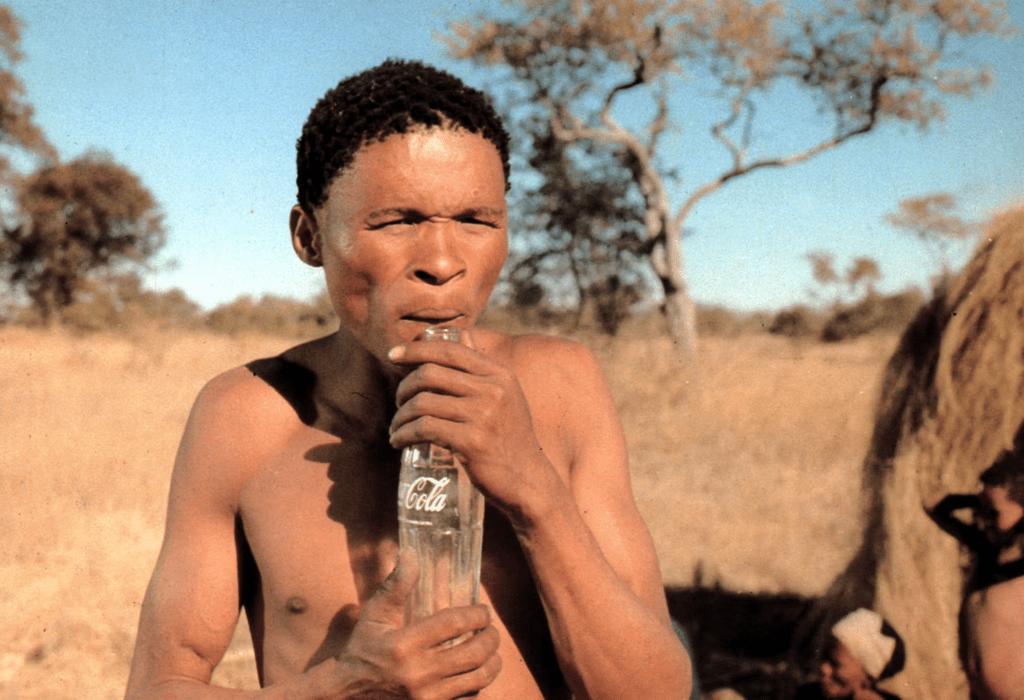
The Gods Must Be Crazy – the first, and most famous, film in what would become a five-part franchise, comprising two originals and three knockoffs – is one of the most successful African movies of all time. For many in the West, it is the only movie with an African protagonist they’ve ever seen. It’s nearly impossible, today, to describe the plot in an inoffensive way. A tribe of Bushmen lose their minds because they encounter a Coca-Cola bottle? Which they think has magic powers? The imagery is absurdly on the nose: half-naked tribesmen in the Kalahari desert, a white damsel in distress, lions and goats and elephants. If you didn’t see the film at a formative age, before you could question such things, to encounter any element of it as an adult can make you squirm.
Gods is 109 minutes long, a blend of mockumentary and slapstick comedy, purportedly depicting the serene lives of the once-nomadic Ju/’hoansi people, hunter-gatherers known for their distinctive “click” language and their tracking prowess in the bush. Written and directed by a white South African named Jamie Uys, the film stars N!xau ǂToma, a Ju/’hoan man – part of the desert-dwelling hunter-gatherer groups in southern Africa who are collectively known as the San. N!xau, playing a protagonist known only as “Xi”, hailed from a small town in the Namibian Kalahari Desert called Tsumkwe. He had never acted before Uys cast him in the leading role. Thanks to the success of the film, N!xau became – and perhaps still is – one of the most recognisable Africans in the world.
In the world of the film, the Ju/’hoansi live simply under the stars, untouched by the corruptions of “civilisation”, until, one day, a Coca-Cola bottle falls from the sky. The bottle lands in the narrative as exotic interloper, fetish object and chaos agent. At first, tribe members use it as a tool, a musical instrument and a toy, but it soon brings discord, and Xi embarks on an epic journey to get rid of it. Other conflicts unfold among the more civilisation-bound characters, including a white woman who abandons journalism to become a village schoolteacher and has a screwball flirtation with the white biologist tasked with her transport; another subplot involves a guerrilla coup attempt in a fictional neighbouring state called “Biryani”.
The film finds many ways to mine humour from the cultural confusion between whites and so-called Bushmen, though never quite outside the logic of apartheid – that is, always under the premise that these characters come from completely discrete civilisations. At the film’s end, Xi throws the bottle off a cliff, which he believes is at the end of the world – but is really just South Africa’s Blyde River Canyon – and peace is restored.
When Gods premiered in 1980, it broke South African box office records within 96 hours, and went on to earn more than $100 million around the world, making it likely the highest-grossing African movie of all time. In 1982, Gods was the most-watched movie in Japan (under the title Bush Man). Despite a slew of initial protests in France – the French journal Politique Africaine denounced it as apartheid propaganda – it eventually garnered success there too, becoming the top-grossing hit of 1983, and even garnering a César nomination for best foreign film. In America, it picked up slowly, but by 1985, it was the most successful arthouse film in the country. And those numbers don’t begin to account for how voraciously Gods was pirated across the world. From the former USSR to Nigeria, the film was a mainstay of 1980s “video salons”.
In the 90s, N!xau was in the same league as such pneumatic action stars as Arnold Schwarzenegger, Jean-Claude Van Damme and Bruce Willis. When the American R&B singer Usher emerged in the late 90s, Kenyan newspapers poked fun at his resemblance to N!xau – indeed, for many years, I myself believed that Usher was N!xau ǂToma’s son. With the disclaimer that “Africa” is not a country and so on, pretty much every single African with access to a television and VCR in the 1980s and 90s watched these movies – the same way that pretty much every Anglophone writer now in their thirties once read Harry Potter.
A sequel, The Gods Must Be Crazy II, followed in 1989, once again starring N!xau. Gods II introduced Xi’s two children, who climb into a truck that belongs to elephant poachers and get inadvertently abducted, prompting Xi’s quest to retrieve them. (Meanwhile, a geopolitical conflict is incarnated by an Angolan and a Cuban soldier who try to kidnap each other, alongside – as in the first movie – a romantic subplot involving a white couple.) While the sequel was less globally successful than the original, it still broke box office records in South Africa. Some years later, N!xau reprised his role in three more Gods films, made, improbably, in Hong Kong and China. Crazy Safari (1991), Crazy Hong Kong (1993) and The Gods Must Be Funny in China (1994) were spurred on by enterprising Cantonese and Chinese producers who saw economic potential in riffing off the popularity of N!xau and Gods in Asia. They borrowed Uys’s basic premise, by which N!xau’s supposed primitive naivety leads to madcap adventures, but instead of all the other characters being African, they are Chinese. As a child, I understood all these movies to be part of a box set.
But I hadn’t thought about N!xau – or the films, for that matter – for a long time, until February 2024, when I was invited to a literary festival in Thiruvananthapuram, India. As often happens at such gatherings, the Africans found each other. We were four, and gathered one evening to drink: two South African poets, a Congolese artist, and me, a Kenyan. I wondered aloud what – or if – the others ever thought about The Gods Must Be Crazy.
Everyone had watched them, it turned out, though it had been ages, and we spent a while recounting our favourite scenes, round-robin. When we exhausted this, we were a little flushed with embarrassment. There was something deeply uncomfortable about thinking back on those films now, cultural products of apartheid-era South Africa that peddled undeniably racist myths about indigenous Africans. It felt a little awkward, even in our little group, to admit that we cosmopolitan writers, invited to an international literary festival, had ever enjoyed these parochial films. We quickly moved on to other cultural totems that connected us. Congolese music from the 1980s, for instance. This felt safer.
But I kept returning to our conversation after I left India. What had we seen in those films? Why did we laugh so much? Doubtless, representation was part of it; the Gods movies were some of the only films in which black Africans of my generation – and older ones – could see themselves on screen. People younger than us wouldn’t get it: Nollywood, which now regularly churns out such hits as Omo Ghetto and Gingerrr, is now the second-largest film industry in the world.
“It truly was a wonder to see a brown face, given the extreme segregation of television and film at that time,” the South African poet Gabeba Baderoon, one of that quartet in Thiruvananthapuram, had told me. “I enjoyed it back then, even though now the thought of it makes me cringe.” People have mentioned Gods to her throughout her life, often as the only piece of South African culture they had ever encountered.
I cautiously fired up Gods I and II again on my laptop. Within minutes, I was relieved to find the movies still hilarious. I cracked up at the exact same scenes, like my favourite one in the entire franchise, from Gods II, in which Xi’s daughter is stalked by a hyena in the bush, but suddenly remembers that hyenas only target short people. To defend herself, she holds a plank of wood on top of her head, making her look taller. (Since my teenage growth spurt, I have never feared hyenas either.) The dazzling shots of the Kalahari held up, too. The plot? Well, it was wacky, but we had never thought otherwise.
What I was newly captivated by, though, was N!xau, the lead actor: a muscular, square-jawed man whose smile extended into his eyes, and who was the only constant across the madcap franchise. He had always seemed, even to us, somehow exotic, an emissary from a wilder Africa. Uys reportedly cast him – this was part of the film’s lore – after three months crossing the desert searching for the right leading man. “He’s got this magic, this aristocracy, this self-pride,” the director told The New York Times in 1985. The funny thing is, I could see exactly what he meant.
But it was still a crazy statement on Uys’s part – and it was only a small part of his chicanery. The extravagant stories that Uys told about N!xau, in interviews and junkets, have long been essential to the films’ mythology. Perhaps they were once received more critically, but by the time I came to the franchise, the backstory had crystallised. It was said that N!xau had never heard of movies or of acting, or even of the concept of work, or of money. He had only ever seen one white man before, according to Uys, but he was nevertheless eager to be in the movie – because Bushmen were, Uys said, “such nice guys”. He told another journalist that, for subsequent meetings with N!xau, he would circle with a plane over the coordinates of their last meeting and wait for a smoke signal.
Was there even a kernel of truth to such patently ridiculous tales? Unfortunately, Uys died in 1996, and N!xau in 2003, so I could not ask either of them directly. If I wanted to separate truth from fiction, my only option was to follow the trail of Gods myself – perhaps even as far as Tsumkwe. It was there, after all, that Uys had created, behind a cloud of myth and perhaps exploitation, one of the earliest pan-African movie stars.
2.
Uys, a maths teacher turned self-taught writer-director, made 24 films, out of which his final two features were Gods and Gods II. His first feature, which he made in 1951, aged 30, was Daar Doer in die Bosveld (Far Away in the Bushveld), a farcical romantic comedy that he wrote and starred in, alongside his wife, also a maths teacher. His biggest hit prior to Gods was a 1974 nature film called Beautiful People, also filmed in the Kalahari, which won a Golden Globe for best documentary – though it later became infamous for faking one of its iconic sequences, in which elephants appear to get “drunk” on the fruits of the Marula tree. (Uys and his team, it turned out, had soaked the fruits in actual alcohol.) In any case, he was a known quantity in South Africa by the time Gods came out. One domestic film poster promised: “Jamie Uys delighted you with Beautiful People, convulsed you with Funny People, now you’ll go crackers with Gods.”
Gods was funded partly by Uys’s longtime collaborator, the producer Boet Troskie, and partly by the apartheid-era South African government. (These state subsidies were typically paid post hoc, against a percentage of box office returns, meaning that a hit film got more state funding than a flop.) With a cultural boycott of South Africa gaining steam, the film’s entanglements would be problematic, and Gods was badged as being made in Botswana.
As the film became a global sleeper hit, Uys’s mythmaking gained traction too – though much of it, like the smoke-signal story, was wholly untrue. N!xau actually hadn’t been hard to find at all – he had been working as a cook at the school in Tsumkwe. And he certainly knew about money, and about white men, including the soldiers of the South African army, who were stationed around Tsumkwe until 1989. Nevertheless, Uys’s manufactured lore had a strange staying power. When the South African film scholar Keyan Tomaselli interviewed N!xau in 1996, he told Tomaselli that he was the first person who hadn’t assumed Gods was a factual depiction of his life.
Tomaselli, probably the world’s pre-eminent authority on the Gods films, describes Uys’s obsession with the Kalahari and its residents as typical of its era; it was a projection of what he calls “Afkrikanerdom’s enduring pastoral fantasy”. For Uys, this seemed to start at home: for a long time, the director’s Cape Town house purposely had no electricity, owing to his yearning for primeval nature. (“I find civilised things more of a nuisance than an aid,” he declared during a press tour for Gods II.) “What endeared audiences at the time of release was the Edenic quality of the social group,” Tomaselli told me over email – “the depiction of a harmonious community before the falling bottle disrupted the cultural tranquility, the social innocence, the small communitarian society, living in harmony with nature, as opposed to the stressful madness of the white urban society, of which Uys was making fun.” Uys’s embellishments, per this reading, are a form of wish fulfillment.
Even against this backdrop, some of Uys’s production choices, enumerated by Tomaselli, can prompt a double take – like the fact that he added extra clicks to N!xau’s dialogue to make it sound more exotic, or the fact that N!xau often changed his dialogue between takes, a fact totally ignored by the film’s narration, which never annotates his speech with subtitles. Many other details are simply an “ethnographic mishmash”, Tomaselli notes, which is to say a foreigner’s fantasy of life in the bush: “Shangaan attire, Sotho hats and a mixture of Southern Sotho, Shangaan, Zulu, and Tswana languages.” Authenticity, in other words, was never really the point. The point was a kind of blank canvas for Uys’s fantasies. Indeed, on one promotional trip for Gods in Japan, Uys demanded that N!xau wear a specially designed cloak, telling an interviewer, “If you put on Western clothes, you’re going to spoil the image of this Noble Savage.” He added: “He’s a sex symbol and a big hero in this country.”
3.
By the late 1990s, with his acting career mostly behind him, N!xau was bitter about how the film industry had catapulted him to fleeting fame. “It does not show how people are really living,” he complained to Tomaselli of the franchise in 1996. The crew had told him to dress up in skins and “pretend to be a real Bushman”. “They said it would be good for me, so I did what they asked.” Shortly before his death in 2003, N!xau joked to a documentarian: “They probably like me so much because of my ugly face.”
His people hadn’t lived in any sort of blissful simplicity for centuries, at least not since before the time of the Boers, the descendants of the white European emigrants who had arrived in southern Africa in the 1650s and started the Dutch Cape Colony. From the eighteenth through twentieth centuries, Boers hunted San for sport in brutal extermination campaigns, and enslaved them to work on their farms. The last permit for hunting Bushmen was issued in South Africa in 1927, and in modern-day Namibia (then known as South West Africa) in 1936 – just eight years before N!xau was born. While Namibia was under German colonial rule, from 1884 until 1915, colonial officials carried out multiple genocidal campaigns, including against the San. White settlers were given instructions to fire on San hunter-gatherers, and the subsequently orphaned children were divided among the white farmers’ wives as servants. In 1976, Tsumkwe became the capital of a region designated by apartheid-era South Africa as “Bushmanland”, one of many ethnicity-based homelands for various peoples of the region.
When I visited Tsumkwe last May, I drove a rental car 750 kilometres from Namibia’s capital, Windhoek, through sprawling desert, past ranches and horses with actual German owners, and a sign for the largest meteorite in the world. The further north I went, the narrower the roads became, and the fewer the cars. Tarmac eventually gave way to murram – unpaved roads of compacted, iron-red soil – and then I was in the Kalahari proper. Tsumkwe itself was less a town than a collection of shops and government offices clustered around the crossroads of two gravelly thoroughfares, plus a few hotels for adventurous tourists. The town is home to about 500 people, and the greater Tsumkwe constituency around 9,000.
Back home in Kenya, the success of the 1985 film Out of Africa had accelerated foreign interest in the idea of going on safari; white visitors dreamed of seeing lions in the wild while being romanced by tall Maasai men. Something similar, I realised, had happened with the Gods movies. Even today, tourist brochures for Namibia urge people to go up north to see ‘the last hunter-gatherer community on Earth’. The San people can teach you how they hunt, how they live, how they talk to the stars, how they find water in the sands of the Kalahari. The region’s Afrikaner administrators in the 1980s seem to have felt that the ideal local economy should comprise hunting and gathering and international tourism; the latter consisted, in no small part, of gawking at hunter-gatherers. Nearly four decades after Bushmanland was abolished as a regional unit, the travel company that booked my tickets promised that “San hunter-gatherers continue their ancient traditions in the Kalahari Desert and Bushmanland”.
Wesley Kashe is a softly spoken Ju/’hoan man around my age – 30 – who manages the Nyae Nyae Conservancy, which includes Tsumkwe. When I met him at the conservancy’s offices, he assured me that he knew all about N!xau, whom he referred to as “the old man”. Though Kashe is too young to have really known him, he promised we could visit the old man’s grave, once we got permission from his kids.
As we toured Tsumkwe and its surroundings, Kashe pointed out how some villagers had taken to farming, growing things like oranges and sweet potatoes; some even kept cattle. The nearest proper shop, he explained, is 280 kilometres away, in the town of Grootfontein, and the Namibian government sends drought-relief food every two or three months. Many animals also call the conservancy home: springbok, kudu, antelope, cheetah. San residents are allowed to hunt some of this game using traditional bow-and-arrow methods – meaning without guns, horses or cars. Visiting trophy hunters could hunt with all of those things, for a fee.
The Tsumkwe resident I had been most advised to meet was someone named Leon Tsamkgao, now 57, and reputedly an authority on local history. When we rendezvoused in the town centre, he was, with a straight face, drinking from a glass bottle of Coca-Cola. He had just returned from a trip to New York, where he had been a delegate at the 24th session of the UN Permanent Forum on Indigenous Issues. In midtown Manhattan, someone had approached him in the street to tell him that he looked just like the guy from The Gods Must Be Crazy.
In the 1980s, Leon had been a student at the school where N!xau worked as a cook. The first Gods movie came out when Leon was still in school, and shortly after its release, Uys and the producers came to screen it in Tsumkwe. Leon and his schoolmates had found it very amusing, and rewatched it many times on their communal VCR – charmed, presumably, by the sight of their neighbours on screen, but also uniquely entertained by N!xau’s dialogue, which was full of Ju/’hoan jokes that must have been unintelligible to most other viewers.
But most of the Ju/’hoansi who featured in the film, Leon told me, were forced to be in it. Nobody in the community had felt they could say no to Uys. “Nowadays you have to sign something to put people in a movie. Back then there was nothing,” he said. Besides, that was a time when “everyone could do what they wanted, if they were white”.
The Ju/’hoan participants in the movie had been paid minuscule amounts of money for their roles, though Uys spread the idea that they didn’t take part in the money system. He told reporters that N!xau had let one cash payment blow away in the wind because he didn’t understand – or, presumably, care – how money worked. That was a stunt. “I knew what money was about,” N!xau later told Tomaselli. Other stories alleged that N!xau had only received $300 for the first movie, but by the time of the second movie he had “learned the value of money” and demanded $500,000 dollars, with which he bought a car and built a house. (This story, versions of which seem to have first appeared in N!xau obituaries in newspapers like The Guardian and The LA Times, has more recently found circulation as a “viral fact” in TikTok videos and Facebook posts with titles like “A FILM STAR WHO DIDN’T KNOW WHAT MONEY WAS!”) Uys sometimes said he was the one who gave N!xau those things – or that he sent N!xau $100 every month, or that he had set up a $20,000 trust fund in N!xau’s name.
I could only ascertain that, about 15 years after the first film came out, someone – perhaps Troskie’s company, Mimosa Films, which also managed N!xau’s affairs – built a five-bedroom brick house for N!xau in Tsumkwe. As for the other claims, when I asked Leon if the old man might have received even larger sums, he was unequivocal in his dismissal: “This place is very small. There is nothing you wouldn’t know.”
But I could see him begin to doubt himself, even as he talked. What if it was true, and there had been a middleman who took the money? Either way, he reasoned quickly, it had certainly not made it to Tsumkwe. They would have noticed if someone had half a million American dollars on them.
4.
Part of the irresistible fantasy of Gods is that the deplorable history suffered by the people being depicted is pointedly not part of the story – but neither is it entirely absent. The first film, for instance, features a ragtag militia led by a man called Sam Boga (played by a white actor in blackface) – an obvious stand-in for Sam Nujoma, an anti-apartheid activist who became the first president of Namibia in 1990. Nujoma and the group he led, the South West Africa People’s Organisation (SWAPO) waged a war of independence for 24 years, and were largely based in northern Namibia.
Uys was filming in Tsumkwe in the middle of that war. The town had hosted a military outpost where Ju/’hoan men were conscripted as trackers for the South African army, which was fighting SWAPO – the very same SWAPO that Sam Boga was meant to caricaturise. Some of them were grabbed straight from the fields. “Terrorist attacks have brought unexpected benefits for thousands of Bushmen in South West Africa,” opined the Argus Africa News Service at the time. “It has given them a chance to join the twentieth century.” In the 1980s, Tsumkwe was ringed by barbed wire and armed soldiers of the South African army. Though the Ju/’hoansi had been forced to live in a reservation by the South African government, a few had rebounded into that same army, as it was one of the few jobs available to them. As their wages trickled in, people in Tsumkwe began spending most of it in shebeens and drinking dens. That’s how Tsumkwe had become, in recent decades, a town of malnourished alcoholics ravaged by tuberculosis.
Astonishingly little of N!xau’s fame translated into tangible benefits, even for his closest relatives. N!xau’s two daughters, Tci!xo and N!hunkxa, still lived in Tsumkwe, and the latter, I was told, spent most of her days drinking. I met her on a day when she didn’t have enough money to do so. The sisters’ lives were identical, from their penury to their scraggly houses with polythene exteriors. Their father’s house had been sold after he died, but they had been too young – around six and eight, though they don’t know their exact age – to be involved in such things. All they remembered was a string of tragedies: their mother dying; having to move out of the house; their father dying not long after; moving in with an aunt; dropping out of school; the hungry nights that followed. And by now, all of it had blended together.
For Tci!xo, the Gods movies were a happy memory: they reminded her, she told me, of what life had been like when her father was alive. Whenever she watched them, she felt his presence. She laughed. Now her livelihood depended on selling handicrafts to tourists, which her father had also done before Gods. Two of her children were in and out of school. Her sister and her husband foraged for food for themselves and their five children. Both had the exact same face as their father, once world-famous.
I was struck by how thoroughly the most famous San person in the world had been unable to create a better life for his family. Himself born in poverty, he must have tried to give his kids some of the economic advantages he never had. But he couldn’t read, and didn’t understand compound interest or how stocks and bonds worked – probably nobody he knew did. When he died, his children tumbled back into the life he had so sensationally, if briefly, escaped.
N!xau himself must have had some lean years near the end of his life; he didn’t act for his entire final decade. Instead, he went back to living mostly in the bush, coming to Tsumkwe only when he needed to, and getting much of his food from hunting. Shortly before his death, he told an interviewer: “I thought that being in a movie would help other people understand how we live here.”
He was found dead in the bush in July 2003, around 59 years old, after having gone out to gather some food, likely infected by the drug-resistant tuberculosis that had been endemic in Tsumkwe ever since the Ju/’hoansi were corralled by the apartheid government.
5.
For all its runaway success, Gods had its share of critics from the start. They took issue with the apartheid government’s involvement, its muddled racial politics and its mockery of liberation movements. One of the most strident voices was an American ethnographer named John Marshall, a film-maker who had, improbably, also filmed Ju/’hoan people in and around Tsumkwe. His documentary N!ai, the Story of a !Kung Woman (!Kung is another name for the Ju/’hoansi) was shot between 1951 and 1978, and followed a woman across many seasons of life.
Marshall, the child of anthropologists who had also studied the Ju/’hoansi, first came to the Kalahari with his father, who gave him a camera when he was 17. Focusing his lens on N!ai from childhood, Marshall documents how her community morphed from hunting and gathering to being ravaged by tuberculosis and forced to settle in Tsumkwe by the apartheid government.
“Before the white people came, we did what our hearts wanted,” says N!ai in Marshall’s film. She describes what they ate: roots, manketti nuts, plums, cucumber, insects, tree sap, baobab fruits. Sometimes people would hunt for meat, and one giraffe could feed 50 people for 10 days. All that changed once they were locked into the reserve. “Here we eat one thing: mealie meal,” she says – a kind of maize flour. In a striking moment, another man is shown feeling resentful of the pocket money N!ai got for being filmed, accusing her: “You run around drinking beer while I starve.”
Marshall could not keep quiet about Gods. “Uys made a fiction film. Anybody can make any fiction film they want,” he told Peter Davis, author of the scholarly 1996 book In Darkest Hollywood: Exploring the Jungles of Cinema’s South Africa. “The problem comes up when he says to … reporters who are presenting ostensibly facts, that N!xau actually lives that way, that there is such a place out there.”
As it happened, Marshall had known N!xau, and the school where he worked before being “discovered”, for years. “For Uys to say that this is a simple child of nature who doesn’t understand money is just another way to rob somebody,” he told Davis.
N!ai, the Story of a !Kung Woman did not achieve anywhere near the success of Gods. There was no box office, its stars weren’t tapped to make other films, and its VHS tapes didn’t do the rounds across the world. Today, you can find it online.
The film collapses nearly three decades of extraordinary footage into less than an hour, and occupies the same space and nearly the same time as Gods. A decade before Gods, the tensions of the outsider’s gaze and the resentment it breeds were already playing out in front of Marshall’s camera. N!ai even reflected on how fraught her own status was: “When white people take pictures of me and pay me, everyone is jealous.”
In an astonishing scene towards the end of N!ai, reality and fabrication converge as we see The Gods Must Be Crazy being filmed. In the same landscape where we have just seen people queuing for relief food, South African soldiers patrolling, and N!ai talking about the hardscrabble economics of Tsumkwe, we now see Uys in a safari hat, communicating with his crew through a satellite radio, giving stage directions to N!xau ǂToma and the Ju/’hoan extras, who include N!ai.
N!ai is confident and experienced enough around a camera to disagree with Uys; she tells someone off camera that his instructions don’t make sense. Another crew member points at N!ai and tells N!xau, “That’s your wife over there.” N!xau smiles and indicates that he understands. Marshall then pans to the trailers of cast and crew, and then back to the action. In the scene within the scene, one of the last shots of Gods, N!xau has just come back home after throwing away the Coke bottle at the end of the world. His son runs into his arms, and N!xau picks him up and lifts him into the air, twice. Uys stops the tape and tells N!xau to lift the child only once. N!xau seems to agree. They shoot the scene again and N!xau lifts his son into the air, twice.
Watching these films side by side changes your experience of what we now call ‘mockumentary’ in Gods: the voiceover, the vérité-style footage. In contrast to N!ai, those conventions, gilded by Uys’s promotional mythmaking, create a sinister air of unreality. Uys was always upfront about his intention to entertain, and Gods undoubtedly goes down easier than its ethnographic counterpart. And yet, after watching N!ai, the entertainment from Gods not only feels violently false, but also hollow and trite.
6.
After the sad revelations of my visit to Tsumkwe, it was cheering to learn that both of the girls from my favourite scene in Gods II – the one with the hyena – were still alive, and lived in Windhoek.
Uys had once claimed that he scoured the length of the Kalahari to find the perfect girls to play N!xau’s children – which turned out, somewhat predictably, to be yet another fiction. But even I was surprised when I learned that they weren’t even San, but Nama, from the southern Namibian town of Keetmanshoop.
Leonora Jacobs – the one who had actually faced off with the hyena – had just started a new job as a camp chef up north, but I got to meet her older “sister”, Wilhelmina Fredericks, now 48, in Windhoek. Wilhelmina was tall and stately, and smiled nervously throughout our conversation. She and Leonora had loved the perks of the acting life: their first time on a plane, their holiday to Swakopmund, and the screenings and publicity events that followed. All of it felt like a long holiday. N!xau was very friendly, despite the language barrier. Over time, they developed a form of sign language for speaking to him on set. He was more comfortable with cameras than they had been, and he helped them get used to the lights, and the retakes. But while the rest of the cast stayed in a caravan in Tsumkwe, he stayed in the bush. “He was a real San,” Wilhelmina said.
As she and I chatted in a hotel in an upmarket part of Windhoek, Leonora texted; she had found a stable network connection. We called her at once, and she said something in Nama to Wilhemina, who laughed. I could tell, even across the phone screen, that Leonora was the outgoing one. Wilhelmina relaxed in her presence (albeit only virtual) and became giggly. That had always been their dynamic, I was told. The women assured me that there had been a real hyena in my favourite scene. Two hyenas, actually; the first one was too aggressive and had to be swapped out.
For their services, each girl had been paid N$4,000, they said, while Uys had told their parents that he’d send more royalties. Instead, he only sent Christmas cards, and those eventually stopped, too. The other cast members had wanted to take the two girls with them to South Africa to make more movies, but Uys refused, arguing that they were his “hidden gems”. In an interview in Huisgenoot, an Afrikaans family magazine, he referred to the pair as his children. Leonora told me that they had certainly hoped to continue acting. But seven years later, Uys died, and his gems remained hidden.
“You’re a writer,” Leonora said, suddenly. “So do you write novels or what?” I said I was writing an article for a magazine.
“Now that you are writing this, what will happen next?” she asked. She said people always told them they would contact them again after interviewing them for some story or documentary, “but then we hear nothing, and just see ourselves on people’s Facebook pages, saying the two girls from The Gods Must Be Crazy said this and that.”
Here, again, was that line – less bright than I had initially thought – between truth and fiction. I wondered how to reply. Did it make a difference that this latest well-intentioned outsider was aware that their stories had been subverted before? I was still a Kenyan writing for a mostly non-Namibian audience, a self-declared narrator of the afterlives of the films that once represented Africa to the whole world. I could make no promises about restitution, but it felt churlish to say that their lives would probably be exactly the same after I left. I certainly could not help Leonora find an acting job again. I let the question hang.
After Leonora hung up, I gave Wilhemina a lift home. As we pulled up to her neighbourhood, with its small, faded-brown bungalows and sheet-iron houses, and narrow streets along which people waited for white taxis, she said people sometimes told her she should be living in the fancy part of town, because she was a celebrity.
When I considered it from Wilhelmina and Leonora’s perspective, a writer like me had some of the same strange power as Uys – in kind, if not degree – to just… say stuff. I didn’t sympathise with Uys, but, in an awful flash of insight, I realised suddenly how much of their story I was already taking, regardless of what I gave back.
Back in Tsumkwe, Kashe, the Nyae Nyae Conservancy manager, had told me that he wished he were a writer, too, so that he could tell his people’s stories. On my last evening in town, he drove me to N!xau’s grave. The sun was setting and children were playing football at the nearby high school. As we walked into the cemetery, Kashe pointed out the path made by elephants stomping through the bush searching for food. The cemetery was not a formal one, and there were no walls or fences. The gravestones were of different styles and sizes, and some graves had no stones at all, just crosses. Wild grass poked through most of the plots. N!xau’s grave was made of polished black stone.
All was quiet but for the sound of cicadas and cowbells in the distance. All those Sunday afternoons rushed back to me: my family’s laughter, the VHS tapes, my father’s jelly – how long ago they felt. I squatted on the ground and began to cry. How long ago N!xau’s adventure was. On his headstone was a photo of him in his late thirties, taken during the filming of Gods I, along with his dates of birth and death, and an inscription reading: “HUMBLE CHILD OF THE VELD”. Below this, another line: “RENOWNED INTERNATIONAL FILM STAR”.
→Carey Baraka is a writer in Nairobi.
Source: EQUATOR
++++++++++++++++++

