
Women in power have always been a threat to patriarchy because their presence challenges the very structure that has taught society to associate authority, leadership and decision-making with men. This is not only about the social dilemma or cultural conditioning that we usually discuss when we talk about feminism. It is also about how these ideas become deeply embedded in masculinity, ego and the need to control. When a woman occupies a position of power, she does not simply enter a space that was traditionally denied to her. She also questions the hierarchy that allowed men to believe that they naturally belonged there. This is why the discomfort around women in powerful positions often becomes much more aggressive than an ordinary disagreement. It turns personal, professional and sometimes even ideological.
Kavita Krishnan, in her book De-Democratisation: A Global Story: Script, Actors, Enablers writes, “In their (US, Russia and Israel) propaganda, democracy can mean anything, and therefore it means nothing.” The same contradiction can be seen in the way some so-called liberal media platforms speak about feminism, freedom and equality. Feminism becomes a principle when it is convenient, but its application becomes selective when it challenges people or institutions they want to protect. A platform may endorse the idea that “all men are potential rapists” and still find ways to defend or sympathise with a convicted rapist like Tarun Tejpal by presenting his detention as a consequence of his ideology or his opposition to the government. At that point, the problem is no longer simply hypocrisy. It is the selective application of principles. If feminism means believing women and taking structures of sexual violence seriously, then that principle cannot be suspended depending on who is being accused, who is being defended or which political position the person occupies.
This becomes even more disturbing when the same platforms that claim to stand against misogyny participate in what looks like a very polite form of witch-hunting against women journalists. Chinki Sinha, the first woman editor of Outlook India, has faced questions about her professionalism and working ethics through podcasts, magazine pieces and material presented as “investigation”. Criticism is part of journalism, and no journalist should be beyond scrutiny. But scrutiny needs evidence, context and professional responsibility. When narratives are built first and evidence is searched for later (which itself does not exist), criticism begins to resemble a campaign. In a polarized society where trolling and character assassination have already become normalized, we have become accustomed to seeing such behaviour from organized troll brigades. What becomes particularly unsettling is when supposedly liberal platforms adopt the same method, only with better language, polished presentation and the appearance of institutional credibility.
The problem, therefore, is not that journalists, editors or media organizations are being criticized. The problem is the manner in which that criticism is constructed and the standards applied to different people. A platform cannot claim to oppose misogyny while simultaneously participating in the public degradation of a woman professional without establishing its claims through credible evidence. It cannot speak about feminism while selectively defending men accused or convicted of sexual violence. And it cannot present itself as a defender of democracy while allowing ideology to determine when principles should apply and when they should not. Patriarchy does not always arrive in the form of open misogyny. Sometimes it appears through respectable institutions, carefully worded arguments and apparently liberal narratives. This is what makes it more difficult to recognize and, perhaps, much more dangerous. So, what Krishnan describes as democracy for the US, Russia and Israel as a form of creating multipolarity, media channels like Newslaundry and Caravan are taking the same stand by witch-hunting a woman by coining it as investigation.
DEBUNKING THE WITCH-HUNT BY NEWSLAUNDRY
On 31st March 2025, Priyanka Ishwari and Tanishka Sodhi published an article making serious allegations against Chinki Sinha and arguing that Outlook had developed a “vanishing edge” after Sinha became its editor-in-chief. This essay is an attempt to examine those publicly available allegations and point out the gaps, contradictions and assumptions within them. It is not an exercise in witch-hunting, because witch-hunting has no place in journalism. If anything, journalism is supposed to protect people from precisely this kind of public trial based on insinuations, selective narratives and unverified claims. Yet when an article presents itself as an investigation, the burden of proof becomes even greater. You cannot simply construct a narrative around a person, attach the language of investigation to it and expect the label itself to substitute for evidence.
What makes this particularly troubling is that the article does not exist in isolation. It comes from a media ecosystem where questions of power, entitlement and patriarchy are themselves not always examined with the same enthusiasm. We see, for instance, Abhinandan Sekhri laughing at and mocking the book and film choices of his own colleague in open. One can dismiss this as harmless banter, but that is precisely how institutional entitlement survives. The behaviour of men in positions of authority is often normalized as humour, personality or workplace culture, while a woman in a position of authority is subjected to intense scrutiny for her decisions, choices and professional conduct. The double standard is not subtle. A man exercising authority is often seen as assertive, confident or even amusing. A woman exercising the same authority is more easily described as difficult, incompetent, arrogant or responsible for the decline of an institution.
This is where the writers of Outlook’s Vanishing Edge: How a Bold Magazine Lost Its Bite become part of the very structure they appear to be examining from the outside. You cannot call out another institution for its failures while pretending that your own institutional location does not matter. You cannot speak about power without examining who possesses it, how it is exercised and whom it is exercised against. And most importantly, you cannot make serious professional allegations against a woman editor without producing serious evidence. If the argument is that Sinha damaged Outlook, then show the evidence. If the argument is that her editorial decisions weakened the magazine, demonstrate how. If the claim is that her leadership affected its journalism, establish it through verifiable examples, editorial records, credible testimony or measurable changes. Perception is not evidence. Disagreement is not evidence. A convenient anecdote is not evidence. And repeating an allegation in polished prose does not turn it into a fact.
There is also something deeply uncomfortable about the ease with which the word ‘investigation’ is being used. Investigation demands rigour. It demands corroboration. It demands that the journalist actively test their own assumptions rather than simply collect material that confirms them. Otherwise, it is not an investigation. It is a narrative with a predetermined conclusion. This distinction matters enormously when the subject is a woman who has reached a powerful editorial position in an industry that remains deeply patriarchal. Women in journalism are already required to prove their competence repeatedly, often in ways men are not. When a woman reaches the top, her failures are rarely treated as individual failures. They become evidence that women are somehow unsuitable for power. That is the deeper problem with this kind of reporting.
The irony is difficult to miss. Liberal media institutions often position themselves as opponents of the troll brigade. They criticize online harassment, misogynistic attacks and coordinated character assassination. But what happens when the same method enters through the front door wearing the clothes of respectable journalism? The language becomes sophisticated. The accusations are packaged as analysis. The personal attack becomes an “investigation”. The character assassination becomes a ‘profile’. The conclusion is presented with enough institutional confidence that readers are expected to accept it before asking the most basic question: where is the evidence? The method does not become legitimate simply because the people using it have better vocabulary or work for a more respectable platform.
This is why the issue cannot be reduced to whether one agrees with Chinki Sinha or with Outlook. Editors can be criticized. Publications can be criticized. Editorial decisions can and should be questioned. But criticism cannot be selectively weaponized against women while male entitlement remains invisible, excused or converted into humour. Similarly, when a woman is questioned in a patriarchal society, the criticism should comply to some of the most basic principles, which can be only applied if one is truly liberal. If patriarchy is a system of power, then it does not disappear simply because the people operating within it describe themselves as liberal. It can exist inside newsrooms, editorial meetings, podcasts, magazines and supposedly progressive institutions. It can operate through who gets mocked, who gets believed, who gets scrutinized and who gets protected.
And perhaps that is the most uncomfortable question this entire episode raises. What happens when the people who claim to oppose witch-hunting begin doing it themselves, only in a more sophisticated language? What happens when a liberal institution adopts the same logic as the troll brigade it publicly condemns, except that its accusations come with a byline, a podcast and the authority of a media platform? We should be able to ask these questions without being accused of defending anyone. Holding journalism accountable is not an attack on journalism. It is an attempt to protect what journalism is supposed to be. If there is evidence against Chinki Sinha, publish it. If there are professional failures, document them. If there are editorial decisions that damaged Outlook, demonstrate them. But if the evidence does not exist, then the investigation begins to look less like journalism and more like a carefully constructed exercise in bringing a woman who occupies power back into the place patriarchy believes she should occupy.
THE ISSUE OF OUTLOOK’S COVER
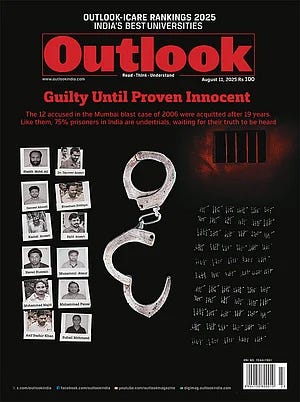
When Newslaundry published its article and podcast about Outlook’s alleged decline under Sinha’s leadership, one of the arguments they repeatedly leaned on was the magazine’s choice of covers. The basic suggestion was that Outlook had somehow lost its political bite because its covers did not always feature the face of a major political leader who was being criticized inside the magazine. But this argument falls apart the moment we actually look at the covers they seem to have overlooked. On 12 December 2022, Outlook published Aa Gujarat Main Banavyu Che, a cover focused on the Gujarat elections, with Narendra Modi’s face prominently featured. The 14 June 2021 issue, Yogi’s Litmus Test, which examined Yogi Adityanath and the politics surrounding him, also carried his face on the cover. Narendra Modi appeared again on the 11 February issue titled Omnipresent Omniscient. The 1 July 2025 issue featured Benjamin Netanyahu and Ayatollah Khomeini, while Donald Trump appeared on the covers of issues published on 11 April 2026 and 21 April 2026. If the argument is that Sinha systematically removed powerful political figures from Outlook’s covers, then these covers are not minor exceptions. They directly contradict the central premise being presented.
What makes this particularly revealing is how eagerly the argument appears to have been constructed around a selective reading of the magazine. A few covers were picked, a conclusion was drawn and the conclusion was then presented as evidence of an editorial decline. But covers cannot be judged in isolation from the editorial philosophy of a magazine. It is not necessary for every issue to put a prime minister, chief minister, politician, journalist or celebrity on the front simply because these are the people mainstream media already gives disproportionate attention to. They have cameras following them, newspapers carrying their statements, television channels discussing their every move and social media amplifying them endlessly. The purpose of a magazine does not have to be to reproduce that same hierarchy of visibility.
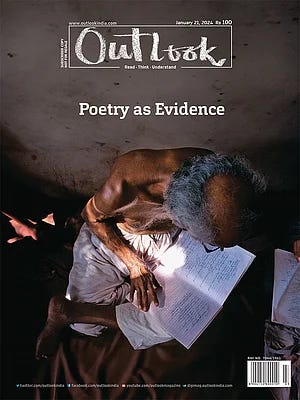
Sinha’s editorial approach appears to have attempted something different. Instead of assuming that a magazine must always place the most powerful person in the country on its cover, she created space for people and visual ideas that are often pushed to the margins of mainstream attention. From Phoolan Devi to an ordinary man sitting with his poetry manuscript, the covers attempted to expand the idea of who deserves to occupy the front page. That is not necessarily a retreat from politics. It can itself be a political editorial choice. A magazine can talk about power without always putting the powerful person’s face on the cover. It can examine politics through art, photography, ordinary lives, cultural memory and visual experimentation. In fact, that can be a far more ambitious understanding of journalism than simply reproducing the faces that television channels have already made ubiquitous.
This is also where the criticism of the covers begins to look intellectually lazy. Under Sinha’s editorship, Outlook was experimenting more visibly with paintings, photography, visual compositions, the merging of different art forms and covers designed to speak to a contemporary audience. Instead of engaging with that editorial experiment, Newslaundry seems to have turned the covers themselves into evidence of professional decline. But where is the actual connection between a different cover aesthetic and a decline in journalistic quality? Does an unconventional cover make the reporting inside the magazine weaker? Does using an artist instead of a politician mean the political journalism has disappeared? Does a photograph of someone outside the traditional structures of power automatically indicate that the magazine has lost its ‘bite’? None of these claims can simply be assumed. They have to be demonstrated.
The problem becomes even more serious when selective evidence is used to establish a moral position. Once the argument is framed as “Outlook has lost its edge”, every editorial decision can be made to serve that conclusion. A cover without a politician becomes evidence. A visual experiment becomes evidence. A different editorial emphasis becomes evidence. But covers featuring Modi, Yogi Adityanath, Netanyahu, Khomeini, Mamata Banerjee, or Trump suddenly disappear from the argument because they do not fit or support the narrative. This is not a neutral assessment of an editorial policy. It is confirmation bias presented as investigation.
There is also a question of privilege in deciding what a politically serious magazine is supposed to look like. Why should political seriousness always be measured by the number of powerful men staring from a magazine cover? Why should the absence of a politician be interpreted as the absence of political journalism? This expectation itself reveals something about the hierarchy of visibility within journalism. Powerful people are treated as inherently newsworthy, while ordinary people, artists, writers and marginalized voices are expected to justify their presence. Sinha’s decision to challenge that hierarchy may be criticized, but it cannot honestly be described as a lack of editorial vision simply because it does not conform to the traditional grammar of political magazines.
The irony is that the people criticizing these choices appear to be doing exactly what they accuse the magazine of doing. They are narrowing the definition of what journalism should look like. They are deciding that a politically relevant cover must look a certain way, that a magazine must foreground certain kinds of people and that editorial experimentation is evidence of decline. The criticism therefore says as much about the critic as it does about the publication being criticized. It comes from a position of institutional and cultural privilege that assumes its own understanding of journalism is the correct one.
A cover is not a newsroom audit. It is not a circulation report, a fact-checking exercise or an assessment of journalistic ethics. If someone wants to establish that Outlook declined under Sinha, there are far more meaningful questions to investigate: the quality of its reporting, the range of its investigations, its editorial independence, the diversity of its voices, its corrections, its readership, its commissioning practices and the impact of its journalism. Instead, turning the artistic and editorial design of its covers into a central piece of evidence is an extraordinarily weak way of making a serious professional allegation.
The larger point is simple. Sinha did not abandon political journalism. Rather, she refused to make every powerful person the visual centre of the magazine through more than many issues. She attempted to ask a different question, who else deserves to be seen? Who else is doing the right kind of politics under the wrong regime and patriarchal society? These questions are uncomfortable precisely because they challenge the old hierarchy of journalism, where power gets visibility and visibility is mistaken for importance. If a magazine chooses to widen that space, it should be debated on its merits. But selectively collecting covers, ignoring those that contradict the argument and then presenting the result as evidence of an editor’s professional failure is not an investigation. It is a predetermined narrative looking for confirmation.
MAKING ROOM FOR LITERATURE
Newslaundry also seems particularly uncomfortable with the fact that, under Sinha, Outlook was becoming more literary. Their criticism appears to assume that a magazine moving towards literature necessarily means it is moving away from investigative journalism. But this is a very narrow understanding of what journalism can do. Sinha was not replacing political journalism with literature. She was creating another route through which political voices could enter a mainstream publication. Writers who had strong social and political positions, but often found limited space in mainstream media, were being given room to write about their experiences, ideas and politics in forms that were not restricted to the conventional journalistic report. From book reviews and poetry to literary non-fiction and personal essays, the magazine was opening itself to writers whose voices were important precisely because they did not always fit comfortably within the existing media establishment.
This distinction matters because the literary ecosystem itself is not as open as it likes to imagine. Many literary magazines, whether online or print, avoid publishing writing that is overtly and directly political because they operate within an oppressive political and economic environment and, like every other institution, have to sustain themselves. Others remain largely focused on fiction, poetry and criticism while rarely taking on writing that requires extensive ground-level research or carries an explicit political position. This is not necessarily a failure on their part, but it does mean that there are writers whose work falls between these institutional spaces. They may be too political for some literary journals, too literary for conventional newsrooms, and too critical for publications that prefer to remain safely within established boundaries. That is precisely why Outlook becoming more literary under Sinha cannot automatically be treated as evidence of decline. It can also be understood as an attempt to occupy a space that many others have abandoned.
Look at the writers who were given space. Anand Teltumbde’s literary non-fiction appearing across different issues of the magazine, or Moumita Alam’s strong feminist and anti-Hindutva writing, are not simply decorative literary additions to a political magazine. These are voices carrying political arguments, lived experiences and ideological positions that deserve to be heard beyond the relatively closed circles of privileged literary and academic publishing. Had such pieces remained confined to specialized literary journals, academic publications or small ideological spaces, their readership would have been considerably narrower. Outlook, under Sinha, offered these writers access to a mainstream readership while allowing them to write in forms that were more intimate, reflective and personal than a conventional news report. That is not abandoning journalism. It is expanding the possibilities of political writing.
This is where Newslaundry’s criticism becomes particularly problematic. If the complaint is simply that the magazine published more literature, then one has to ask what exactly is wrong with that. If the complaint is that literature cannot be political, then that is an extraordinarily outdated understanding of literature. If the complaint is that political writing must always appear in the form of an investigative report, then that reduces journalism itself to a formula. A poem can carry a political position. A personal essay can document structural violence. Literary non-fiction can expose a system more intimately than a conventional report. A writer documenting their own life under a particular political or social reality can sometimes tell us things that statistics and official statements cannot. The form changes, but the politics does not disappear.
The same logic applies to the People’s Archive of Rural India (PARI). It does not restrict itself to one rigid definition of journalism. It documents lives, publishes field-based reporting, carries photographs, supports translators and creates space for writers who might otherwise remain outside mainstream publishing. Its importance lies precisely in its willingness to recognize that people need to be represented in multiple forms. If Newslaundry’s criticism of Outlook is that it was opening itself to literature, personal writing, translation and voices outside conventional journalism, then the criticism indirectly raises a much larger question about what kind of media ecosystem we actually want. Do we want every publication to follow the same model, use the same language and publish the same kind of political material? Or do we want more spaces where political ideas can enter public discourse through different forms and from people who are otherwise excluded from mainstream visibility?
There is an uncomfortable contradiction here. When institutions close their doors to writers because their politics are inconvenient, they often describe it as editorial discretion. When another institution opens its doors to those writers through a different form, suddenly that becomes a dilution of journalistic standards. The result is that the same voices keep getting pushed from one space to another until they have nowhere left to go. This is how a subtle form of cancel culture operates. Nobody has to formally ban a writer. You simply make every available space conditional on them changing their politics, their form or their language.
Sinha’s editorial approach, at least in this respect, seems to have challenged that logic. She did not insist that every political voice had to speak in the language traditionally accepted by mainstream journalism. She allowed writers to speak through literature, memory, criticism, poetry, personal experience and literary non-fiction. That choice can certainly be debated, but it cannot simply be dismissed as a retreat from serious journalism. In fact, for writers who have been systematically pushed towards the margins, giving them a mainstream platform may itself be an act of editorial intervention.
The irony is that a publication criticizing the magazine for becoming a literary space should perhaps ask why such spaces matter in the first place. Journalism does not exist only to expose governments. It also exists to record society, preserve memory, document lived experiences and make people visible. Sometimes the most political thing a publication can do is allow someone who is usually spoken about to finally speak for themselves. If the magazine under Sinha’s guidance was attempting to create that space, then reducing the experiment to “the magazine became literary” is not criticism. It is an unwillingness to recognize that journalism can take forms beyond the ones traditionally sanctioned by powerful media institutions.
And that is perhaps the biggest weakness in Newslaundry’s argument. In trying to prove that Outlook had lost its edge because it was publishing literature, they seem to overlook what that literature was actually doing. They saw the form but ignored the voices. They saw poetry but ignored the politics within it. They saw literary non-fiction but ignored the experiences being documented. They saw a magazine becoming more literary but failed to ask why that literary space was being created and who was finally being allowed to enter it. When political voices are denied space in one part of the media ecosystem, opening another door for them is not a retreat from journalism. It is a challenge to the gatekeepers of journalism. And perhaps that is precisely why the decision makes some people uncomfortable.
IT MADE SOUND, THEY WANTED NOISE
When Priyanka Ishwari and Tanishka Sodhi repeatedly suggest in the article and podcast that Outlook was no longer “making much noise” after Sinha became editor-in-chief, the claim sounds not only vague but almost impossible to measure. What exactly constitutes “noise” in journalism? Is it the number of political leaders appearing on covers? The number of television debates that discuss a story? Or is it the ability of a magazine to put difficult stories, unpopular voices and suppressed narratives into the public domain? If it is the latter, then the claim becomes difficult to sustain. In fact, some of the strongest examples from Sinha’s tenure directly contradict it.
Eight months after these allegations were published, Zohran Mamdani, now the Mayor of New York City, publicly read Umar Khalid’s letter, My Dear Apocalypse, originally published in Outlook on 17 January 2022. The cover of that issue did not carry a political leader. Umar Khalid was not on the cover either. It showed two terrains divided by a road, a deceptively simple image that carried an entirely different kind of political meaning. Yet that piece travelled far enough to be read publicly by one of the most prominent political figures in New York. Was that not “noise”? What exactly were the writers looking for? A screaming television headline? A politician’s photograph? A viral hashtag? Chinki Sinha and her team had gone to Tihar Jail and asked Umar Khalid to write that piece. Anyone who understands the circumstances surrounding his incarceration knows that getting such a piece out was not an ordinary editorial exercise. It required access, persistence and a willingness to create space for a voice that the mainstream media could easily have ignored.
The same problem appears when we look beyond a single article. The 1st February 2024 issue titled In the Name of Ram carried Kishore Desai’s piece, which became an important voice for many secular Indians because it attempted to explain how Ram is understood by ordinary people rather than simply reproducing the political language surrounding Ram. Again, this is journalism that does not necessarily conform to the narrow idea of what “noise” is supposed to look like. It is not about shouting louder than everyone else. It is about putting something into public discourse that would otherwise remain poorly understood. If a magazine gives readers the opportunity to encounter a subject through lived experience, cultural memory and individual interpretation, its impact cannot be measured merely by whether a political establishment reacts to it.
The claim that the magazine was also no longer doing sufficiently journalistic work becomes equally difficult to defend. Take Snigdhendu Bhattacharya’s Reduced To ‘Nowhere People’, How Anglo-Indians Are Waging A Battle For Survival. The piece draws from timelines, census reports, interviews with ordinary people and conversations with political leaders. It involves exactly the kind of groundwork that journalism demands. Avantika Mehta’s A Class Of Controversies: How NCERT’s Revised History Curriculum Politicises Education examines more than five decades of educational and historical material to make its argument about the politicisation of education. If this is not research-based journalism, then perhaps the problem is not with Outlook’s journalism but with the definition of journalism being used to judge it. It is very easy to say that a magazine has stopped doing serious journalism. It is considerably harder to make that claim when the actual reporting is placed in front of you.
There is another example that exposes the ideological inconsistency even more sharply. A supposedly left-liberal media ecosystem that claims to care about journalism and dissent did not, according to this account, make space to properly acknowledge Tarun Bhartiya, the photographer, filmmaker and journalist whose work documented Meghalaya and kept alive an important strand of left political thought and cultural documentation in India. Yet the same ecosystem found space to publish a letter defending a convicted rapist. Chinki Sinha, on the other hand, chose to pay tribute to Bhartiya and acknowledge his contribution. That editorial decision matters because journalism is not only about breaking news. It is also about deciding whose work deserves to be remembered, whose voice deserves to be heard and whose contribution should not disappear from public memory.
This is why the Newslaundry narrative becomes increasingly difficult to reconcile with the examples. The problem is not that every story published under Sinha was necessarily brilliant. No editor can produce an uninterrupted catalogue of exceptional journalism. The problem is the sweeping conclusion that the magazine stopped making noise or stopped doing serious journalism when there are so many examples pointing in the opposite direction. A few selected examples cannot establish institutional decline, particularly when other examples that contradict the argument are simply left outside the frame.
And perhaps that brings us back to the question that sits beneath this entire controversy: who is actually uncomfortable with a woman taking charge? Because the resistance to Sinha’s editorial choices cannot be separated from the larger history of how women in positions of authority are treated. When a man makes unconventional editorial decisions, he is often described as experimental. When a woman does it, the same decisions can become evidence of incompetence. When a man is outspoken, it becomes personality. When a woman is outspoken, it becomes arrogance. When a man changes an institution, he is credited with vision. When a woman changes it, people begin asking whether she has destroyed what existed before her.
The issue, therefore, is not that every criticism of Sinha is misogynistic. This would itself be an intellectually lazy argument. The issue is that criticism has to be examined for the structures of power through which it operates. Who gets to define what journalism is? Who gets to decide what counts as impact? Who gets to determine whether a magazine has “bite”? And why is a woman’s attempt to expand the editorial vocabulary of a mainstream publication so easily interpreted as a decline?
At the same time, there is a much more serious problem when criticism of a journalist’s work stops being about journalism and starts becoming an attack on the journalist herself. When publications such as Newslaundry and The Caravan describe Sinha through words such as ‘toxic’, ‘egoistic’ and other judgments about her personality, they move beyond the legitimate boundaries of professional criticism. You can question an editor’s decisions. You can challenge her editorial politics. You can disagree with the way she runs a newsroom, the stories she commissions or the direction in which she takes a magazine. But the moment the argument shifts from “this editorial decision was wrong” to “this woman is toxic” or “this woman has an ego”, the subject of scrutiny has changed. It is no longer the journalist. It is the woman.
This distinction is not trivial. In fact, it is one of the oldest mechanisms through which women in positions of authority are undermined. A man can make an unpopular decision and the decision is debated. A woman makes the same decision and her personality is immediately brought into the discussion. Her confidence becomes arrogance. Her firmness becomes toxicity. Her insistence becomes ego. Her authority becomes an attitude problem. The professional disagreement slowly becomes a character judgment, and once the character judgment enters the narrative, everything she does can be interpreted through it. This is precisely how misogynistic structures work. They do not always need to say that a woman is incapable because she is a woman. They simply create a narrative in which her personality becomes the problem, and eventually her professional credibility is made to look inseparable from that personality.
This is also why calling out Sinha’s editorial choices is legitimate, but constructing a narrative around her identity is not the same thing. If her editorial decisions weakened the magazine, demonstrate how. If she failed as an editor, document those failures. If her management practices harmed the newsroom, provide evidence and allow those claims to be examined. But calling her ‘toxic’ or ‘egoistic’, does not establish any of those things. These are subjective descriptions, not professional evidence. They tell us what the writers think about her, but they do not establish what she actually did. Journalism cannot turn personal dislike into fact simply by publishing it.
The problem becomes even more glaring when these descriptions are attached specifically to a woman who has occupied a position of institutional power. The expectation seems to be that a woman can be powerful only as long as her power remains comfortable for everyone around her. The moment she exercises authority in a manner that others dislike, the vocabulary changes. She is no longer simply an editor making decisions. She becomes ‘difficult’, ‘toxic’, ‘egoistic” or ‘controlling’. This is a familiar pattern across workplaces, politics, academia and media. Women are often allowed to occupy positions of authority, but they are simultaneously expected to perform a particular kind of acceptable femininity while doing so. They must be powerful, but not intimidating. Decisive, but not difficult. Confident, but not arrogant. Assertive, but never controlling. The rules are contradictory by design.
What makes this especially troubling in journalism is that journalists are supposed to understand the difference between investigating a person and constructing a personality. A journalist’s job is not to diagnose someone based on workplace anecdotes, impressions or selective accounts. It is to establish what happened, who was involved, what evidence exists and what can be independently verified. Once personality becomes the central evidence, journalism risks becoming gossip with institutional legitimacy. Calling someone ‘toxic’ does not tell readers what she did. Calling someone “egoistic” does not establish professional misconduct. These descriptions may make for compelling narratives, but compelling narratives are not necessarily truthful ones.
And this is where the gendered dimension cannot simply be ignored. If the criticism were genuinely about journalism, then Sinha’s journalism should remain at the centre of the discussion. Her stories, editorial decisions, commissions, interviews, investigations and management choices should be examined. Instead, when the narrative repeatedly moves towards describing what kind of person she supposedly is, the journalist begins to disappear behind the woman. Her identity becomes the story. Her personality becomes the evidence. Her behaviour becomes the explanation for everything. That is not merely a criticism of an editor. It is a familiar mechanism for disciplining women who refuse to make their authority palatable.
There is a fundamental difference between saying, “Sinha made a poor editorial decision,” and saying, “Sinha is a toxic person.” The first is an argument that can be tested. The second is a judgment of character. One demands evidence. The other demands that the reader accept someone else’s perception. When media institutions blur that distinction, they risk reproducing the very patriarchal structures they claim to challenge. Perhaps the most important question, then, is why the woman herself has to become the subject when her work can be examined on its own. Why must an editorial disagreement become a personality assessment? Why must a woman who exercises authority be described through her temperament rather than her professional record? And why does a powerful woman so quickly become the story instead of the journalism she produces?
Criticize Sinha’s journalism. Question her editorial decisions. Challenge her politics. Examine her record. But leave the misogynistic vocabulary of personality assassination out of it. The moment criticism stops interrogating what a journalist did and starts telling readers what kind of woman she supposedly is, it ceases to be simply professional scrutiny. It becomes an attempt to diminish the woman behind the position. And that is precisely where a supposedly liberal media establishment needs to look at itself before claiming the moral authority to lecture anyone else about patriarchy. And then to stay safe, they make it entirely about Outlook’s failure to create any noise.
The answer cannot simply be that Sinha failed to make enough noise. The evidence presented by the magazine itself suggests something else. She gave Umar Khalid a platform from inside Tihar. She published writing that questioned the politics of religion. She commissioned research-heavy reporting on communities and education. She created space for writers, photographers and cultural figures who were not necessarily receiving mainstream attention. She preserved the work and memory of people like Tarun Bhartiya. These may not all fit into the conventional idea of headline-making journalism, but they are precisely the kinds of editorial choices through which a publication builds a broader public sphere.
Newslaundry appears to be asking why the magazine was not making the kind of noise they expected. Sinha’s editorial record, however, suggests that she was interested in making a different kind of noise, one that did not always come from the people already occupying the centre of public attention. And perhaps the problem is that when a woman begins changing who gets to speak, who gets to be seen and what gets to be considered journalism, the people accustomed to controlling that space start mistaking the loss of their control for the decline of the institution. No man owns journalism. No woman owns it either. The newsroom, the magazine and the public sphere belong to everyone. But men who have spent generations treating those spaces as extensions of their own authority may find it difficult when a woman enters, changes the rules and refuses to ask for permission. This discomfort should not be confused with evidence of failure.
THE BECOMING OF WHAT THEY DESPISE, I SUPPOSE
Both the Newslaundry journalists and the writer from The Caravan have pointed to the number of people who resigned during Sinha’s tenure as evidence of a supposedly toxic workplace. It is entirely possible that several people did resign during that period. That fact, by itself, is not something that needs to be disputed. But a resignation is not automatically evidence of workplace toxicity, and the fact that some of those who left were women does not suddenly make the conclusion stronger. If anything, it makes the question more complicated. People leave organizations for hundreds of reasons like disagreements with the management, better opportunities, personal circumstances, career changes, salary, relocation, editorial differences, professional ambitions or simply because they no longer want to continue in that particular workplace. To turn the fact of resignation into proof of misconduct requires considerably more evidence than the resignation itself.
There is a very basic distinction here that journalism should understand is that correlation is not causation. The fact that people left while Sinha was editor does not establish that they left because Sinha was toxic, abusive or professionally unethical. If that is the claim, then it needs to be investigated. Why did each person leave? What exactly happened before their resignation? Were there complaints? Were those complaints formally recorded? Were there witnesses? Did the organization investigate them? Did the employees themselves identify Sinha’s conduct as the reason for leaving? Were there other factors involved? Without answering these questions, the argument remains circumstantial. It may create suspicion, but suspicion is not evidence.
The logic becomes clearer if we look at the MeToo movement. When allegations against Sajid Khan emerged, several women, including Tanushree, Sherlyn Chopra and Saloni Chopra, spoke about their experiences. The fact that other actors had worked with Khan but had not publicly accused him could not be used to invalidate the women who came forward. At the same time, the existence of people who had worked with him and had not complained could not, by itself, prove that the allegations were false. Both things could exist simultaneously. Someone can have had a different experience of the same individual. Someone can choose not to speak. Someone may not have witnessed the behaviour in question. Someone may have left the workplace for an entirely different reason. The absence of an allegation is not proof of innocence, just as the existence of a resignation is not proof of misconduct.
The same principle has to apply to Sinha. If a woman journalist resigned from her team, her resignation deserves to be respected and, if she has made an allegation of misconduct, that allegation deserves to be taken seriously. But neither her resignation nor anyone else’s resignation can automatically become evidence of a toxic workplace. If the argument is that there was a pattern of harassment or professional misconduct under Sinha, then the journalists making that claim had a responsibility to investigate the pattern rather than simply list departures and allow readers to draw the conclusion themselves. A serious allegation requires a serious investigation.
Instead, what we seem to have is a strange inversion of journalistic responsibility. The circumstantial evidence is presented as though it is conclusive, while the investigation that could have established whether there was actually a pattern appears to be missing. The people who left could have been approached. Their reasons could have been documented. Former employees could have been interviewed on record or, where necessary, with appropriate confidentiality. Workplace complaints could have been examined. Timelines could have been established. Contradictory accounts could have been tested. Other members of the newsroom could have been interviewed. That is what an investigation looks like. Simply saying that several people resigned and then attaching the word “toxic” to the workplace is not enough.
And this is where the treatment of Sinha becomes particularly disturbing. Once the label of a ‘toxic workplace’ is established without sufficiently demonstrating the circumstances behind each departure, every subsequent event begins to reinforce the original narrative. Someone resigns, and it becomes evidence. Someone criticizes her, and it becomes evidence. Someone has a disagreement with her, and it becomes evidence. Someone does not like her management style, and it becomes evidence. Eventually, the allegation becomes the framework through which every action is interpreted. At that point, the journalist is no longer investigating the person. The journalist is building a case against her.
There is another uncomfortable dimension to this. If a woman editor is being publicly described as toxic, egoistic or professionally problematic, the burden on the journalists making those claims should be higher, not lower. Such labels can materially affect a person’s professional reputation and future opportunities. They should not be casually constructed from circumstantial information. If there is evidence of misconduct, publish it. If there are former employees willing to describe specific incidents, report those incidents responsibly. If there are documented complaints, examine them. But if all that exists is the fact that people resigned, then the honest conclusion is that people resigned. Everything beyond that requires proof.
What is happening now is even more troubling if, as you suggest, the scrutiny has moved from investigating her professional record to repeatedly tracking, monitoring or harassing her. There is a fundamental difference between journalism scrutinizing a powerful editor and a sustained campaign in which the individual herself becomes the object of attention. Once a journalist has established that people left an organization, the next step should be to investigate why. It should not be to stalk the person, repeatedly frame her as toxic or continue searching for material that confirms an already established narrative.
The irony is that the same media institutions that speak so strongly about evidence, accountability and ethical journalism should understand this distinction better than anyone. A resignation is a fact. The reason for that resignation is another fact that needs to be established. A workplace being described as toxic is an allegation. Whether it was actually toxic is a matter requiring investigation. And Sinha being a “toxic” person is a completely different claim altogether, one that cannot be established simply by putting together a list of people who left.
If there is a genuine pattern of misconduct, investigate it. Do not manufacture certainty from circumstances. If there are women who left because of Sinha’s conduct, let their experiences be heard and independently examined. But their existence should not be used selectively to construct a predetermined narrative, just as the existence of women who remained should not be used to disprove allegations. Journalism has to be capable of holding both possibilities at once. Otherwise, what is being produced is not accountability. It is a narrative in search of evidence. And once the narrative is about a woman who has already been repeatedly described through words such as ‘toxic’ and ‘egoistic’, the danger is that professional criticism has quietly transformed into character assassination.
The most laughable contradiction, however, appears when we look at the treatment of the woman who accused Tarun Tejpal of sexual violence and misconduct. Nirupama Sekhri, the sister of Newslaundry founder Abhinandan Sekhri, wrote a letter questioning the woman’s account, and the letter was received with considerable appreciation. Newslaundry and its audience appeared willing to engage with, and even applauded it, a text that placed the credibility and conduct of a woman who had made an allegation of sexual violence under intense scrutiny. So, what exactly was that? Was that not witch-hunting? Was that not a form of vilification? If the same media ecosystem has spent years speaking about the importance of the MeToo movement, of believing women and of challenging structures that silence survivors, then why did those principles suddenly become negotiable when the accused happened to belong to a familiar intellectual and media circle?
This is where the contradiction becomes impossible to ignore. You cannot build your public identity around supporting MeToo and then become remarkably generous towards the accused when the accused is someone from your own ideological or professional ecosystem. You cannot repeatedly tell society that women must be heard and then turn around and dissect the motives, character and credibility of a woman when her allegation becomes inconvenient. The entire point of MeToo was never that allegations should be believed blindly. It was that allegations should be taken seriously, investigated responsibly and not dismissed simply because the accused happens to be powerful, famous, influential or politically convenient. If your commitment to those principles disappears when the accused is someone you know, admire or identify with, then perhaps the commitment was never to the principle in the first place.
The subsequent support extended by sections of the intellectual and cultural establishment to Tejpal makes the contradiction even more uncomfortable. If a court has convicted a person, and if the legal process subsequently results in imprisonment or other punishment, the appropriate response from intellectuals should be to engage with the judgment, the evidence and the legal reasoning. It should not be to transform the accused into a political martyr simply because he belongs to a particular intellectual circle or because his supporters believe that his politics make him worthy of protection. Ideology cannot become a shield against accountability. The Left cannot have one standard for sexual violence committed by people on the Right and another for people within its own circles. The Right cannot do the same. The moment political identity determines whether we take an allegation seriously, we have already abandoned the principle we claim to defend.
There is an even deeper problem here. Many of these same people have repeatedly emphasized the idea that men must be held accountable for the structures that enable sexual violence. Yet when accountability comes close to home, the language changes. Suddenly there are explanations, qualifications, political contexts and elaborate arguments about the character of the accused. The woman becomes questionable, while the man becomes complicated. The allegation becomes political, while the accused becomes ideological. This is precisely how patriarchy protects itself. It does not always deny that sexual violence exists. It simply creates exceptions for the men it considers worth saving.
Newslaundry’s removal of the letter from its platform, as you point out, makes the episode even more significant, although the circumstances surrounding its removal should themselves be documented rather than assumed. If a publication once considered a particular argument legitimate enough to publish and later removed it, readers are entitled to ask why. What changed? Was the editorial judgment reconsidered? Was there criticism? Was there new information? Transparency matters because otherwise the deletion itself becomes another part of the contradiction. A publication cannot demand accountability from everyone else while treating its own editorial decisions as beyond scrutiny.
And this brings us to the uncomfortable question, who are we actually fighting for? There was a time when many young people looked towards writers, journalists, academics and intellectuals as moral reference points. We believed they would stand with principles even when those principles became inconvenient. But admiration becomes dangerous when it turns into loyalty. The moment we begin defending a person because we admire their politics, their writing or their intellectual reputation, rather than examining what they have actually done, we stop being principled and start becoming part of a camp.
The comparison of Tejpal with Umar Khalid, particularly if made by Tejpal himself or his supporters, is another matter that deserves serious scrutiny rather than rhetorical equivalence. Umar Khalid’s imprisonment and the allegations against Tejpal arise from entirely different factual and legal contexts. Conflating them simply because both involve people who have become symbols within political discourse reduces both cases to ideological ammunition. A person facing criminal proceedings cannot automatically claim the moral legitimacy of another person simply because both have been treated controversially by the state or media. If anything, such comparisons trivialize the experiences of everyone involved. One stood against the government and is in prison for six years but still has a smile on his face, and the other is a rapist and no matter what ideology he believes in, what his history is, the act cannot or should not be forgiven.
And this is where the argument returns to Chinki Sinha. The contradiction is stark. A woman who changed the editorial vocabulary of a mainstream magazine, opened space for writers who were often excluded from conventional media, commissioned political and literary work, and brought marginalized voices into a wider public conversation is subjected to descriptions such as toxic and egoistic. Meanwhile, when allegations of sexual violence are directed at a powerful man within a familiar intellectual ecosystem, some of the same people who speak loudly about feminism suddenly become extraordinarily interested in defending the accused. That is not feminism. This is ideological loyalty dressed up as feminism. This is a bubble that has been created to stay relevant.
And the principle should be brutally simple. It should not matter whether you are Left, Right, liberal, conservative, socialist, nationalist or politically unaffiliated. If you defend sexual violence because the accused belongs to your ideological family, you have abandoned the principle you claim to represent. If you question a woman’s credibility because her allegation is inconvenient to your political camp, you are participating in the same patriarchal structure you claim to oppose. And if you use a woman’s personality, temperament or professional identity to discredit her rather than examining the evidence against her, you are not challenging patriarchy. You are reproducing it.
The same standard has to apply to journalism You cannot demand accountability for powerful men while refusing accountability for powerful women, nor can you defend women only when they belong to your ideological camp. Perhaps the real fight then, is not for the intellectuals we once admired. It is for the principles we once believed they represented. People can disappoint us. Institutions can contradict themselves. Political camps can become hypocritical. But the principles of evidence, equality, due process and opposition to sexual violence cannot be allowed to change depending on whose name appears in the allegation. If we abandon those principles whenever they become inconvenient, then we are not fighting patriarchy. We are simply choosing which patriarchy we are willing to tolerate and which to criticize because it will keep us trending.
+++++++++++++++++

