The Soviet-Jewish writer bore eternal witness to the crimes of totalitarianism
Vasily Grossman, the Russian-Jewish writer best known for the 1959 novel titled Life and Fate, has that book’s protagonist, Viktor Shtrum, express the view that the USSR is remarkably similar to its mortal enemy, Nazi Germany. Both are one-party states; both use unlimited violence against their own people; both suppress all disagreement; both rewrite the past whenever it suits them; and both maintain concentration camps on a vast scale. Still worse, they both regard some people as enemies not because of anything they had done, or even thought, but simply because of their ancestry.
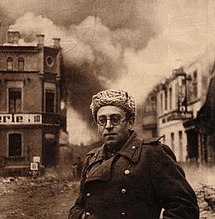
Vasily Grossman with the Red Army in Schwerin, Germany, 1945
In Germany, Jewishness earned a sentence to Auschwitz or Treblinka; in Stalinist Russia, the Gulag consumed those who belonged to the wrong social class. It makes no difference, Shtrum reflects, whether a person is good or bad, gifted or stupid, loyal or disloyal:
Hitler says none of that matters—all that matters is that they’re Jewish. And I protest with my whole being. But then we have the same principle: what matters is whether or not you’re the son of an aristocrat, the son of a merchant, the son of a kulak…. And we’re not talking about the merchants, priests, and aristocrats themselves—but about their children and grandchildren. Does noble blood run in one’s veins like Jewishness? Is one a priest or a merchant by heredity? Nonsense!
For Grossman, Marxism was racism by class. And it was also simple racism, which is to say discrimination by race, since Stalin purged whole nationalities by deporting them to uninhabitable wastelands. As a rule, half the transported perished, either during the journey or in the harsh conditions of their new home. Life and Fate is set in the period during which Stalin began to go after Jews specifically; it was only his death in 1953 that saved the Jews from mass deportation to Soviet Asia. Jews were condemned for “rootless cosmopolitanism,” and Jewishness became a badge of dishonor: In Grossman’s novel, Shtrum is informed that his discoveries in nuclear physics “stink of Judaism.”
Unsurprisingly, Grossman was not permitted to publish Life and Fate. He died in 1964; dissidents succeeded in smuggling the text out, and when it was published in English in 1980, it was immediately recognized as one of the greatest books of the century. But his career did not follow the path of dissident writers like Aleksandr Solzhenitsyn. He was never imprisoned for his writings and opinions. In fact, he had a successful career and was best known for his novels about World War II and his wartime journalism. As Robert and Elizabeth Chandler note in their splendid collection just published by New York Review Books, From the Front Line: Stalingrad–Treblinka–Berlin, 1941–1945, the Soviets spent enormous resources on journalism and fiction intended primarily for Red Army soldiers—a testament to Russia’s unrivaled emphasis on the importance of literature. More than 1,500 newspapers and periodicals, employing some 5,000 full-time journalists, were produced for the army, and soldiers read Grossman’s articles and his novel The People Immortal to shreds. (The Chandlers released a translation of that novel, also with New York Review Books, four years ago.)
Unlike other journalists, who played it safe, Grossman went to the most dangerous places to interview soldiers under fire. He produced 49 articles about the war, from its first days after the Nazis broke their peace pact with the Soviets and took city after city in an overwhelming onslaught, all the way to the fall of Berlin. Early in the war, his editor gave him two months off to write The People Immortal. Taken together, the novel and articles offer a remarkably powerful portrait of the war as Russians experienced it—and as Jews suffered it.
Grossman was the first person on this earth to report on the Holocaust, in part because the Soviet liberation of parts of Poland in 1944 led to Russia’s discovery of the death camps earlier than the other allied nations’. In two remarkable articles, “Ukraine Without Jews” and “The Hell of Treblinka,” he offered a harrowing picture along with disturbing reflections on what had happened. I thought I was well acquainted with the facts of the Holocaust, but Grossman’s detailed descriptions based on interviews of survivors and the Soviet troops who pushed the Germans out still shocked me.
Shortly after the German defeat at Stalingrad, Grossman observes, Heinrich Himmler visited Treblinka and ordered the construction of crematoria to destroy the evidence of mass murder. Experts supervised the excavation of a pit, about 250 to 300 meters long, 20 to 25 meters wide, and 6 meters deep, to house a giant grill for burning corpses; soon afterward, two more such grill pits were built. Each could incinerate about 4,000 corpses at a time. More than 800 prisoners—“more than the number of workers employed in the furnaces of even the hugest iron and steel plants”—were made to assist in the mass cremations. “This monstrous workshop operated day and night for eight months, without interruption,” Grossman explains, “yet it still could not cope with the millions of human bodies,” inasmuch as trains were still bringing more and more Jews.
But that was not the worst of it. The Germans “singled out for particular torment those who had participated in the uprising of the Warsaw Ghetto.” These survivors of the great and tragic stand in 1943 were not gassed and then burned, like other Jews; they were instead taken straight to the grill pits and burned alive.
Mothers crazed with horror were forced to lead their children on to the red-hot grill where . . . corpses tossed and turned as if they had come back to life again, where the bellies of women who had been pregnant burst from the heat and babies killed before birth were burning in open wombs. Such a spectacle was enough to rob the most hardened man of his reason, but its effect—as the Germans well knew—was a hundred times greater on a mother struggling to keep her children from seeing it. The children clung to their mothers and shrieked, “Mama, what are they going to do to us? Are they going to burn us?” Not even Dante in his Hell saw scenes like this.
For the guards, it all made a diverting spectacle. “Sometimes the SS organized a kind of picnic by the grill pits; they would sit upwind from them, eat, drink wine, and watch the flames.” “Sit upwind”: This detail illustrates Grossman’s technique of first shocking readers with a description and then leading them to imagine still more. What was that smell like that the SS men were avoiding? Horror hinted at magnifies horror expressed.
All the same, Grossman seems to despair at the inadequacy of received forms of expression to what he witnessed. The destruction of Jews in countless destroyed Ukrainian villages forms the central theme of “Ukraine Without Jews.” What most shocks Grossman is what he does not see and the sounds he does not hear. No trace of recently abundant Jewish life remains: “The Jews of Ukraine are silent. There are no Jews in Ukraine. Not in a single city, nor even in one of Ukraine’s hundreds of shtetls or thousands of villages, will you see the dark little face of a hungry Jewish boy or the dark, tear-filled eyes of a small Jewish girl; nowhere will you hear the slow, sorrowful voice of an old Jewish woman. Stillness. Silence.”
Stalin is supposed to have observed that one death is a tragedy but a million is a statistic. The artistic problem facing Grossman was the same that confronted Solzhenitsyn in his descriptions of the Gulag: how to reveal the horror behind the numbers.
The Mishnah tells us that whoever destroys a single life destroys a world, and whoever saves a life saves a world. Grossman wants us to imagine whole worlds destroyed, one after another—each world distinct, each infinitely precious, each lost forever. To do so, he lists the many occupations of the murdered: “Tailors, hatmakers, cobblers, tinsmiths, jewelers, housepainters, furriers, and book binders—have been murdered; porters, mechanics, electricians . . . have been murdered; millers, bakers, cooks, and water-carriers have been murdered; doctors, dentists, surgeons, gynecologists and physiotherapists have been murdered.” The list goes on for a page. Occupations are just one way to imagine lost lives: “Grandmothers who could mend stockings and bake tasty bread, who could cook chicken soup and make apple strudel with walnuts, have been murdered; grandmothers unable to do anything except love their children and grandchildren have been murdered; women always faithful to their husbands have been murdered, and so have frivolous women; beautiful young women, jolly schoolgirls, and serious woman students have been murdered;… the blind and deaf-mute have been murdered;…. two-year-old and three-year-old children have been murdered; eighty-year-old men with eyes clouded with cataracts…newborn babies sucking at their mothers’ breast until their last moment have been murdered.” And that’s not the whole of it: It is not just individuals who have been murdered but a whole people, a faith, a tradition.
No list can do justice to so many worlds destroyed. As Grossman observes, we grow numb. “Man gets used to everything, the scoundrel!” declares the protagonist of Dostoevsky’s Crime and Punishment. The real story of “Ukraine Without Jews,” we come to realize, concerns the author’s ultimately unsuccessful attempt to bring home to the reader what he has seen. He reflects on his struggle for adequate expression:
Human consciousness is constructed in such an unfortunate—or perhaps fortunate—manner that when someone reads or hears about the death of millions of people, they simply cannot grasp what has happened. They cannot imagine it; they cannot take in the depth of the tragedy. Someone who… chances to witness a truck crushing an eight-year-old child may feel shaken for the next few days…. But no one is endowed with the power and sensitivity of mind and soul to comprehend—from books and newspapers—the full horror of what is now taking place in the world.
As Grossman never forgot, something comparable had taken place in the USSR in the previous decade, when several million peasants, mostly in Ukraine and Kazakhstan, were deliberately starved to death during the collectivization of agriculture. In his last novel, Forever Flowing—also unpublishable in his homeland—one character attempts to evoke what mass slow starvation means. Like the Jews murdered by the Nazis, these doomed peasants had done nothing whatever to merit their fate.
_____________
Throughout his writing career, Grossman struggled to put as much as he could into words, to stretch the boundaries of what was expressible. Of course, even under Khrushchev, the Soviets would never have allowed Stalin’s worst crimes to be mentioned. Grossman was also well aware that there was no point in trying to report the mass rapes and sadistic murders of civilians, not only in Berlin but even in Allied countries reached by the Red Army. No less obviously was it impossible to mention the “blocking detachments”: machine gunners placed behind advancing Soviet soldiers ready to mow them down should they try to retreat. Above all, he could not remind readers that during the first third of the war, the USSR was in effect an ally of Nazi Germany.
All this makes sense, but what reason could there be for the limits the censors placed on Grossman’s account of Nazi crimes? Why not use them all for propaganda? For one thing, honest reporting would have entailed describing the many Ukrainians who helped the Nazis murder Jews, a fact unacceptable not only because the regime wanted to describe all Soviet citizens as united in their hatred of fascism but also because of another truth that had to be obscured. Readers might wonder why so many Ukrainians volunteered to help the Germans destroy the USSR, and the regime could not allow them to know that this was so because of the mass-starvation campaign. It was also hard to report on the Nazi destruction of Jews because official policy demanded that one not “divide the dead” by mentioning that Jews were treated differently from anyone else. The regime preferred accusations of Nazi atrocities against undifferentiated “Soviet Citizens.”
In their versions of Grossman’s journalism and The People Immortal, the Chandlers, to reveal his difficulties in saying what he wished, include notes explaining what was omitted, either by editors or by the prudent Grossman himself. They did the same thing in their translation of Grossman’s novel Stalingrad, which went through several changes as the Party line altered. First Grossman had to please Stalin, and then Stalin’s detractor Khrushchev! The Chandlers’ edition allows one to see the text as a kind of palimpsest, with different versions showing through. I know of no other translation of Soviet literature that makes such a detailed reconstruction possible.
The omissions to which the Chandlers call attention are themselves instructive. Grossman ended an article on a soldier named Vlasov by saying that “such a figure, I believe, deserves to be called a great man.” This sentence was deleted, for there could be only one great man in Stalin’s USSR. Also censored was Grossman’s observation that “hatred of the Jews became a furnace: it brought the flames of the Fascist conflagration to their greatest intensity.” This judgment both contradicted Marxist theories of historical causation and placed too much emphasis on the Jews. By the same token, when Grossman observed that Soviet principles “entail respect for Polish property and the independence of the Polish nation,” he may have been trying to convince authorities to endorse such principles, but they already knew what they planned to do with Poland, so the sentence was dropped. Perhaps most interesting is that Grossman’s mention of the fall of Paris had to be excised because the event took place during the Hitler-Stalin pact and so might call attention to the deal Stalin wanted the Soviet populace to forget.
Grossman did his best to write truthfully. When he was criticized for not reporting on the heroic defense of the city of Oriol, he countered daringly that there was no such defense. The Chandlers’ notes explain that Grossman’s editors not only omitted mention of defeats that might dim morale, they also added approved clichés, like “the great [Soviet] army now driving away and annihilating hordes of invaders.” Most Americans are unaware of the difficulties that experts on Soviet literature often face when trying to read through additions and omissions, censorship and self-censorship, to determine the author’s real intention. Often enough, when self-censorship haunted creative work from beginning to end, the author himself did not know.
Grossman once remarked that his reporting and novel were so popular not because they were so good but because everything else on offer was so awful. In his notebooks he quotes the kind of bilge published in Soviet military newspapers: “The severely battered enemy continued his cowardly advance.” Soldiers detected such absurdities and, Grossman reports, circulated a parody: “Ivan Pupkin killed five Germans with a spoon.”
For Grossman, literature, like all forms of creative work, demands independent thinking. One cannot create anything of value to order and according to formula, as official socialist realism demanded. This year the Party needs novels about industrialization! In Life and Fate, Shtrum refuses to think along approved lines. He hits upon a great scientific discovery shortly after a daring conversation in which he and his interlocutor fearlessly explore forbidden ideas. When he returns to physics, still in a mood of free intellectual play, he is at last able to get beyond the puzzling experimental data to see something deeper.
The new theory was not derived [only] from experience. Viktor could see that quite clearly. It had arisen in absolute freedom; it had sprung from his own head…. The theory had sprung from the free play of thought…. The experiments had been merely a jolt that had forced him to start thinking.
“Free play of thought” is precisely what collectivist Stalinism was designed to abort. Socialist realist literature frequently told the story of how a dedicated but naive Communist learns to overcome his “spontaneity”—his individual ideas—and instead embraces “consciousness,” the infallible direction of the Party, which possesses the scientific laws of history. The young man must learn to submit to authority and not think for himself. Nothing could have been further from Grossman’s way of looking at things, and we can appreciate the central drama of his creative life as negotiating the conflict between official conformity and creative energy.
In a somewhat disguised form, that conflict informs a core story in The People Immortal. Bogariov, the novel’s hero, reeducates another officer, Mertsalov, who has all the right qualities except the ability to think for himself. Having earned the country’s highest honor, Hero of the Soviet Union, in the 1940 war with Finland, Mertsalov is surprised when Bogariov reproaches him for wanting to charge heroically at enemy lines when he should have been considering what action would be most effective. It comes as a shock to Mertsalov that he is to think on his own, all the more so because staying at his command post to plan flatly contradicts official Order 270.
“‘Dead husks and shells are the enemy of thought,’ [Bogariov] would sometimes say to himself, as he struggled to let go of some long-held view,” Grossman writes. In the novel’s pivotal scene, Mertsalov takes Bogariov’s lesson to heart and experiences a flash of inspiration:
And suddenly it was as if his heart and mind, everything inside him, were illuminated by a bright joyful light. An extraordinarily simple and mathematically irrefutable solution flashed into his mind.
This flash resembles the one Shtrum experiences in Life and Fate:
A mathematician or physicist is often overwhelmed in the first stage of his research by the complex and obstinate contradictions he has discovered in some apparently simple and ordinary phenomenon. He struggles to reconcile the various elements. . . . And then, as a reward for this arduous work of analysis, a clear and simple thought unexpectedly dawns on him, dispelling all confusion and complexity and yielding the only correct, astonishingly simple and irrefutable solution. This moment is what we call creative thinking.
Never had Mertsalov experienced such joy. When he outlines his plan, his subordinate warns him that it goes against official orders. “‘What of it?’ Mertsalov replied. ‘Remember Babadjanian’s words: the only norm I know is victory.’” Part of this scene was omitted from the published version.
Mertsalov’s plan contradicts Order 270 in more than one way. If the plan should fail, consequences would be dire, inasmuch as Order 270 promised punishment not only for the soldier who disobeyed but also for his whole family (a common Stalinist practice). But the plan succeeds.
In all of his published work, Grossman tested the boundaries of the permissible by using what the Russians have called “Aesopian” language. The term derives from the 19th-century satirist Mikhail Saltykov-Shchedrin’s use of fables to express unorthodox ideas in a disguised form that the censor would not detect.
In The People Immortal, the common soldier Ignatiev, who remarks that he has experienced hunger, is described as an embodiment of the true Russian spirit. He begins the novel unenthusiastic about the war but at last learns to fight wholeheartedly. Reading Aesopically, a Russian might detect in hunger and lack of enthusiasm for the Soviet Union’s struggle for survival an allusion to the terror famine.
At times Grossman Aesopically denounces the Nazis for evils as common—or even more common—in the USSR. Talking to German POWs, Grossman is impressed that none of them expressed any regret for the murder of Jews and other atrocities: “Not once did I observe any sense of shame… with a strange naivete, they continued to believe that a crime against humanity was not a crime if it was carried out for the good of Germany.” Substitute “the Soviet Union” or “the Communist Party” for “Germany” and you have a statement of Leninist ethics, according to which it would be a crime not to commit mass murder, or anything else, if doing so would serve the interests of the Party. To think otherwise would be to embrace the bourgeois idea of universal “extra-class morality.” But “extra class morality” is precisely what Grossman appeals to here and explicitly defends in Life and Fate.
To be sure, Grossman remarks, some Germans objected to Nazi ethics, but the ones who “thought otherwise, who…retained a sense of universal human morality… these Germans had been exterminated or sent to concentration camps.” If they escaped that fate, they remained
silent, aware that the slightest act—the slightest hint of a word or act—will bring about their immediate destruction. In today’s Germany such Germans are not real; their thoughts and speech are paralyzed; every aspect of their lives is frozen. Today there is only one ideology in Germany.
This description applies at least as well to Grossman’s USSR. It was in the USSR, not Germany, that the criminal code defined mere “suspicion of espionage” as a crime in itself—espionage itself was covered under a different article—and so was “contacts leading to suspicion of espionage”! Of course, the USSR proudly proclaimed it was a land of one scientifically proven ideology. Life and Fate would describe in detail how the systematic imposition of “paralysis”—or “hypnotism”—precluded real thought.
In “Ukraine Without Jews,” Grossman declares that the Nazi leaders do not really believe their own propaganda because they “are guided only by the thought of what can be of use at a given moment,” a statement that contradicts an earlier one about the Nazis’ unflagging faith in their system of beliefs. I cannot help wondering whether Grossman meant to allude to Lenin’s insistence that “what can be of use at a given moment” should guide a truly Marxist party. To think otherwise, to cling pointlessly to ideology, was what Lenin famously called “‘Left-Wing’ Communism: An Infantile Disorder.”
_____________
After describing the grill pits at Treblinka, Grossman imagines readers asking—as many did—“Why write about such things?… Why recall such things?” Grossman answers: “It is the writer’s duty to tell the terrible truth, and it is a reader’s civic duty to learn this truth. To turn away, to close one’s eyes and walk past is to insult the memory of those who perished.” Those who want people to forget, Grossman continues, often cite a Russian proverb: “He who remembers the past loses one eye.” They forget how the proverb continues: “And he who forgets the past loses both eyes.”
In his writings, Solzhenitsyn also mentioned people quoting the first half of this proverb while forgetting the second. Both writers warned that such forgetting invites a repeat of the horrors. In his Nobel Prize speech, Solzhenitsyn foresaw that the ideology that enslaved his country was bound to appeal to others. “This torpid inability to understand someone else’s distant grief” is the rule, not the exception. The most rational and well-supported arguments will prove of little avail. Solzhenitsyn could think of only one thing that could “impress upon a sluggish and obstinate human being… an insight into the magnitudes of events and delusions he has never experienced”: Literature, and literature alone, can do that.
Like nothing else, literature has the power to “overcome man’s ruinous habit of learning only from his own experience, so that the experience of others passes by him without profit.” With that typically Russian faith in great writing, Solzhenitsyn affirms that only literature can convey “the experiences of other men, so we can assimilate it as our own” and not repeat earlier mistakes. Grossman, too, hoped that Life and Fate could do what no treatise, not even “The Hell of Treblinka,” could accomplish.
Reading Grossman and Solzhenitsyn, I cannot help asking: How can long novels help today when so many students now come to college, even to a great university, without having read a single book—let alone a long novel? How can reminders of events they have never heard of—like Soviet murders and even, more and more often, the Holocaust—make a difference?
Solzhenitsyn ends The Gulag Archipelago, published half a century ago, with a warning to Westerners:
All you freedom-loving “left-wing” thinkers in the West! You left laborites! You progressive American, German, and French students! As far as you are concerned, none of this amounts to much. As far as you are concerned, this whole book of mine is a waste of effort. You may suddenly understand it all someday—but only when you yourselves hear “hands behind your backs there!” and step ashore on our Archipelago.
Russian experience shows that totalitarians will go as far as they can unless they are stopped, and so what really matters is whether the liberals and progressives who may not share their views are willing to oppose them. What really scares me is how rare such opposition still is.
https://www.commentary.org/articles/gary-morson/vasily-grossman-ussr-nazi-germany
+++++++++++++++
Reading Vasily Grossman’s ‘Stalingrad’ and ‘Life and Fate’
The Manuscript that was arrested – Linda Grant on Vasily Grossman’s Life and Fate
Book review: Aleksandr Solzhenitsyn’s masterpiece is finally appearing
Chris Hedges: The Gaza Riviera

