By Shoaib Ahmed Sayam / Global Southasia / sapannews.com
This past June, an elderly man was found stranded in no-man’s land on the Bangladesh-India border. For 24 hours, he and his nationality were shoved from one flank to the other. In the sweltering heat, border officials of both countries kept grilling Shosti Chandra Barman — a man caught in the bureaucratic gears of a painful Partition trauma who couldn’t remember where he belonged.
Alone and confused on land none is allowed to wander, Barman might as well have landed from Mars. For India’s Border Security Force (BSF) and Border Guard Bangladesh, the neighbouring countries are analogous to Earth and Mars — Mars, of course, being the ‘other’ alien nation for each side.
But Barman, perhaps, just wanted to return ‘home’.
The ‘other’ side
In the recently released film Main Vaapas Aaunga, Ishar Singh (played by Naseeruddin Shah), an elderly man much like Barman, longs to return home. The only issue is — home is on the ‘other side’.
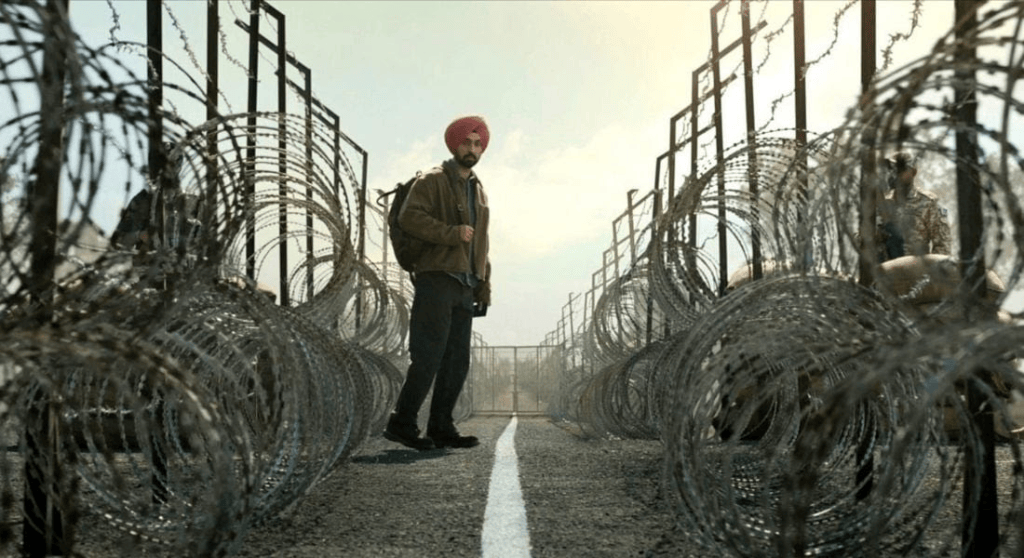
Screen shot of actor Diljit Dosanjh who portrays Nirvair Singh in the film Main Vaapas Aaunga, standing between two countries. Screenshot via film.
Hailing from Sargodha in Pakistan’s Punjab, he was forced to migrate and settle in India after partition. Suffering from dementia, he keeps remembering the life he left behind — the unkept promises, his love, and the carnage brought on by communalism.
For Singh, Martians were the outsiders — those from distant lands, called by their leaders to arrive and sow division along the Radcliffe Line. The Martians only landed when lines were drawn. This was the case in the life of the fictitious character Singh. It was the reality for millions, nearly 80 years ago. When outsiders are present — particularly the hostile kind — home takes on a different meaning. It gets redefined; it becomes dearer.
“… You don’t have a sense of the importance of roots until you realise that you have been deprived of something,” as the Pakistani painter, activist and art educator Salima Hashmi said in a webinar organised in August by the Southasia Peace Action Network (Sapan).
These roots are attached to familiar streets, warm greetings, lively bazaars, and cozy abodes. They are also steeped in blood. Around 15 million were uprooted during the partition, when their homes were redefined by the outsiders – the British, who may as well have been Martians.
Why did we let these ‘aliens’ define our homes?
To this day, those in power would like us to believe that it is Martians, not humans, who live across the border.
In 2018, Indian Home Minister Amit Shah stated that millions of infiltrators, meaning Bangladeshis, had entered the country and are eating it like “termites” who must be uprooted. As of January this year, at least 296 Bangladeshis have died in border areas over the past decade, as India’s Border Security Forces (BSF) pushes “illegal Bangladeshis” across the border in the dead of night.
In her poem “Home”, Warsan Shire writes, “no one leaves home unless / home is the mouth of a shark / you only run for the border / when you see the whole city running as well.” If this stands true, the rulers spewing words like “termites”, “parasites”, and “infiltrators” may just be trying, so so desperately, to convince the people that they are not the Martians.
During the discussion, Hashmi described her experiences of crossing the border from Pakistan into India: how Indians welcomed her, the “flash of recognition” of someone who shares their culture and history, and the eagerness to be in the conversation, to embody a collective belonging.
This begs the question — at a time when hate speech comes from ministers and ultranationalist movies are talk of the town — can we reclaim the right to define our own homes?
In 1947, the people of this region “lost languages, ways of life, property, heirlooms, people, as historian Priya Satia says in an interview published in Stanford Report in 2019. The experience “shaped their attitudes toward government, minorities and the concept of home”.
Such trauma has lasting consequences, she says: “It affects what is shared with and what is concealed from future generations.”
“This is the generality of Partition: it exists publicly in history books. The particular is harder to discover; it exists privately in the stories told and retold inside so many households in India and Pakistan,” writes Urvashi Butalia, who moderated the Sapan discussion, in her groundbreaking book The Other Side of Silence: Voices from the Partition of India (Penguin, 1998).
In Imtiaz Ali’s film, the protagonist’s younger brother, Kirpal Dada (played by Vinod Nagpal), who witnessed the partition, refuses to tell Singh’s grandson Nirvair (played by singer Diljit Dosanjh) what happened during that time to the family. He resolves to take those stories to his grave, a reaction that reflects Satia’s findings.
How can we find our homes when their memories are locked away, asks Nirvair, who eventually convinces Kirpal Dada to reveal his scars.
“I honestly believe I was being called in by my grandfather to finish a conversation that I hadn’t finished with him when I was about 10 or 11 years old,” said Nayanika Mahtani, co-writer of the film and a speaker at the webinar.
Like Mahtani, her character Nirvair also finishes the conversation with his grandfather. It is this that allows him to find his home.
We have to “build bridges in a world which is getting more and more divisive,” as Mahtani said.
When these bridges are built — by unlocking histories, unpacking traumas, and driving out the Martians — maybe then we may return to our rightful homes.
End Credits
Shoaib Ahmed Sayam is a writer, journalist, and communications consultant based in Dhaka, Bangladesh.
Email shoaib.ahmed.sayam@gmail.com
This is a Global Southasia (formerly Sapan News) syndicated feature available for republication with due credit to sapannews.com. This article was written and edited by humans. Click here for the Global Southasia AI policy.
Hyperlinks
Stranded in no-man’s land –
grilling Shosti Chandra Barman https://www.youtube.com/watch?v=-Ea7h0weB5Y
Southasia Peace Action Network – https://southasiapeace.com/2026/08/22/sun-30-aug-home-love-loss-and-dosti-friendship/
15 million – https://www.britannica.com/event/Partition-of-India
Millions of infiltrators – https://www.aljazeera.com/news/2018/9/24/bjp-chief-slammed-for-calling-bangladeshi-migrants-termites
296 Bangladeshis – https://www.dhakatribune.com/bangladesh/400188/296-bangladeshis-killed-at-borders-in-last-decade
Pushing “illegal Bangladeshis” – https://en.prothomalo.com/bangladesh/x0qypzgw2v
Stanford report – https://news.stanford.edu/stories/2019/03/partition-1947-continues-haunt-india-pakistan-stanford-scholar-says
The other side of silence – https://archive.nytimes.com/www.nytimes.com/books/first/b/butalia-silence.html
Global Southasia / sapannews.com
++++++++++++++++++++++++++++++++++++++=
A WHITE LINE AND A MOSQUE (December 2000)
A Season Outside | India’s Quest Series | Amar Kanwar
Domination and Chaos: India’s radical conservatism
It is time for Punjabis to atone for the sins of 1947
Seventy-five Years After Indian Partition
Mobarak Haider: A society at war with itself
Pakistan’s First Law & Labour Minister, Jogendra Nath Mandal’s Resignation Letter, October 1950
Extracts from B. R. Ambedkar’s book on Pakistan (1940, 1945)
Akhtar Balouch: Why did Qurratulain Hyder leave Pakistan for India?
The CPI in 1947: ‘Bleeding Punjab Warns’ by Dhanwantri & P.C. Joshi
Satyagraha: An answer to modern nihilism
The Oceanic Circle: Talk on the occasion of Mahatma Gandhi’s 155th birthday
Closing the Circle (E-Book)
The further you look, the more you realize you don’t have a clue

