
The historic wave of labour unrest that swept India
{ONE}
MORNINGS ARE TYPICALLY RUSHED at Hosiery Complex NOIDA, a prominent industrial hub in Uttar Pradesh. In the urban village of Yakubpur, thousands of migrant workers wake up in small and windowless rooms, rented from local Gurjar farmers, and get ready for work. They share these rooms with night-shift workers, who return to sleep as their day begins.
These workers—mostly men and women from Uttar Pradesh, Bihar, Madhya Pradesh, Jharkhand, West Bengal and Odisha—stream through the narrow winding lanes of Yakubpur toward their factories. They walk past old homes and temples, past shops that offer medicines, fruits, vegetables, phone recharges, loans and remittance services. The lanes open onto an uneven patch of ground strewn with rubbish, cows and the remnants of agricultural fields. Through the gates of low brick walls, one can see charpais and hookahs. Tractors operated by local farmers blare music as they ferry chaff or metallic parts. Women and children sort through piles of rubbish in a settlement of bamboo and tarpaulin homes. Contractors sit on the ground with copybooks, writing down the names and phone numbers of those looking for work.
As they move on, the workers enter another world: the wide paved roads, grid-like streets and glass-fronted factories of Hosiery Complex, the Noida Special Economic Zone and surrounding industrial areas. Workers from other urban villages, such as Bhangel and Barauha, arrive crammed together in electric autos. The expensive cars of managers and the motorcycles of supervisors make their way through the crowds and swerve through factory gates. Along the roadside, mothers and daughters hurriedly make rotis, parathas and puris to sell to workers. Young men sell sugarcane juice and vegetarian biryani; children sit beside them, making chai and selling tobacco. Some workers stop for a quick bite; others have their food packed for lunch. The smells of food mingle with the acrid smells of metal and chemicals.
The factories are enclosed by high walls topped with barbed wire and watched by CCTV cameras. Security guards check workers’ bags and swipe them with metal detectors before they disappear through the gates. Inside, they produce auto components, electronics and garments for international companies such as Calvin Klein, J Crew, BMW and Mercedes, as well as for India’s large domestic market.
By 9 am, the sounds of workers’ conversations and the rush of traffic have given way to the dull, repetitive monotony of heavy machinery, the low hum of sewing machines and constantly moving production lines. Trucks and tempos ferry parts from one factory to another. Where factories are hiring, groups of workers stand expectantly beside contractors, identification documents in hand.
Approximately twelve hours later, weary day-shift workers head back home to Yakubpur as night-shift workers take their place. In some factories, supervisors claim orders are urgent. They lock the gates, forcing workers to continue production into the early hours of the following morning.
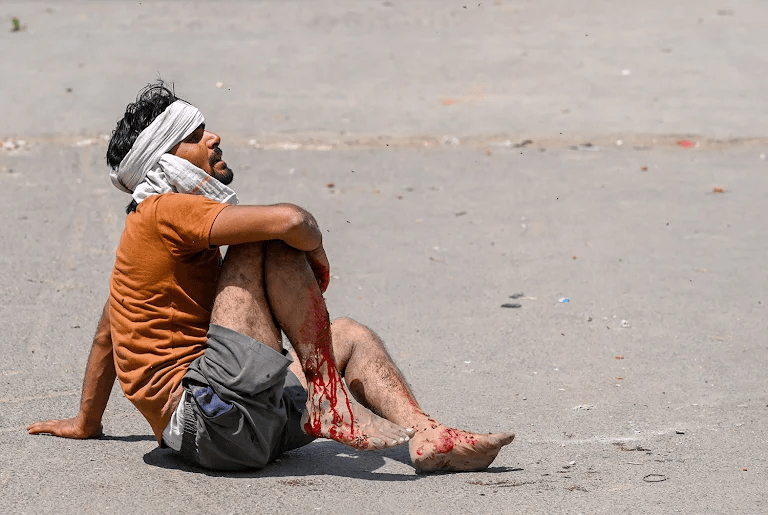
A worker injured in a police lathi charge during the protest by workers over wage hike demands in NOIDA on 13 April 2026. Sunil Ghosh / HT Photo
ON 13 APRIL this year, however, the scene was completely different. There was an explosion of strike activity across NOIDA—part of a strike wave that had swept central and northern India since February, which I closely followed as it moved from region to region. As I travelled on the metro, which gave an aerial view of the surrounding industrial areas, I saw hundreds of workers assembled outside factory after factory. On this day, according to the police, forty-two thousand workers were protesting at 83 locations across NOIDA.
Pushpa was among the hundreds of young women and men strikers gathered around a large peepal tree near the gate of her factory when I got to Hosiery Complex. From the Etawah district of Uttar Pradesh, Pushpa came to NOIDA when she was 18 years old. “Our land in the village is small and mostly barren,” she told me. “We also work on other people’s farms.”
She had heard about NOIDA’s factories at school, where a local contractor spoke to the students of the high wages they could earn there. Vague information about the Narendra Modi government’s Skill India scheme promised paths of promotion. A few years later, she got work at an electronics factory that made parts for air conditioners. It did not take long for her to become disillusioned.
Making seven thousand parts a day, over 12-hour shifts six days a week, with minimal rest breaks, for less than the minimum wage, was a different life from what she expected. “They destroy our bodies—they extract so much production, but the salary is so low,” she said. “We work five Sundays a month and do lots of overtime, but our salary is never over twelve thousand rupees. There’s so much exploitation.” Pushpa is now in her early twenties and was a prominent voice in the strikes.
The strikers made three common demands: a minimum monthly wage of R20,000 for unskilled workers, an eight-hour shift and double pay for overtime. “These are not just the demands of our factory,” Shahid, a migrant worker, also working at Pushpa’s factory, told me, “but of every factory.” In conversations with union leaders and workers, I repeatedly heard how almost all of the workers’ waking hours were consumed by the demands of production for low pay. The rise in prices of food and cooking gas, exacerbated by the US–Israel war on Iran in February, had strained their budgets to breaking point.
Given the increasingly desperate situation, workers looked to the Modi government’s new labour codes, which came into effect on 1 April, for relief, particularly the prospect of higher wages. The four codes consolidated 29 existing labour laws in order to “simplify and streamline” work regulations. The government claimed that, by doing this, it would improve workers’ lives and align “the labour ecosystem with the evolving world of work.” However, the government’s “simplification” has caused confusion, with delayed notification of rules, overlapping legislation by state governments and the circulation of false propaganda on the benefits the codes would bring. For instance, widely shared posts on social-media handles loyal to the government falsely claimed the codes would raise wages, reduce working hours and, “for the first time,” ensure double pay for overtime, whereas this last requirement has been law since 1948.
As 1 April came and went, and factory managements did not post notices on their gates with the new wage rates workers expected, strikes broke out. “We saw the news of the increased wages from government sources,” Pushpa told me. “Because of this, the youngsters came into the factory excited: ‘We will fight for our rights.’”
“The government has increased the salary—then how are these company people not giving it?” Sandeep, an auto components worker originally from Farrukhabad, asked me. “They are all thieves, each one of them.” Slogans captured this sentiment in workers’ demonstrations: “Gyarah hazaar mein dum nahin, bees hazaar se kam nahin!” (Eleven thousand is not enough, nothing less than twenty thousand); “Yeh janata ki hai lalkar, band karo yeh bhrashtachar!” (This is the call of the people: end this corruption!); “Gali gali mein shor hai, company wale chor hain!” (In every street the same cry, the company owners are thieves!).
The workers pointed to a notice on the gate of Pushpa’s factory. It stated that the company could not afford a wage rise. “That’s nonsense,” a worker said, ripping it off the gate. Workers raised the slogan: “Chahe jo majboori ho, hamari maange poori karo!”—Whatever your difficulties, fulfil our demands! When a supervisor emerged, a worker whispered to me, “He threatens us, says he’ll fire us.” The supervisor asked for representatives of the workers to come in and negotiate. There were cries of protest: “Speak in front of everyone!” The supervisor took on an intimidating tone and told the workers that, in that case, management would not be negotiating with them.
Pushpa immediately pushed a yellow police barricade onto the road. Workers cheered and assembled behind it. Further down the road, hundreds of garment workers made roadblocks out of what they could find: male workers moved branches, construction material, paving stones, and heavy road dividers into place; women spread them out across the breadth of the road. Hosiery Complex became a maze of roadblocks.
THIS WAS JUST ONE SCENE in the historic strike wave that stretched from February to June this year. There were as many as two hundred and seventy-five strikes across at least ten states—Gujarat, Rajasthan, Uttar Pradesh, Haryana, Punjab, Uttarakhand, Madhya Pradesh, Bihar, Jharkhand and Chhattisgarh—in the oil, cement, power, automobile, electronics, garment, footwear, pharmaceutical, food and other industries. I verified each strike through news publications, most often by local Hindi-language papers. Where such reportage was not available, and when it was not confirmed through my own reporting, local trade unionists and workers helped me with confirming these strikes and supplying local news cuttings from their cities and towns. My count of the number of strikes excludes those reported by workers through videos but not confirmed by the press, and strikes by sanitation workers, firefighters, Anganwadi workers and others, which can be traced to longer-standing movements, or those that made different demands from the three demands mentioned earlier.
By most accounts, even the most modest strikes drew in at least one hundred workers, while some of the largest involved more than fifteen thousand workers. Together, these strikes involved roughly two hundred thousand workers.
The strike wave forced increases in the minimum wages of Haryana, Uttar Pradesh and Uttarakhand—a significant achievement. Each win, I found, propelled more strikes in neighbouring states. Through these protests, hundreds of thousands of workers showed that they refuse to accept the relentless increase in inequality or to keep paying the price for India’s deepening economic crisis.
While these strikes were larger in scale, made more significant gains and were repressed more brutally than the youth protests over education at Jantar Mantar and elsewhere, they went almost entirely unreported by the mainstream media. The absence of coverage did not go unnoticed. Rani, a striking worker, asked me, “Where are the media people? They are all sold out, each one of them.” Indeed, apart from sporadic reports, mainstream channels and legacy media, particularly the English-language press, ignored most of the strike wave.
The scale and geographical spread of the strikes make this wave one of the most dramatic developments in India’s labour politics in recent decades. In a few months, hundreds of strikes took place across enormous swathes—a scale of mobilisation perhaps unmatched since the strike waves of the late 1970s. But this revival of strikes was taking place in a very different industrial context, and through new political forms.
This wave represents the first large-scale revolt of contract workers, who demonstrated a remarkable ability to spread and sustain strikes, through social media, marching from factory to factory and using networks built over years of migration between villages and cities or through working jobs in different factories. The increasing similarity in working conditions of contract workers across industries—being paid minimum wages for long hours—allowed common demands to spread across sectors rather than being confined to a particular industry.
Workers also showed that the decline of the Left, trade unions and a judicial framework for settling labour disputes has cut both ways. With the decline of negotiating and settlement mechanisms through labour courts and departments, almost all the strikes were “lightning” or “wildcat” strikes, breaking out without any prior notice to factory managements, and continuing indefinitely, with workers staying on strike until their demands were met. In the absence of negotiations, some factories struck multiple times. Bargaining was replaced by a more direct clash of forces. Contract workers showed that they could strike in large numbers—and win. Yet, the aftermath of the strike wave proved that the absence of a centralised union was a weakness, as workers struggled to defend the gains they made.
The ripple effects of this momentous workers’ strike wave continue. At the time of publication, bus workers at the Delhi Transport Corporation, young women workers at a medical supplier in Faridabad and garment workers at several factories in Karnataka had gone on strike. The history of the labour movement suggests that workers’ rights are rarely granted by governments or factory managements—they have always been won through strikes.
{TWO}
THE BEGINNINGS of India’s trade union movement date back to the end of the First World War. In India’s colonial economy, the main industries—railways, docks, textiles, jute, coal and tea—were concentrated in Bombay, Calcutta, Madras, Cawnpore and parts of eastern India. The labour contractor brought workers from villages to the factories and supervised them in the workplace. The First World War brought with it shortages and price rises, with wages failing to keep pace, and colonial authorities used the Defence of India Act to suppress labour unrest. At the end of the war there was a major strike wave, which led to the establishment of trade unions in major industries and the formation of the All-India Trade Union Congress.
The AITUC was soon dominated by the Communist Party of India, and trade unions increasingly coordinated strikes across multiple centres. Through strike waves in the interwar years, workers won the right to form trade unions. The colonial state appointed labour officers to address workers’ complaints and labour courts to settle industrial disputes and control discontent, first in Bombay and then in the rest of the country. Powerful strike waves after the Second World War were a major factor in ending British rule.
Amid these strike waves, the Nehruvian postcolonial state was forced to concede workers’ rights in order to legitimise itself. The expansion of the railways, new dams and steel mills went hand in hand with the building of working-class towns and housing in Bokaro, Durgapur, Bhilai, Rourkela and Chittaranjan. The rise of direct hiring and permanent or long-term contracts in the larger industries undermined, to an extent, the position of the contractor. Tripartite labour conferences were called to discuss national labour policy, industrial tribunals settled disputes, and trade unionists were elected to parliament.
The Factories Act, 1948, established a 48-hour workweek—eight hours a day, six days a week—and double pay for overtime. That same year, the Minimum Wages Act came into force, establishing standard mechanisms for calculating wages. Medical insurance systems such as the Employees’ State Insurance scheme were organised. But these years also saw attempts to control and split the trade union movement through forcibly imposing pliant Congress-affiliated trade unions, organised under the Indian National Trade Union Congress, as the sole representative unions in industries. While permanent workers in the larger industries sustained the movement, the vast majority of workers remained in precarious employment in the largely unorganised informal sector.
The economic crises and oil shocks of the 1970s saw the first cracks in this model of industrial relations. Coal, steel and oil were mostly nationalised. Repeated strike waves by railway, engineering and textile workers brought new combative rank-and-file trade unions to the fore, swelled the ranks of the Centre of Indian Trade Unions—affiliated to the Communist Party of India (Marxist)—and framed the rise of maverick leaders such as George Fernandes and Datta Samant. Some of these strikes were a major reason for the declaration of the Emergency, which saw the wide-scale repression of trade unions and workers’ leaders. However, in its aftermath, large-scale strike waves resumed. In the 1980s, the closure of large industries where trade unions had been strong—textiles and the docks—and the deindustrialisation of erstwhile industrial centres were substantial setbacks for the trade union movement. Larger, integrated factories were broken up into a mass of subcontracted smaller units to break trade unions and circumvent labour laws.
Liberalisation in the 1990s led to fundamental shifts in the economy and the workforce. Permanent workers were gradually laid off and replaced by temporary and contract workers. State governments competed with each other for investment by loosening regulations, and Special Economic Zones demarcated industrial spaces exempt from most labour laws. The region surrounding Delhi, which extends into Haryana, Rajasthan and Uttar Pradesh, expanded into a vast industrial zone with the spread of factories integrated into global supply chains, where unions were either weak or non-existent.
The period from 2005 to 2015, shaped by the global economic crisis of 2007, witnessed strikes within this belt, involving both permanent and temporary workers. The most important developments were the repeated factory occupations at Maruti Suzuki, in Manesar, through which workers won recognition of their union. Major sudden and short-lived strikes took place in NOIDA, in 2013, and among Bengaluru’s garment workers, in 2016. However, there was a sharp decline in strikes thereafter. In the absence of strikes, states such as Uttar Pradesh and Haryana stopped revising the basic minimum wage every five years, despite being legally mandated to do so.
This period saw a waning of the Left and the trade union movement. The rise in prominence of the Bharatiya Mazdoor Sangh, the labour wing of the Rashtriya Swayamsevak Sangh, and the decline of the AITUC, the CITU, the CPI and the CPI(M), has allowed managements to evade labour rights and drive down wages. Today, contract workers constitute 40.7 percent of the workforce even in the formal manufacturing sector, often making up more than two-thirds of the workforce even in large multinational automobile and electronics factories, and the entire workforce of many garment factories. Labour contractors have regained their former importance, supplementing village networks for recruitment with videos on Instagram and messages on WhatsApp groups. Gig work has seen a massive expansion. The informalisation of industrial work has meant that younger workers increasingly alternate between periods of factory and gig work, in search of better pay and conditions. The increase in contract workers, their short periods of work in different workplaces and attempts to legally bar them from joining unions have been a severe blow for the trade union movement.
A whole legal architecture of national-level labour conferences, industrial tribunals, labour courts and labour departments, within which these unions operated, has been undermined and replaced with the arbitrary rule of police chowkis. Gangeshwar Dutt Sharma, the district secretary of the CITU in NOIDA, explained to me that the government machinery for factory inspection has collapsed, with cuts to staff in labour departments and labour courts. For all of NOIDA, with over eleven thousand industrial units, there is only one labour court, with one judge. Cases can run on for decades. The application of labour law, which was always uneven, is increasingly the exception rather than the rule. “If we ask questions in the factory, they threaten us and tell us to leave,” Shahid said.
The four new labour codes legalise much of what was formerly illegal or at least contestable: allowing more non-permanent workers in “fixed-term employment,” extending limits to overtime and night-shifts, and severely curtailing the right to strike. “The factory owners have been let loose to run the factories any way they like,” Sharma said. While the police always intervened violently in labour disputes when they seemed to spread, they now intervene almost immediately to repress them, seeing them as a law-and-order problem.
The trade unions that remain are portrayed as obstacles to economic growth. On 29 January, while responding to a public-interest litigation seeking minimum-wage protections for domestic workers, Surya Kant, the chief justice of India, stated that “jhanda” unions—a veiled reference to communist unions—were responsible for the closure of India’s traditional industries and that “trade union leaders are largely responsible for stopping industrial growth in the country.” On 10 May, speaking at a public meeting in Hyderabad during the strike wave, Modi declared: “In our country, strikes and protests led to copper plants being shut down. And now … we have to import copper from abroad, which results in the expenditure of valuable foreign exchange. Therefore, I would urge all labour unions to keep such issues in mind carefully. We must distance ourselves from anything that obstructs India’s journey towards self-reliance.”
Yet, despite everything, strike activity has seen a revival in recent years. During the COVID-19 lockdowns, migrant workers struck against being prevented from leaving industrial areas for their homes. After the pandemic, there was a major strike at Samsung in Sriperumbudur, near Chennai, as well as protests by gig workers across the country. The present strike wave not only continued this growing momentum for industrial action, it significantly expanded it in scale, drawing in a younger generation of contract workers in northern India. “Such a big strike!” a young woman worker exclaimed to her friends at Hosiery Complex. “I’m seeing it for the first time in my life.”
The unbroken movement of strikes from one region to another this year took place in three chronological phases. In February and March, strikes began in large dispersed industrial complexes, such as oil refineries and thermal power plants. By April, the strikes shifted to the National Capital Region, with Manesar, Faridabad, NOIDA and Bhiwadi being important centres. Young women workers like Pushpa were prominent during this phase of the strikes. Here, the explosions of strikes in one area forced up wages and, after being repressed, quickly moved to other centres. From the end of April, the strike wave spread to Uttarakhand and Kanpur before ending in mid-June.
{THREE}
ON 23 FEBRUARY, up to forty thousand contract workers demonstrated at the gates of Indian Oil’s Panipat refinery, one of the country’s largest refinery and petrochemicals hubs. A day earlier, an accident had killed two workers and severely injured one. The Haryana Police carried out a lathi charge, injuring several protesting workers, and personnel from the Central Industrial Security Force fired into the air. Angered workers responded by overturning police vehicles and throwing stones. Network jammers were used and internet services suspended to prevent news of the strike from spreading. Police arrested workers and labour activists from the Mazdoor Adhikar Sangharsh Abhiyan, a platform of workers’ unions.
Videos of the Panipat strike, of a sea of thousands of workers in yellow helmets, were circulated on social media. It had a trigger effect, shaping the first phase of the strike wave.
The sites of these initial strikes were the dispersed, sprawling complexes of oil refineries, thermal power, chemical, steel and cement plants belonging to large nationalised and private companies such as Indian Oil, the National Thermal Power Corporation, Adani Enterprises, Vedanta Power, Jindal Steel and UltraTech Cement. The Migrant Workers Solidarity Network, a group of activists, aptly referred to these strikes as the “Yellow Helmets” movement, given the involvement of male migrant construction and maintenance workers working under subcontractors in heavy industry, who typically wear yellow-coloured safety helmets at work. There were forty-five strikes at such establishments.
In videos circulating on social media, workers from these complexes spoke of repeated industrial accidents, the lack of basic amenities, low wages and exploitation by contractors. In Gujarat’s Hazira, more than five thousand Larsen & Toubro contract workers at the ArcelorMittal Nippon Steel India plant went on strike. Workers claimed that the plant’s security manhandled some workers, in reaction to which they pelted stones and set vehicles on fire. The police fired more than thirty five teargas shells, lathi-charged the crowd and detained 25 workers. Shaifali Barwal, the deputy commissioner of Surat, told the Indian Express that the strike was a result of workers watching videos of the Panipat strike. Within weeks, contract workers at coal fields, zinc and thermal-power plants across Jharkhand, Madhya Pradesh and Rajasthan were on strike.
On 14 and 15 March, workers at the Adani Power plant in Singrauli, Madhya Pradesh, struck in protest at the death of a worker and overturned jeeps. Over the next few days, six thousand workers at Adani plants in Korba and Raigarh in Chhattisgarh struck in solidarity. Videos showed workers marching through the large complex of the plant shouting slogans. (Despite the strikes, accidents have continued, sparking more discontent. On 14 April, a burst boiler killed 24 workers and injured 36 others at the Vedanta Thermal Power Plant at Sakti district, in Chhattisgarh, where a strike had taken place over safety, in March. On 9 June, at the Adani plant in Singrauli, a worker was reportedly killed when he got stuck in a boiler, prompting trade unions to demand an investigation.)
In the first ten days of April, over fifteen strikes broke out in Manesar, which houses roughly two thousand auto assembly and component factories. On 2 April, contract workers at Honda Motor Cycle and Scooter India demonstrated, and won a wage increase. Over the following six days, strikes broke out at auto, garment and medical-equipment factories. Units of Richa Global, one of India’s largest garment export firms, which produces clothes for brands such as Calvin Klein, Superdry and J Crew, also struck. Roughly fifteen thousand workers gathered at the gates of their factories and then demonstrated outside the labour commissioner’s office.
On 8 April, in the face of the rapidly developing strike wave, the Haryana government raised the basic minimum monthly wage from Rs 11,274 to Rs 15,220 for unskilled workers, with retrospective effect from 1 April. In six days, the Manesar workers had forced the Haryana government to raise the minimum wage across the state for the first time in over a decade.
The day of the Haryana wage increase, workers in Faridabad began strikes to force managements to implement it in their factories. On 13 April, over seven thousand workers, mostly from auto-component makers Motherson and Sai Auto, blocked the Delhi–Agra national highway, paralysing traffic for two hours. The next day, police detained 23 workers. Over twenty sporadic strikes continued for months thereafter in auto, engineering, plastic, metal processing, printing and cloth-dyeing factories in Faridabad, while strikes also spread elsewhere in Haryana, to Gurugram, Ambala, Karnal, Bhiwani and Panipat.
The bulk of the strike movement had shifted from relatively isolated complexes to the densely packed factories of large urban centres. This changed the speed and character of the mobilisation. The industrial areas where the strikes developed—Manesar, Faridabad and NOIDA—are tightly integrated, with larger companies operating units across them. However, workers across these areas are paid different minimum wages for the same work in the same companies, because they fall in different states with different minimum wages. The tensions caused by this gave the strike wave an electrifying momentum.
On 9 April, after the Richa Global strike in Manesar, workers at the company’s unit at Hosiery Complex struck, demanding similar wage increases.
ON 11 APRIL, I arrived at Hosiery Complex at around 9.15 am to find a group of fifty striking workers standing opposite a garment factory. They called out to workers standing hesitantly inside the factory compound to come out and join them.
“Aa jao! Aa jao!”—Come! Come!—the strikers beckoned. Some women came out of the gate and were met with encouraging shouts and slogans: “Hamari mange poori karo!” “Mazdoor Ekta Zindabad!”—Fulfil our demands! Long live workers’ unity! There were cheers and slaps on the back. A group of striking workers from another factory joined the growing crowd. A few workers shot videos of the two groups converging. By my count, fifty workers had just become two hundred.
Two women appeared from a side road carrying a banner which read: “Jai Hind! Jai Bharat! Inquilab Zindabad! Mazdoor Ekta Zindabad! Mazdooron ki Salary Badhao! 8 ghante ke 18,000 se 20,000/- Double Overtime”—Victory to India! Victory to Bharat! Long Live the Revolution! Raise monthly salaries to twenty thousand rupees for eight hours of work, and provide double pay for overtime. They led the striking workers toward the Dadri Main Road. Along the way, they stopped outside large factories shouting slogans and whistling. “Why are you sitting inside? Come out on the road,” a worker shouted. From factory after factory, workers began emerging through the gates, swelling the crowd. More striking workers appeared from side streets. Down one side street, about a thousand men and women showed up, some walking, others on cycles. Two hundred strikers had become thousands.
A striker recognised a friend on the way: “Rajesh, are you joining?”
“Yes, this will be a good fight.”
The crowd spilled onto the Dadri Main Road, which connects NOIDA to Delhi. Police personnel wielding lathis and revolvers, wearing cricket and motorcycle helmets, stood along the road, as did paramilitary personnel in battle fatigues, with padded body vests, rifles, lathis, shields and helmets. The strikers climbed over a fallen road divider and walked toward the main circular traffic intersection connecting the Dadri Main Road to Sampark Marg, which links the NOIDA–Greater NOIDA Expressway to Ghaziabad.
Some climbed the raised platform surrounding the large metro pillar at the centre of the intersection. Women with dupattas wrapped around their heads to protect them from the sun sat down on the Dadri Main Road, while younger men and women blockaded Sampark Marg or rushed to the smaller roads leading in and out of Hosiery Complex. Large groups occupied other radial roads. A worker waved his hands over his head to signal to the traffic that there was no way through: “All the roads are blocked, brother. You’re not allowed to go through here.” The workers made sure ambulances, fire trucks and scooters carrying children were let through, but buses, trucks, tempos and cars were turned back. The workers waved goodbye and laughed as the cars U-turned, reversed and got in each other’s way. The larger and more expensive-looking the car, the louder the cheers.
The roadblocks became a forum where workers explained their strike to commuters and passing workers, and mocked strike-breakers. A group of construction workers passing by, sweating and covered in dust, asked the strikers what it was all about. They immediately declared they would join the strike, raising their mortar pans over their heads and drumming on them. The sound of thousands of workers cheering rent the air.
News soon spread of a strike at the sprawling factory of the Motherson group—one of the world’s top auto-component manufacturers, which supplies companies such as Volkswagen, Mercedes-Benz, Audi, Honda, Suzuki, BMW, Stellantis and Hyundai. The importance of this factory, with its large, uniformed workforce, coming out on strike was recognised by all the workers I spoke to and was to be immensely consequential for the strike wave.
Two days later, 13 April, saw an explosion of strikes across NOIDA and beyond. Workers continued their blockade of the intersection in larger numbers. The roadblocks multiplied in the inner streets of Hosiery Complex, with each striking factory organising its own roadblock. Here and in other parts of NOIDA, workers demonstrated outside factories, forced open their gates by shaking them collectively, demonstrated within HR offices, removed barbed wire and broke CCTV cameras mounted on factory walls. According to the police commissioner, Laxmi Singh, protests turned violent only in two areas, where some workers pelted stones and attacked police cars.
New slogans emerged, more explicitly political. Woman workers shouted: “Modi tere raaj mein, bura mera haal hai!” (Modi under your rule, my condition is terrible!) A striker addressing a crowd of workers said: “Yogi, Modi ki jai nahin; bolo aam aadmi ki jai!” (Don’t say victory to Adityanath and Modi, say victory to the common man!)
The workers refused to let representatives negotiate with employers or contractors on their behalf and demanded that the administration and employers put forward common terms in front of them. “Talk in front of everyone—does anyone debate on the phone?” a worker asked a contractor on the phone. Without a trade union to negotiate with, the police, the Central Reserve Police Force and the deputy labour commissioner Rakesh Dwivedi divided into groups and used megaphones to tell different groups of workers about the terms offered by the state government and employers’ associations. Workers gathered and recorded what the speakers were proposing on their phones. They rejected the demand that workers clear the roads and return to work before negotiations began. And they were also unwilling to rely on the government’s word on raising wages, or even to wait a month to see them take effect. “Within a week, within a month… they are trying to make a fool of us,” a worker said.
The strikes also spread beyond NOIDA, including nearby Dadri, Hapur and Bulandshahr. Motherson units in Faridabad, Lucknow, Haldwani, Pathredi (Rajasthan) and Pithampur (Madhya Pradesh) went on strike. Strike waves began in Rajasthan, Punjab, Uttarakhand and Madhya Pradesh.
As NOIDA’s workers blockaded traffic leading out of Delhi to the north-east, workers in Palwal blocked the Delhi–Agra highway going south-east, while workers in Bhiwadi blocked smaller internal roads. In Madhya Pradesh, striking workers at Motherson’s Pithampur factory blocked the Mhow–Neemuch highway.
The NOIDA strikes were inspired by the wage hike in Haryana. Victory came for the NOIDA workers as well. On 14 April, the UP government announced a wage hike for Gautam Buddha Nagar and Ghaziabad. The basic wages of unskilled workers rose from R11,313 to R13,690, effective from 1 April, and were notified on factory gates across Hosiery Complex. In less than a week, NOIDA’s workers had forced the UP government to increase the minimum wage for the first time in twelve years.
Alok Agarwal, a senior vice-president of the Indian Industries Association, worried about the hopes the NOIDA strikes had raised among workers and the momentum it would give to the strike wave. “This government is famous for not being forced to do things under pressure,” he told the Indian Express, but the wage hike had sent the message, “go on strike, get your demands accepted.”
Over the following days, as workers were arrested and forced to return to factories across NOIDA, those routinely paid below the minimum wage continued striking to have the wage rise implemented in their workplaces. From 14 to 20 April, domestic workers and security guards at gated communities such as Cleo County, Cape Town Society and Godrej Woods went on strike, months after a Supreme Court bench argued against applying wage regulations to domestic workers since it could result in households deciding not to hire them. Women gig workers affiliated to Urban Company demonstrated, as did security guards employed at Shiv Nadar University in Dadri.
THE WAGE INCREASES in Uttar Pradesh triggered the third phase. The strike wave now moved beyond the NCR industrial belt.
Ram Singh, an experienced organiser of the Kanpur Zilla Committee of the CITU, told me that workers in other parts of Uttar Pradesh responded with a mixture of hope and anger—the government had notified a relatively lower rise in the minimum wage for municipalities other than NOIDA and Ghaziabad, and an even smaller one for other parts of the state. Strikes broke out in Prayagraj, Mathura and the bangle-making factories of Firozabad. But it was Kanpur, where 36 strikes took place, that developed into a new centre of the strike wave. Strikes swept through the industrial areas of Dadanagar, Panki, Jainpur, Rania and Chaubepur, in and around the city. In the 23 days from 9 May to 1 June, Dainik Jagran reported 23 strikes in and around Kanpur. Strikes spread through footwear, adhesive, food and paint factories of well-known companies such as Goldiee Masala, Rupani Chappal and Nerolac Paints, and factories that make Parle-G and Britannia biscuits.
Despite Kanpur’s rich trade union history, Adityanath, the chief minister of Uttar Pradesh, slandered union leaders during a media event in the city. “Trade union leaders do no work—they roam around carrying bags on their shoulders and spreading disturbance,” he said. “They fill their own homes through collections while pushing labourers towards starvation. Kanpur is a clear example. Trade union leaders became MPs and ministers, but labourers were pushed to the verge of starvation.” While the police was heavily deployed during the strikes, Ram Singh said that the labour commissioner and the police tried to resolve individual disputes quickly at the factory gates, rather than allow the strikes to spread as they had in NOIDA.
The strike wave developed dramatically in Uttarakhand, in a string of industrial sites moving north-westwards from Pantnagar to Haridwar to Dehradun. I recorded 36 strikes in this region. On 14 April, the death of Suresh Prasad, who worked at Bajaj Motors in Pantnagar, led to protests outside the factory gates, with crowds gathering around his body.
Over the following weeks, strikes broke out at V-Guard, India’s largest voltage stabiliser maker, large auto-component makers such as Yazaki India and Belrise, and the Motherson factory near Haldwani. Workers gathered in large numbers and demonstrated outside the gates of the factories, reportedly preventing finished goods from being moved out. Less than two weeks later, strikes broke out in Haridwar and Dehradun, at footwear, pharmaceutical and houseware factories. At Haridwar, workers marched to the labour office in Roshanabad. At Dehradun, strikes broke out at large companies such as Dixon Technologies, Lightanium Technologies and Global Medikit. As the protest intensified, workers occupied the highway between Dehradun and Paonta Sahib.
The Uttarakhand government announced an increase in minimum monthly wages from Rs 12,539 to Rs 13,018, on 23 April. Separate minimum wages were notified for engineering factories employing more than fifty workers, including Rs 13,800 for unskilled workers. However, workers continued to demand a Rs 20,000 minimum wage across engineering and non-engineering industries. Workers’ slogans simply changed from “11,000 mein dam nahi”—11,000 isn’t enough—to “13,000 mein dam nahi, 20,000 se kam nahi”—13,000 isn’t enough, nothing less than 20,000. The Uttarakhand strikes underlined the fact that the wage increases across states were far from sufficient.
In Rajasthan, 23 strikes swept through industrial estates concentrated in a constellation of towns near Delhi, including Bhiwadi, Pathredi, Tapukara, Kahrani and Khushkhera, as well as Chomu, in Jaipur district, and the Japanese Industrial Zone at Neemrana. On 13 April, striking workers at Suprajit Engineering and, a day later, Motherson demonstrated and blocked the road, setting off strikes in houseware, footwear, auto, tyre and food factories. Rather than address Rajasthan’s very low minimum monthly wage of Rs 7,410, the Bhiwadi Manufacturing Association reportedly distributed gas cylinders to workers.
Eight strikes broke out in Punjab. Farmers’ unions joined a strike at Sportking India and blocked one side of the Bathinda–Amritsar highway. On 1 May, Punjab minimum wages were revised upwards for unskilled workers, from Rs 10,899 to Rs 13,486, the first increase in thirteen years.
IN MOST INSTANCES, repression followed concession. The administration imposed Section 163 of the Bharatiya Nagarik Suraksha Sanhita, which allows the administration to prohibit gatherings and unauthorised demonstrations, at several centres. Paramilitary forces and police officers were deployed during strikes. The police used lathi charges to clear sit-ins outside factory gates and conducted flag marches to project their authority.
In Haryana, prohibitory orders had little effect on the strikers. However, when workers demanded that notices about the new wage rates be posted on factory gates, scuffles broke out involving workers, supervisors and the police. Police arrested fifty workers, including 20 women, along with activists from the Inquilabi Mazdoor Kendra, a workers’ organisation. It conducted raids in the urban villages nearby, where workers live. I witnessed how separate police teams were posted outside each striking factory, creating an atmosphere of fear. When I asked a woman on her way to work whether I could speak with her about the strikes, she responded, “There’s too much police here, brother. It’s not safe to stop and talk.” Within two months, in Gurugram, each police station reportedly organised Labour Liaison and Industrial Coordination Teams, and five new companies of police personnel were formed to prevent further strikes.
In Haridwar, police arrested 22 workers and activists and initiated proceedings against some under the colonial-era Goondas Act, which allows district and police officials to extern those convicted from districts. In Dehradun, more than ten workers and others were reportedly arrested under “Operation Prahar,” a state government programme aimed at tackling organised crime, gangsters and criminals.
The Uttar Pradesh government’s repression of the strikes was highly militarised and far more dramatic than in Haryana or Uttarakhand. Referring to the NOIDA strikes, Adityanath stated that the workers’ protests may be part of a “larger conspiracy” to revive “Naxalism by those elements who are not liking growth and prosperity.” The state’s labour minister, Anil Rajbhar, stated that the government was investigating a “Pakistan connection” behind the protests.
Despite the non-violence of the workers, the state government treated NOIDA like insurgent-held territory. The district magistrate, Medha Roopam, and security forces appeared in padded vests and helmets. Lorries and armoured vehicles full of police and paramilitary personnel including the CRPF, Rapid Action Force and Rapid Response Force, patrolled the area, turning it into an armed camp. Busloads of more police and paramilitary forces were brought in from adjacent districts. Police carried out lathi charges on workers and shot tear-gas shells.
At Hosiery Complex, as workers gathered at factory gates on 15 April, police forced them to enter the factories and arrested those who had played a prominent role during the strikes. Gangeshwar Dutt Sharma explained the arbitrary nature of the detentions on the streets. “People walking on the road were sent to jail. Handcart-sellers, tea sellers, women going to the market to buy vegetables were sent,” he told me. “They went to the extent of picking up and jailing children.” For weeks, families went to different police stations, looking for relatives who had been arrested. Organisers of the NOIDA CITU unit were put under house arrest or jailed, as were labour activists belonging to Bigul Mazdoor Dasta, a workers’ organisation, some of whom remain incarcerated. By the end of the month, the Gautam Buddha Nagar police commissionerate announced the creation of an Industries Police Cell, headed by a dedicated deputy commissioner of police and a team of inspectors. There was also heavy police deployment across NOIDA on May Day, in the event that strikes break out again.
{FOUR}
THROUGHOUT MY REPORTING, workers told me about how almost all their waking hours were spent tending to the demands of production.
Before this year’s strike wave, basic monthly minimum wages for unskilled workers—which are supposed to guarantee 2,700 calories per day for four members of a household—were Rs 11,274 in Haryana, Rs 11,313 in Gautam Buddha Nagar, where NOIDA is situated, and Rs 12,539 in Uttarakhand. While the Minimum Wages Act, 1948, mandates that state governments revise the basic wage at least every five years, the UP and Haryana governments did so more than a decade ago. A dearness allowance is regularly added to the basic wage, but workers told me that it does not cover the increase in the cost of living, while others claimed they simply do not receive it.
According to an analysis by the Indian Express, while prices rose by 27.9 percent between February 2021 and February 2026 in Gurugram, the overall minimum-wage rate increased by only 15 percent between July 2021 and July 2025. Another report, by India Ratings and Research, found that real wages had only grown 0.01 percent across the country between 2020 and 2025, and had, in fact, contracted by a yearly average of 1.7 percent and 1.2 percent in Haryana and Uttar Pradesh, respectively. Sharma explained that if minimum wages were actually calculated according to the terms set out in the Minimum Wages Act, they should be more than thirty thousand rupees a month today.
But even the basic legal minimum, for the most part, exists only on paper. According to a recent report by the Safe in India Foundation, a group that has helped eleven thousand workers in Haryana and Maharashtra since 2016 in the event of workplace injuries, about a fifth of auto workers they assisted claimed they did not receive the minimum wage. “We don’t get salary slips, so how do we know how they are paying us, how much they are cutting and for what?” Sandeep told me. He said that 12-hour shifts are paid for eight, piece rates are manipulated, two days’ pay is cut for a day’s holiday, and arbitrary amounts are deducted for ESI and PF. “They tell us one rate, but then, in our salary, we find that we’ve received another rate.” Through my conversations with workers, it became clear that what is legally the minimum wage has today become more like the average wage, with many earning below it, and those earning above it only able to do so through working many hours overtime.
The working day has also lengthened. Workers reported to me that, in many factories, shift work has changed from three eight-hour shifts, five days a week, or 48 hours to two 12-hour shifts, six days a week, 72 hours. This is despite the fact that the Occupational Safety, Health and Working Conditions (Central) Rules, 2026 only allow factories to work 48 hours a week. According to the SIIF, 96 percent of the workers they interviewed worked more than this. During the strike wave, workers demanded that work be limited to eight-hour shifts, 26 days in a month, with weekly and national holidays.
The OSHW (Central) Rules, 2026 has increased permissible overtime from 75 hours a quarter to 125 hours, with some states, such as Uttar Pradesh, Haryana, Rajasthan and Maharashtra, increasing the cap to 144 hours. However, workers reported they often work more than these hours to complete orders or increase their wages. Workers told me that they frequently work 14- and 16-hour shifts. According to the SIIF report, 72 percent of auto workers said they worked more than sixty hours a week, with some reporting frequent 24-hour shifts. “All the factories are running on overtime,” Pushpa told me. “That’s how they manage to take so much production from us. It’s overtime and overtime—whenever you ask, they say overtime.”
In garment and electronics factories, workers reported that it is a usual practice for management to lock gates and force workers to do overtime to complete pressing orders. “We regularly do two-and-a-half hours overtime,” Pushpa said. “Often, they force us to do overtime till 10 pm, till 1 am. They lock the gates. The line leaders say, ‘This is urgent, that is urgent.’ If you don’t agree, then they write down your name.”
Despite both the Factories Act and the new labour codes mandating that overtime be paid at double the regular hourly rate, this law is broken in almost every factory and became one of the central demands of the strikers. In fact, during the strikes at Hosiery Complex, some employers announced that they had decided to pay double for overtime—as if it was not a legal requirement, but a concession.
The intensity of work has also increased, with workers reporting higher production targets and reduced break times. “We have to produce seven thousand parts a day—the work is so dangerous, our fingers get cut and our eyes get spoiled,” Shahid said. “We only get a bathroom break once in four hours. They don’t make a bathroom pass otherwise. They tell us to finish quickly. If we go to drink water, they shout at us. If we go to the washroom, they shout at us. Tell me, if someone is working, will they not drink water?” CCTV cameras in toilets allow management to monitor bathroom breaks, while supervisors follow workers into toilets to make sure they are not “wasting” time. “They don’t let us leave work even if we are ill or have an emergency at home. They don’t give us gate passes,” Sandeep told me. “Our problem is with the supervisor, the contractor, the company.”
These factors have made working conditions deeply unsafe. At Pushpa’s factory, a worker raised an arm cut off at the wrist and told me, “This happened at this factory!” According to the SIIF report, in 2025, 72 percent of worker injuries in the automobile supply-chain factories were so-called “crush injuries,” which resulted in an average loss of two fingers per worker. Moreover, most injury cases involved power-press machines used for shaping metal. The SIIF claimed that sensors, which exist on some of these machines, were removed in 95 percent of cases so that the machines could run faster. Nearly nine in ten workers said supervisors ignored their complaints that the machines were faulty. Nearly ninety-eight percent of the nine thousand injured workers the SIIF assisted worked in the supply chain of India’s top six automobile brands—Maruti Suzuki, Honda, Hero, Tata Motors, Mahindra and Bajaj—while 44 percent were in companies affiliated with the Automotive Component Manufacturers Association. As the report notes, “this is not only a small factory problem.” A garment worker I spoke to at Manesar, the day after a lathi charge against workers, said, “First the machine broke us, now the police will.”
Ram Singh said that many employers do not maintain contract workers on official company rolls or enrol them in ESI schemes. When an accident occurs, factory managements refuse to pay compensation, and the worker is not able to receive free treatment at an ESI hospital.
Women workers have to confront further obstacles, often facing abusive and arbitrary behaviour from managers and supervisors. “They don’t talk to women properly,” Pushpa said. “The demand of production is so much that they check if we are not lying, if we say we are on our period.” She looked away in embarrassment. Women workers do not trust the way they are treated will change. When, during the strikes at Hosiery Complex, employers offered, before the workers, to set up sexual-harassment cells in the factories, women workers walked away in disgust, saying, “What will that achieve?” Their anger gave the strike wave an added energy. At the roadblock, Pushpa’s colleague Rani told an older woman who was heading home, “Will you come tomorrow? Everyone has to come. Don’t sit at home. Will you grind coriander and ginger or will you teach these bastards a lesson?”
The low wages have a direct effect on living conditions. Room rent in NOIDA varies between Rs 4,500 for an individual to Rs 12,000 for a family, with increases every six months. To cover rent, four or more migrant workers share rooms that are so small they cannot all sleep at the same time. Their wages come weeks and sometimes months late, adding to their stress. “They pay us on the fifteenth, the eighteenth.” Pushpa said, “If the landlord comes, the shop-owner comes, the school people for the children’s fees, will anyone wait till the eighteenth?” During the strike wave, workers demanded they be paid no later than the seventh of the month.
Food is a major expense for migrant workers, who often carry sacks of rice, onions and potatoes when they return from their villages to the cities. According to the ministry of statistics and programme implementation, the Consumer Food Price Index rose steadily from 2.13 percent in January to 5.32 percent in June, driven by increased prices of ginger, cauliflower, green chillies and lime—all essential for workers’ diets. Between January and May, the price of edible cooking oil increased by ten to thirty-five rupees per litre. By April, workers could no longer afford to buy green vegetables. On 14 May, workers, who purchase packets of milk daily, were hit when Amul and Mother Dairy hiked prices by two rupees per litre. By the end of May, tomato prices had risen 48.4 percent year-on-year.
On 7 March, a week after US and Israeli planes began bombing Iran, the government reduced subsidies on domestic and commercial LPG prices for those with registered connections, citing supply disruptions due to the closure of the Strait of Hormuz. However, migrant workers do not have registered gas connections, forcing them to buy from private suppliers who charge higher, unsubsidised rates. Prices for five-kilogram cylinders, which are used by workers and local eateries, more than quintupled in late March, to four thousand rupees in some cases. Moreover, LPG price increases disproportionately affect workers, since they do not have fridges and must cook multiple meals every day.
While LPG supply remained relatively undisrupted in the regulated market, cylinders ran short in industrial areas. Workers in NOIDA had to stand in long queues before and after shifts to get cylinders, sometimes leaving emptyhanded. I witnessed how they left roadblocks in “shifts” during the strikes to stand in line for cylinders. Pushpa said that those who earn R2 lakh a month would not have noticed that LPG prices had touched seven hundred rupees a kilogram. “They get gas delivered at home. We have to stand in lines.”
“How long will my gas refill last?” Sandeep said. “Three or four days. On a salary of Rs 12,000. Rs 3,000 will go monthly only on gas. How will we think of anything else for ourselves, our families?” In a striking reversal of the Modi government’s Pradhan Mantri Ujjwala Yojana to promote LPG cylinders and end woodfire cooking, workers who could no longer afford or obtain cylinders turned to burning wood for cooking. However, landlords banned workers from burning firewood within the building, claiming it would blacken the walls. They were forced to cook outdoors or threatened with eviction.
This created an emergency-like situation in the industrial areas as workers’ budgets were squeezed between low wages and rising prices. Prices of food and tea in local eateries, of fares in shared autos, doubled. Workers were unable to repay loans. Migrant workers who left villages to earn money in the city and support family farms, started asking their relatives in the village to send money to subsist in the city. As strikes broke out, workers posted Instagram reels contrasting the current minimum wage with the prices of different items in their budgets. Noting that companies had started raising the prices of the goods that he and other workers were producing, Shahid said, “The price of everything is rising—why can’t our salaries rise?”
Workers at Manesar, Faridabad and NOIDA, drawing on their experience of how the government handled the COVID-19 pandemic, said that they expected a lockdown. Indeed, in scenes reminiscent of the early days of the pandemic, large numbers of migrant workers left cities such as Surat, Gurgaon and NOIDA for their villages, with scenes of packed railway stations and platforms. For those who stayed behind, this gave an urgency to the struggle for increased wages. “We have to fight—it’s now or never” was a common sentence I heard during the NOIDA strikes. In this way, the war in West Asia became, in India, a war on prices and wages. Through the strikes, these compounding economic pressures became a large-scale confrontation between workers and employers.
IN JUNE, the unbroken movement of strikes from one centre to another came to an end. However, sporadic large and significant strikes have taken place since, which were not seen before the strike wave: among embroidery workers in Surat, garment workers in Faridabad, oil refinery workers in Bihar, Flipkart warehouse workers in Haryana, Uttar Pradesh and Bihar, and trainees at Bajaj and Mahindra & Mahindra in Maharashtra. For, even where the wage increases workers won have actually been implemented by factory managements, they can only provide a temporary reprieve, as food prices continue to rise.
Political elements in the strikes have gradually emerged and developed in tandem with other developments. For instance, three weeks after the Cockroach Janta Party’s Jantar Mantar protests, thousands of embroidery workers struck in Surat for weekly Sunday holidays. They circulated videos calling on fellow workers to form a “Silai Janta Party”—Sewing People’s Party. Young trainees at the Bajaj strike held up posters reading: “Student Power!” The Jantar Mantar protesters may have been unaware of the hundreds of thousands of workers who have gone on strike this year, but workers have taken inspiration from them.
However, industry fought back against workers, demanding a firmer hand from state governments. In the absence of organised trade unions, workers found it difficult to maintain the gains they made. Employers’ associations threatened to move factories or shut down after the wage increases. Managements reduced annual bonuses or piece rates, and demoted or fired workers—particularly those most active in the strikes—to counteract the wage increases. Employers in other states, such as Karnataka, fought back against similar minimum-wage revisions, demanding that sections of industry be exempt and challenging them in the high court.
On 3 September, I reached Hosiery Complex once more, to talk to workers on their way to the morning shift. The roadblocks had been dismantled, the slogans replaced by tense whispers. I caught up with Pushpa. She told me of the arbitrary arrests that took place in the factories and on the streets, of how the increase in the minimum wage did not cover her expenses. I asked her how workers would respond. “We will have to do it all again,” she said, before disappearing beyond the factory gate.
Zaen Alkazi is a labour historian.
Source: CARAVAN
+++++++++++
‘A little unhinged, or totally fearless’ : the chronicler of China’s 170 million migrant workers
The People First: Rohini Hensman on Democracy, Resistance, and the Global Left
Democracy and workers’ movements – stories from Jamshedpur
1938: the year Indian workers fought for themselves
Too ill to work, too poor to get better: how debt traps families working at India’s kilns
In a Delhi heat ward, two workers fight a lonely battle for life
Unworkable: Swapping Palestinian workers with Indians

