
Albert Camus has long been misunderstood, but a new translation of his complete notebooks offers a corrective
By Matthew Lamb
The Complete Notebooks by Albert Camus. Translated by Ryan Bloom
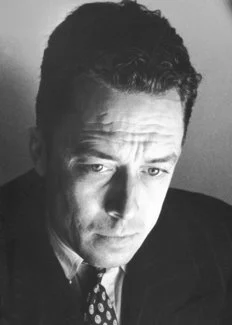
Source: https://www.nobelprize.org/prizes/literature/1957/camus/biographical/
EACH NEW TRANSLATION of a work from a major author should spark a reevaluation of that author’s critical reception and public reputation. Since his death in 1960, a number of posthumously published works by Albert Camus have been translated into English. This has included A Happy Death (1971), his abandoned first novel; The First Man (1994), his unfinished final novel; and several collections of lyrical essays, journalism, lectures, correspondence, and notebooks, covering his entire creative life. And yet the public image of Camus has remained stubbornly unchanged since his initial reception in the 1940s, with each new translation either reinforcing a caricature—Camus as an existentialist or a philosopher of the absurd—or else simply not being read at all because of how uninteresting this caricature was. It is a silhouette projected as much by admirers of Camus as it is by those indifferent or hostile to him.
The latest in a quixotic lineage of translators is Ryan Bloom, who previously translated the third volume of Camus’s notebooks, his South America and United States travel journals, and his collected plays. Bloom’s most recent contribution is a translation of The Complete Notebooks, a 712-page volume that brings together for the first time a new, consistent translation of all three previously published volumes of Camus’s notebooks, covering the period between 1935 and 1959. It also includes Camus’s 1949 South America journals as well as his reading notes from 1933, the earliest known notebook. The most remarkable inclusion, however, is the translation of previously unpublished notes from 1938 to 1942, written when Camus was in Oran, Algeria, writing The Stranger and The Myth of Sisyphus. The Oran Notebook—only discovered in 1988—is the most revealing of all of Camus’s notebooks, written, uncharacteristically, in a direct and personal style. It provides fresh insights into the background of Camus’s first works. This alone is worth the price of admission.
¤
One difficulty in reviewing an author’s private journals is that they can’t be read in isolation. They remain a storeroom, a backstage, a rehearsal space, the full significance of which can only be registered when considered in relation to the author’s public-facing works. Take, for example, The Stranger and The Myth of Sisyphus, both published in 1942. The Complete Notebooks defamiliarizes these famous works.
By June 1938, Camus had already completed a draft of A Happy Death, his first attempt at writing a novel. His teacher and mentor, Jean Grenier, was less than enthusiastic with the results. Camus revised the manuscript, and over the next six months, he transformed it into what would later become The Stranger. But this transformation was accompanied by a crucial shift in his thinking and approach to his own writing.
“We think only in images,” Camus noted in 1936, the year he began writing A Happy Death. “If you want to be a philosopher, write novels.” But in 1938, he reviewed Jean-Paul Sartre’s Nausea, which challenged his earlier opinion. In the published review, Camus wrote: “[T]he philosophy need only spill over into the characters and action for it to stick out like a sore thumb, the plot to lose its authenticity, and the novel its life.” For Camus, Sartre had “broken” the balance between images and ideas. This was also a self-criticism, leveled at A Happy Death.
In 1938, Camus also discovered Franz Kafka, newly translated into French. By February 1939, he was writing an essay on The Trial (1925) and The Castle (1926): the beginning of a series of literary essays that became The Myth of Sisyphus. Camus thought The Trial was a work that articulated the contours of a particular human experience, where the ballast that maintained the balance between images and ideas was the human body. In The Castle, however, Kafka had—like Sartre—betrayed this experience, creating instead a work of consolatory hope. In Sisyphus, Camus criticized this subordination of literary fiction to philosophy. “The thesis-novel, the work that proves the most hateful of all, is the one that most often is inspired by a smug thought,” he wrote. “Those creators are philosophers, ashamed of themselves.”
In August 1936, after completing his bachelor’s dissertation on Christian metaphysics and Neoplatonism, Camus told Grenier that he’d like to do more work in a similar vein: “I mean of a technical nature and in philosophy.” Earlier that year, Camus made a passing reference in his notebooks to write a “Philosophical Work” on “absurdity.” No other references on this topic appear until December 1938—after his encounters with Sartre and Kafka—and at this time, he makes his own attempts at writing fiction. Here, he writes a long note about the difference between absurdity and irrationality, and the importance of resisting hope, an emotion he associated with irrationality.
Later, in Sisyphus, this opposition to hope would underpin the charge he leveled against a number of thinkers, from Søren Kierkegaard to Edmund Husserl—the charge of “philosophical suicide”—a form of thinking that betrays itself, by seeking to escape from its own pre-philosophical conditions. Sisyphus transposes the criticism he had previously directed at Kafka and Sartre—and at himself—into a literary argument against philosophy itself. In February 1939, Camus told Grenier: “I have many projects. I am working on my essay on the Absurd. I have given up making a thesis out of it. It will be a personal work.”
The first line of Sisyphus explicitly announces this abandonment of philosophy: “The pages that follow deal with an absurd sensitivity that can be found widespread in the age—and not with an absurd philosophy which our time, properly speaking, has not known” (emphasis added). The second paragraph then suggests his literary approach: “There will be found here merely the description, in the pure state, of an intellectual malady. No metaphysic, no belief is involved in it for the moment.”
The first part of Sisyphus outlines Camus’s argument against philosophical discourse, while the final part outlines the alternative: literary discourse as a legitimate form of human inquiry. Here Camus clarifies the statements he made in the opening pages by further distinguishing the artistic creator from the philosopher. As human beings, they may both begin with the same experience, but the philosopher proceeds by “explaining and solving” away the experience (by reducing it to a mere concept, an abstraction) while the artist resists such attempts at escape (accepting the impossibility of such conceptual closure) and is concerned simply with the act of “experiencing and describing.” As he states in the Oran Notebook, “You would have to experience and embody the life of an artist, and that life alone. That’s the essential meaning of making a choice. And that’s where we find the apparent contradiction. But the first part of Sisyphus gives the solution.”
It would therefore be incorrect to read Sisyphus and conclude, as many have done over the past 80 years, that Camus was somehow attempting to produce a “philosophy of the absurd”—a claim disavowed in the very first line of that book. And it would be equally incorrect to consider, as many still do, that The Stranger is a thesis-novel, an illustration of such a philosophy—a claim Camus explicitly argued against in the final part of Sisyphus.
The literary form of Sisyphus very much enacts what it otherwise argues: the passion, freedom, and revolt of the artist transposed into an intellectual style. The Complete Notebooks confirms time and again that Camus distanced himself from philosophy and saw himself first and foremost as an artist. “The absurd world,” he notes, “receives only an aesthetic justification.”
+++
The charge of “philosophical suicide” in Sisyphus sets the metaphor of self-destruction against its literal counterpart—physical suicide—an act Camus equally rejects. The point is to maintain the primacy of the human body in experiencing the world.
These arguments—against hope, against philosophy as a form of intellectual suicide, for the primacy of the body, and for an awareness of its finitude—are found in their raw form in Camus’s notebooks: “Thought is always ahead of things. It sees too far, further than the body, which is in the present. To take away hope is to bring thought back to the body—and the body must rot.”
In the 1940s and 1950s, Camus extended his argument against philosophical suicide to encompass an argument against political murder: murder justified or legitimized by philosophy. For Camus, instrumental violence can only lead to abstraction and the devaluing of human life. In its physical form, Camus rejected violence in the form of the death penalty, war, and revolutionary violence. In its symbolic form, Camus rejected polemic, insult, and lying. “Every time we decide to take an individual as an enemy,” he wrote in his notebooks, “we make him an abstraction. We move further from the person. […] He becomes a silhouette.”
¤
Camus told Jean Grenier that he had abandoned writing a technical, philosophical work and had decided instead on a more literary, “personal work.” The Oran Notebook reveals just how personal this was. It suggests that his argument against suicide—in both its physical and symbolic forms—might stem from an actual suicidal moment in his own life, an experience that changed his perspective, and prompted the crucial shift in his thinking later that same year. “That day, every car was a temptation. I could see their wheels rolling over me—and from within my otherwise motionless body, another being reached out to that soulless force that would have flattened me,” he notes in March 1938. “I’d accepted the idea of dying and I was no longer thinking like a living person but like one who’d already been sentenced.”
This was Camus’s state of mind when he read the fiction of Kafka and Sartre later that same year, the state in which he abandoned his own novel manuscript and began approaching the absurd more critically. Again, the Oran Notebook:
I was erecting barriers between which I was narrowing the possibilities of my life, and, in taking man’s freedom seriously, I can now see that I was doing the same thing that so many bureaucrats of the mind and heart do, those people who inspire in me nothing but disgust.
That sort of intellectual is something I ceased to be that night.
This phrase—“bureaucrats of the mind and heart”—is an initial draft of what would soon become “philosophical suicide,” a charge applicable to the growing cultural influence of existential philosophy in France.
¤
Commentators sometimes say that Camus is not an existentialist, but they usually frame this as a simple rejection of the label. It’s a rhetorical loophole that allows them to continue misapplying existentialist notions to him and his work. The mistake here is that Camus rejected not just the label but also the entire philosophical edifice behind it. So why does this mistake persist?
There are four notable moments in the construction of Camus’s public image, which otherwise runs counter to his life and work.
With the publication of Being and Nothingness in 1943, Sartre became the embodiment of an existential philosophy Camus had explicitly criticized in The Myth of Sisyphus. Sartre reviewed The Stranger in Les Cahiers du Sud, but crucially, he predicated his piece on a misreading of “Philosophical Suicide.” Camus had made pains to distinguish between the experience and the concept of absurdity, between the “feeling” and the “notion,” and he rejected the rhetorical move philosophers made by trying to escape that experience through prioritizing the idea. But Sartre sidestepped Camus’s argument and instead repositioned its terms into a relationship between the essay and the novel. “The Myth of Sisyphus might be said to aim at giving us this idea,” Sartre wrote, “and The Stranger at giving us the feeling.” In this false simplification, Sisyphus ceased to be a literary essay and became a philosophy, and The Stranger was reduced to a thesis-novel.
That was the foundational moment of misunderstanding, but it only laid the groundwork for more. In late 1945, Sartre and Simone de Beauvoir began what they later called their “existentialist offensive.” They launched their monthly journal, Les Temps modernes, in October; Sartre gave his famous lecture “Existentialism Is a Humanism” later that month. This lecture, which reduced Being and Nothingness to easily digestible slogans, was then published in their journal in November. In the subsequent media frenzy, anybody vaguely associated with Sartre was considered an existentialist. It was in that context the oft-repeated quote from Camus is cited, from an interview he gave during the existentialist offensive, in November 1945: “No, I am not an existentialist.” But the rest of the quote is rarely given, especially the part where he explains:
Sartre and I published all our books […] before we had ever met. When we did get to know each other, it was to realize how much we differed. Sartre is an existentialist, and the only book of ideas that I have published, The Myth of Sisyphus, was directed against the so-called existentialist philosophers.
In his notebooks, Camus continued to outline his disagreement with Sartre. He notes, for example, that “Greek thinking is not historical. The values are preexistent. Against modern existentialism.” He even started using the term “inexistentialism” as a shorthand for this disagreement.
The third moment came in 1946, when Camus’s novel The Stranger was first translated into English by Stuart Gilbert and published by Knopf in the United States. Their marketing strategy was to exploit the current fashion filtering through from Europe, and so they used Camus’s book to launch a series under the title “Existentialist Novels.” What was already a media invention became a useful marketing strategy. Together, this created a fixed idea few could dislodge. “Albert Camus has been nominated by a great many critics to the position of major disciple of the existentialist doctrine of despair,” wrote Albert J. George at the time, “but, despite their efforts to lump him in with the faithful, he has several times loudly denied any adherence to this philosophy.”
But it was already too late. “Buy The Stranger by Albert Camus—the first of a series of Existentialist books to be published by Knopf,” touted Eric Bentley in an article in Books Abroad, in the summer of 1946. “You are safe too in ignoring Camus’ assertion that he is not an Existentialist. After all, Karl Marx said he was not a Marxist.”
To be fair, for most English-language readers, Camus’s own ideas were not directly available, and so they were unable to immediately correct the false impression. Remarkably, Sisyphus would not be published in Justin O’Brien’s English translation until 1955—13 years after it first appeared in French—so Anglophone readers remained overly dependent on journalists and book reviewers to mediate his work. But such commentators were often dependent on each other, the same formulas, phrases, and inaccuracies, being carried over from one article to the next, amplified in the process, and becoming settled convention.
A final rescue attempt was made, in June 1947, in a letter to the editor of The Wall Street Journal, when Marcel Aubry, a representative of Gallimard in the United States, wrote to clarify a few points in a recent article about France and existentialism. The first was that “The Stranger is a novel by Albert Camus, and not by Sartre.” And the second: “Albert Camus repeatedly and formally emphasized that he did not adhere to ‘existentialism.’” But it was all in vain.
Blanche Knopf thought the existentialist fad would pass, but unfortunately, by the late 1940s, Camus’s image had already become consecrated by academia. This only got worse in the following decades, and subsequent generations of students were trained by these “bureaucrats of the mind and heart” to accept marketing as intellectual substance. This is the fourth and final moment in an ongoing process of abstraction, of keeping Camus as a silhouette rather than the writer he was. What has developed since is an uncritical repetition and reinforcement of this pattern, currently providing content for various social media platforms. The silhouette has now become a meme.
¤
In an essay composed in 1950, but first translated into English in The Atlantic in 1957 by Dorothy B. Aspinwall under the title “The Riddle” (a better-known translation calls it “The Enigma”), Camus demonstrates that he was very much aware of this process of traducement:
A writer writes largely in order to be read (let us admire those who deny it, but let us not believe them). More and more in our country, however, he writes in order to gain that final distinction which consists of not being read. Indeed, the moment he can furnish the material for a picturesque article in our widely circulated newspapers, he has every chance of being known to quite a large number of people who will never read him because they will be satisfied with knowing his name and reading what has been written about him. He will hereafter be known (and forgotten) not for what he is, but for the picture that a hurried journalist has given of him. To make a name for oneself in the literary world, it is no longer necessary to write many books. It suffices to have written one that the evening newspapers have talked about and on which the writer’s reputation will henceforth rest.
Or, as he states more succinctly in his notebooks, “Fame! In the best of cases, a misunderstanding.”
And yet, we are currently living through a cultural moment in which, increasingly, political violence is legitimated, in both its physical and symbolic forms, reinforced by the forces of abstraction—media, technology, government, and bureaucracy—and justified daily through individual polemic passing as political debate. To resist it, we need to clarify misunderstandings, not repeat them—to correct errors, not perpetuate them. Now, more than ever, we need the intellectual and imaginative resources to work out how best to live together without appealing to political ideologies, religious doctrines, or philosophical systems.
The work of Albert Camus offers one such resource, but to benefit from this requires a wholesale reevaluation of his life and work, his reception and reputation. Ryan Bloom’s excellent and necessary translation of The Complete Notebooks may finally offer a corrective.
¤
Some elements of this essay have been adapted from an essay originally published on the author’s Public Things Newsletter on Substack
https://lareviewofbooks.org/article/albert-camus-complete-notebooks-ryan-bloom-existentialism-absurd
======================
Albert Camus: The Wager of Our Generation
Albert Camus on Strength of Character and How to Save Our Sanity in Difficult Times
Albert Camus: Letters to a German Friend (1943)
Albert Camus: The Almond Trees (1940)
Invincible Summer – Albert Camus
ALBERT CAMUS: by Nicola Chiaromonte
Resistance, Rebellion, & Writing – Albert Camus’s dispatches on the Algerian crisis
Albert Camus: Create Dangerously (1957)
Shakespeare and the Politics of the 21st Century
Book review: The Hamlet Doctrine: Knowing Too Much, Doing Nothing
Harry V. Jaffa: Macbeth and the Moral Universe
Happiness. By Jorge Luis Borges
The Just. By Jorge Luis Borges
Jorge Luis Borges’ ‘The Secret Miracle’ (1943)
Jorge Luis Borges – Deutsches Requiem: a short story (1946)
Quantum poetics: Borges and Heisenberg on language and reality
J L Borges + a self-portrait; and his musing on eternity: The Library of Babel
Everything and Nothing by Jorge Luis Borges / “Borges and I”
Three Versions of Judas: Jorge Luis Borges
J. L. Borges: A New Refutation of Time
The Tremendous World I Have Inside My Head: Franz Kafka: A Biographical Essay
Before the Law. A parable by Franz Kafka
 After the truth-shower