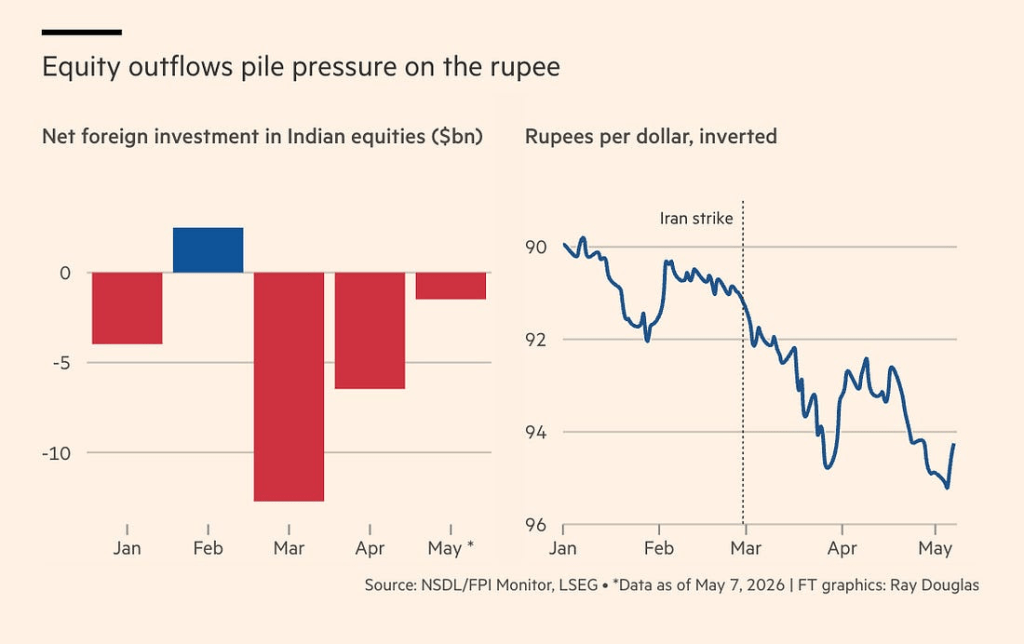
Foreign investors have dumped Indian stocks during the Iran war at the fastest pace on record, as surging energy costs send the rupee to historic lows and raise fears of a ballooning current-account deficit. Overseas investors have pulled almost $21bn from Indian stocks since the US and Israel started bombing Iran on February 28, including almost $13bn in March, by far the biggest monthly outflows on record according to securities depository NSDL. The rupee has fallen to a historic low of more than 95 to the dollar, having entered the war at about 91. Bond prices have slumped, sending 10-year government borrowing costs for the world’s fastest-growing major economy to an all-time high above 7.1 per cent in late April, from 6.7 per cent before the conflict. “When the war started, the first reaction was ‘India is one of the [world’s] largest importers of energy’,” said Suvodeep Rakshit, chief economist at Kotak Institutional Equities.
“It becomes a natural choice, that this is not the country I would want to be invested in.” … India is the world’s third-biggest energy importer and relies on other countries for 90 per cent of its oil and gas. It spent $174bn on such imports in the year to March 31, with half of imported crude and two-thirds of natural gas coming from Gulf countries whose energy exports have been all but shut down by the war. … The rupee was already Asia’s worst-performing currency this year before the war began, thanks to India’s growing trade deficit and a slump in foreign direct investment in productive assets. It was down 10 per cent before the war and has spiralled more than 4 per cent since, hovering above 95 to the dollar despite multiple interventions by the central bank that cut the country’s foreign exchange reserves by more than $40bn from the end of February, before a partial recovery. “It’s a double whammy of sorts,” said Rakshit. “What was a . . . capital flows problem is now a capital flows plus current account problem.”

 After the truth-shower