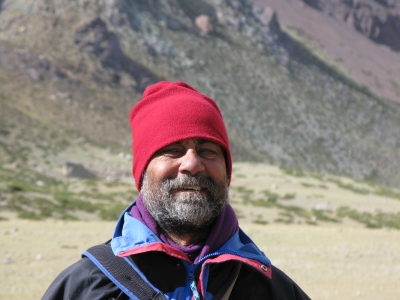
NB: The story of this remarkable man may also be read in Chapter 3, The Heart of the Heart, of Benjamin Labatut’s book When we Cease to understand the World; which is where I first read about hi.
This is an English translation of a post written in French by my father Gérard Lebrun. The pages numbers refer to the original text of Grothendieck’s work Récoltes et Semailles (“Crops and Seeds”).
I was intrigued by the unusual path of Grothendieck, the recently deceased mathematician genius who, after twenty years of work that garnered him the 1966 Field Medal (the Nobel Prize for mathematicians) brutally severed all links with the mathematical community and lived for 45 years in seclusion and solitude, devoting himself to meditation, the search for meaning, and introspection. I tried to understand.
Outside the circle of mathematicians who are still exploring the paths opened by this visionary, there is little documentation on Grothendieck, except for an account written by his own hand, a kind of a diary that he kept (intimate and at the same time “extimate”, since he sent a few copies to former colleagues or former students, and considered publishing it at one point, but didn’t find a publisher) – a very long diary of over a thousand pages entitled “Crops and Seeds: Reflections and Testimony about my Past as a Mathematician.” Although unpublished then, the text has already been making its way to readers. I will quote a few excerpts from it, so that you can learn about and appreciate the ideas of a man in search of the absolute.
This post is divided into 3 parts:
I. A secret genius or some biography details
II. Accomplishments in mathematics
III. Break with the mathematical community: meaning and spirituality
The name of Grothendieck, a mathematician who died recently at the age of 86, is not very well-known or is completely unknown to the public. We are talking here about an extraordinary person who made a mark on the culture of his time – a lone genius who opened new unimagined paths in mathematics, not only one of the greatest scientists of the twentieth century, but also a libertarian spirit, a rebel, a nonconformist who brutally broke all ties with the mathematical community in 1970 at the height of his fame just like Rimbaud suddenly abandoned writing poetry. Rimbaud turned away from his muse and chose personal advancement over his art by getting into the coffee and gun trade; Grothendieck withdrew from society to live in solitude in a small village in the Pyrenees, not to escape from himself but to find himself in an insatiable spiritual quest that is documented in Crops and Seeds.
I. A secret genius
Some key elements of a remarkable biography, along with quotes gleaned here and there from Crops and Seeds.
Alexander Grothendieck was born to a Russian-Jewish father, a revolutionary anarchist named Schapiro, and a German mother, a left-wing activist named Grothendieck (as you can see, he has his mother’s last name). His father was incarcerated from 1906 to 1917 for participating in the revolution against Czar Nicolas II. The couple emigrated to France as Hitler rose to power, leaving their child Alexander (he was six years old at the time) in Germany in the care of a foster family – with a pastor who practiced the Frénet method and promoted the “back to the land” movement.
It was in 1933, when I was six years old that the first turning point in my life occurred; it was also a turning point in the life of my mother and my father, in their relation to one another and to their children. It was the episode of the violent and definitive destruction of a family of four, a destruction whose facts, twists and turns I was the first and the only one to establish forty-six years later by reading the correspondence of my parents and by recalling one or two lifeless memories, enigmatic but unyielding in their power, memories that I patiently examined and decrypted – long after my father’s and my mother’s deaths. It is not my purpose here to talk in depth about what I have learned and understood in the process of this lengthy undertaking, nor to discuss the meaning and the broader consequences of these events […] In December 1933, I recall being dropped off to live with a family of strangers, that neither I, nor my mother who brought me from Berlin, had ever seen before. In fact, these strangers who she left me to stay with were simply the first people she came across who agreed to take me on as boarder for a modest fee, and with no guarantee whatsoever that it would ever be paid. Meanwhile, my mother was about to join my father as soon as possible, who was impatiently waiting for her in Paris. [P.451]
After taking part in the Spanish Civil War, his parents returned to France in 1938 with a refugee status and reunited with their child (he was then ten years old). But in 1939 they were deemed “suspicious” because of their nationality and their activities: his father was first interned in the Vernet camp (Ariège), after which he was handed over to the Nazis by the Vichy authorities and would eventually die in Auschwitz; his mother was interned with her child at Rieucros camp (Lozère). From 1942 to 1944, young Alexander was hidden in Chambon-sur-Lignon at the”Cevennes College”, administered by Pastor Trocmé who had been leading resistance efforts aimed at rescuing Jewish children.
During the last years of the war, when my mother was still interned at the camp, I was staying at “Secours Suisse”, a children’s home for refugee children at Chambon sur Lignon. Most of us were Jewish, and when we were warned (by the local police) that there would be raids by the Gestapo, we would hide in the woods for a night or two in small groups of two or three but did not think too much about how this behavior was meant to save our lives. The area was full of Jews who were hiding out in the Cevennes country, and the support of the local community helped many of them to survive. [P.32]
Alexander followed his studies in high school without considering himself to be one of the “brightest” students; actually, as a student, he tended to pursue his interests; this independent approach would stay with him in his later years….
https://al3x.svbtle.com/alexander-grothendieck
=========================
Peter Kreko, Alan Sokal: In defence of the objective world
Book Review: “Fashionable Nonsense” 20 Years Later
Pope Leo Compares AI Threat to Biblical ‘Tower of Babel’
The Dark Side of AI: Manipulating Reality / Ensuring Re-sponsible Use Of AI
The Commonwealth Short Story Prize is Dead
Kurt Gödel to his mother: We’ll meet again
Toys from Trash: Teaching kids science using everyday objects / Visit Arvind Gupta’s Archive
Jimena Canales: This Philosopher Helped Ensure There Was No Nobel for Relativity
Albert Einstein and Lev Landau: Scientific geniuses as well as anti-capitalists and anti-Stalinists
Behind ‘Oppenheimer,’ a Prizewinning Biography 25 Years in the Making
Julián Casanova: The Spanish Civil War, 80 years after
Sam Jones: From Che Guevara to lockdown: photo book tells story of Madrid

