Let’s withdraw
And meet the time as it seeks us: Shakespeare; Cymbeline
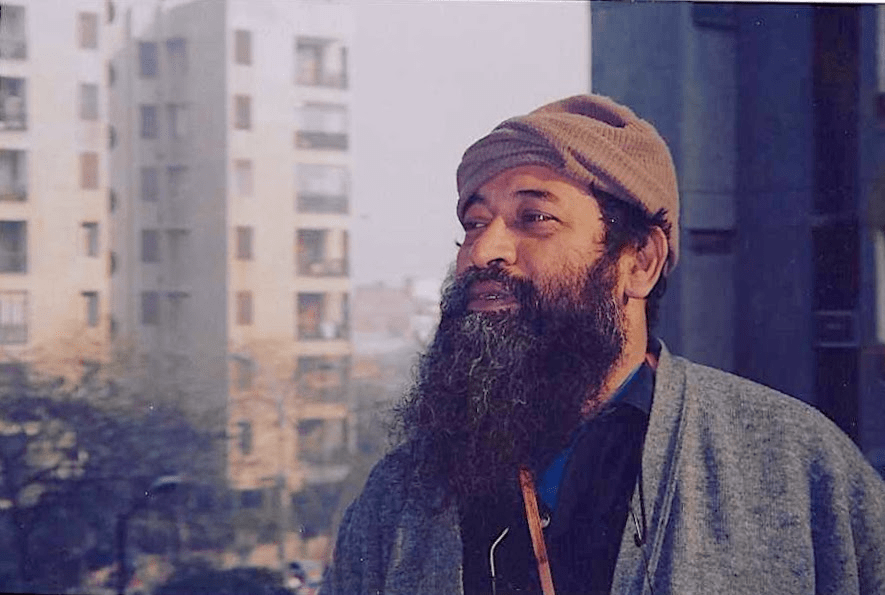
Monju in Patparganj, Delhi, Winter 1995
Achintya Barua, known as Monju – or Manju – by his vast gathering of friends and accomplices passed away on May 17, 2026. Among the gang of dreamers from our college days six decades ago, he was up there as the funniest and most eccentric
The bond we forged in those catastrophic times remained strong for fifty-eight years. With Lalloo (Rabindra) for me, the bond lasted fifty-three years, he passed away in 2019. Lalloo and I preceded Monju by two years in our undergraduate years. There were many others, but this is about Monju. For friendships to last so long, there must be something beauteous and enigmatic in them, beyond doctrines, religion, caste, and all those things which supposedly define us as human beings.
Monju was unpredictable in tonality of speech, themes worthy of conversation, physical movement, moments of day or night suitable for sleep or wakefulness, matters of work or relaxation or nourishment. He could link the price of tomatos to terrorism, the thick foliage visible on Assamese roadsides to the second world war, and the attraction of Japanese tourists to remote villages in Karbi-Anglong district to anthropological theories regarding the origins of the Nipponese people. His thought-trains would leap from crag to crag like a mountain goat – the mixed metaphors are only a reflection of his conversations. He could conduct knowlegeable conversations with trainers of elephant mahouts, not to mention the impact of the covid pandemic upon the costs of the transport of vegetables.
Monju loved Bollywood music: on the long journeys to and from Gauhati he would hand over a memory stick to the driver and soon the music system in the car would be filled with songs like Gori Gori, O Baanki Chhori; and Yeh Hai Bombay Meri Jaan. Not to mention Lungi Dance.
He insisted that the recent past shown that Marx had ‘got it wrong’ regarding the stages of historical modes of production: capitalism doesn’t lead to communism, according to Monju, but it was the other way around. India was now in the stage of Gujarati communism. He also had a plausible theory as to why recently constructed Assamese jails were modelled along the lines of five star hotels
Decades ago, when he still used to visit Delhi now and then; and later, in Wild Grass, if we happened to be sleeping in the same room, he would never turn off the lights or the conversation unless forced to do so, and even then could wake up in the middle of the night and carry on talking as if no time had elapsed. Or he could simply get up and disappear at 3 AM. His work was conducted in the same way, he would appear and disappear silently. He’s done it again, we talked on his very last morning, and by the afternoon he was gone. I’m grateful for this small mercy.
Monju had an anarchist soul, he could never be tied down to any fixed pattern of thought or being. I can’t comment on how he communicated in Assamese, but I can say I was among a handful of people who could follow about half his feast of reason when he was speaking. And he had a habit of saying listen to me, listen to me, even when the person in front hadn’t uttered a word.
Despite all this, he established and ran a successful tourist resort for nearly four decades, and was the fulcrum of the lives of his immedate and extended family. The staff were devoted to him because he treated them with consideration and respected their dignity. An astonishing combination of attributes in a single individual.
There are many things to say, but this has to suffice for the time being. In 2010, I published a novel about our revolutionary escapade, Revolution Highway. The proofs came in when Monju and Moromi were visiting Delhi, and stayed with me for a few days. They were among the first to read it, and Monju finished it in less than two days. Amongst its many characters, he and Lalloo were the only ones whose portraits could not be altered by my literary imagination: in their case reality was far stranger than fiction. I simply described them as they were. The penultimate paragraph in the book is about Monju:
Sin Taw, the Original Ahomiya Lunatic, made a living via sundry contractorships in Assam until he tired of them. Then he camped on the southern bank of the Brahmaputra amidst rhinoceri, jackdaws and falciparum mosquitoes. These days, he invites wayfarers from all continents to come and get lost. He found himself, finally.
It was befitting of his personality that his livelihood was besides a vast and primeval forest. Monju was a forest spirit. He’s no longer with us because he’s simply returned whence he came. It was a privilege to have known him.
The trees that whisper in the evening
Carried away by a moonlight shadow
+++++++++++++++++

