
“Profit is the life blood of capitalism”
…quando coeli movendi sunt et terra
On Tuesday 6th of October, one of the greatest political economists of our time passed away. Anwar Shaikh indeed “moved heavens and earth” by offering an entirely new, highly sophisticated and deeply impacting (both scientifically and politically) vision in the critical economic thought. Being one of the landmark figures in erstwhile heterodox political economy, he brought forth a unique amalgamation of classical thought, inspired by Smith, Ricardo, Marx, Schumpeter and Keynes, and concrete mathematical and statistical foundations. Equipped with an Engineering degree from Princeton University; with deep knowledge of Mathematics and Physics – but also of Philosophy and Political Theory; and with a fervent political and social awareness (having partcipated in the civil rights movement and the anti-war protests of the ‘60s and ‘70s), Shaikh became one of the most fitting persons to continue and expand the tradition of the ‘Surplus Approach’ and turn mainstream economics on their head. His unique approach, deeply rooted in data (but not data-driven) and empirically derived stylised facts (yet never empiricist), and heavily influenced by the unique political and institutional constitution of capitalism (the role of class, race and gender), as well as his methodical questioning of widespread beliefs, has marked many contemporary economists and has entirely reshaped our understanding of what political economy is and what it can accomplish.
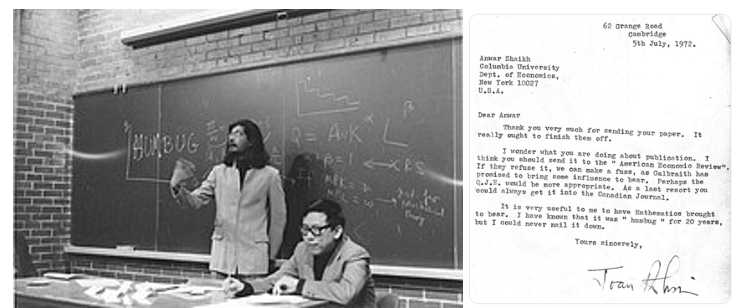
Figure 1: On the left: Anwar Shaikh (standing) presenting his paper on the ‘Humbug’ production function in a conference in 1975. On the right: Joan Robinson’s letter to Anwar Shaikh on the paper.
His 55-year long career was marked by a huge number of breakthroughs that few other economists (heterodox or otherwise) could claim; the range of topics covered spans from the theory of value to a reconceptualision of finance, and can be compared only with that of the classical worldly philosophers (like Smith, Ricardo and Marx) or with that of the major economic theorists of the 20th century (like Samuelson and Galbraith). His magnum opus, Capitalism: Competition, Conflict, Crises, the result of a lifelong research project, is not only the culmination of all these topics, but also a radical and pragmatist perspective on a number of economic matters (from production theory to exchange rate dynamics). And that highlights Shaikh’s highest objective and his greatest offer to modern Economics: his attempt to reconstruct the entire economic theory, founded on the classical and Marxian tradition as well as on solid empirical grounds, and provide the grounds for applications and economic policies beyond the narrow grounds of modern neoclassical perspectives or from their naïve heterodox alternatives.
“I have but to swallow this … and be for the rest of my days, persecuted by a legion of goblins, all of my own creation. Humbug, I tell you— humbug!”
His first breakthrough came at the time he was a PhD student at Columbia University (supervised by Ronald Findlay, himself a student of Robert Solow) between 1968 and 1973. His argument was simple enough: aggregate production functions, like the ones used in many neoclassical models (e.g., the Solow-Swan growth model) are “humbug”. And to prove it, what he did was compare the regressions of output per capita against capital-labour ratios in Solow’s growth accounting to similar regressions of artificially constructed data that spelled the word HUMBUG on a graph. But, this was just the beginning. Shaikh explained that what is actually measured in these regressions is not the generation of output on aggregate (as a production function should do), but its distribution between capital and labour. By doing so, he connected this brilliant result to the ongoing debates about theorising and measuring capital that have been fought between the ‘orthodox’ economists of Cambridge, MA and the ‘heterodox’ of Cambridge, UK. His impact on this field was so big that Joan Robinson (who had herself started that debate more than 20 years ago) wrote to him “It was very useful to me … I knew that it was ‘humbug’ for 20 years, but I could never nail it down”. Anwar’s blow was unfortunately only half-given: his paper on the subject, Laws of Production and Laws of Algebra, was accepted in the Review of Economics and Statistics only as a short note, with Solow having the chance to reply, whereas he hadn’t.
“Nowadays people know the price of everything and the value of nothing.”
In 1972, before finishing his PhD, he was already employed in the New School for Social Research, his work having impressed the esteemed economists of the institution, Robert Heilbroner and Adolph Löwe. Shaikh spent his entire career in the New School, teaching, researching and supervising several students. Interestingly, some of the first issues on his research (and on that of his students) were related to the validity of the labour theory of value and its implications. The total contribution took almost twenty years and left an important body of work, that is continued and still inspiring researchers today.
The first part was a paper published in 1977 titled Marx’s Theory of Value and the ‘Transformation’ Problem, where he presented the view that Marx was not incorrect in his attempt to solve the ‘transformation’ from values to prices; he understood his calculations were merely one step in a longer sequence and he bothered not to continue it. By continuing it, Anwar showed that the algorithm Marx seemingly proposed converges to the ‘correct’ prices of production and the ‘correct’ rate of profit (as calculated by Bortkiewicz, and as they would in any Leontief-Sraffa model). This algorithm mimics the price adjustment of actual firms to conform to competitive capital reallocation that would lead to a uniform rate of profit, exactly in the manner Marx presents it in Capital, vol. III. The second part focused on the computation of actual labour values and prices of production, making his first breakthrough in 1984 with The Transformation from Marx to Sraffa (continued in 1998 with The Empirical Strength of the Labour Theory of Value), where he showed that it is possible to compute these categories from input-output data and that the labour values really approximate prices of production well. At a time where neoclassical and neo-Ricardian thought alike were targeting Ricardo’s and Marx’s use of the labour theory of value, Shaikh not only proved its empirical strength, but also the validity of Ricardo’s and Marx’s arguments around the price-value deviations. This work was continued and is still continued today by many scholars around the world. It also led to an entire reconceptualisation of national accounts – a work that Shaikh (and many of his students) undertook over the next years, culminated in one of Shaikh’s and Tonaks’ greatest publications, Measuring the Wealth of Nations, and it is still forming part of the heterodox economics’ landscape.
“The dynamic and brutal war … appears here as a decorous ballet.”
Shaikh’s next big contribution was on the sphere of competition. Unlike many Marxists of the time, Shaikh felt discomfort using the concepts of ‘monopoly’ and ‘monopolistic competition’ to contrast contemporary capitalism with the earlier industrialised capitalism described by Marx; and unlike many Sraffians of the time, he felt discomfort with the idea that the choice of technique is static and does not involve competitive adjustments within and between industries. The source of this discomfort was that both were trapped in a conception of competition advanced by the marginalists, where different firms are presented as passive and price-taking, while the relation between them as a careful choreography. Competition is “war between capitals”, he said, in his 1980 paper Marxian Competition versus Perfect Competition; and the tendencies we observe (towards a uniform price within industries, and towards a uniform rate of profit between industries) are the results of this dynamic and turbulent process. Uniform prices and rates of profit do not really exist, but are the abstractions we make when the results of competition have been fully assumed. Shaikh also proposed the concept of ‘regulating capital’, i.e., the capital representing the typical technique of each industry (whether actually in use or not), on which occur the equalisation of prices within-industry and the equalisation of rate of profit between-industries.
The concept could be easily utilised outside the strict theoretical description of competition. The most obvious and most important application was the application of the law of value in international trade – an idea that, at the time, had already been popularised by Emmanuel and other theorists of unequal exchange. In a two-part paper in 1979 and 1980, titled Foreign Trade and the Law of Value, he explained how this theory of competition extends to the international level and gives an absolute cost-competitive advantage to countries that have higher concentrations of capital and operate closer to the ‘international regulating capital’, thus explaining economic imperialism, uneven development and the international transfers of value in a consistent value-theoretic manner. This proposal (also applied later in the dynamics of exchange rates, in his 1999 paper Real Exchange Rates and the International Mobility of Capital) has been widely popular, with many theorists refining it and applying it even today.
“Profit is the life blood of capitalism”
Shaikh praised Heilbroner’s remark about profit being the raison d’ être of the capitalist system, the manifestation of the self-interest, that all capitalists pursue. This praise though was not a simple theoretical remark, but rather a way to reconceive the way the capitalist system operates and leads itself to growth and prosperity, but also to inequality, inflation, unemployment and crises – the very themes that much of his work and his magnum opus explore. His long trajectory on this issue starts with a revival of Henryk Gorssman’s and Maurice Dobb’s theory of crises in his 1978 papers, Political Economy and Capitalism: Notes on Dobb’s Theory of Crises and An Introduction to the History of Crisis Theories, where he proposed that the decline of the rate of profit is responsible for the historical trajectory of the capitalist system, but also the cause of major crises (e.g., the Great Depression of the ‘30s and the Stagflation of the ‘70s). In his subsequent works, he pointed out that the decline of the rate of profit combined with the stagnation of the mass of profits leads to overaccumulation of capital and to the outburst of a crisis roughly every fifty years, connecting this Marxian explanation to the Kondratieff waves. For Shaikh, the accumulation of capital is driven by the reinvestment of profits and, thus, goes hand-in-hand with the disproportionate expansion of capital stock and deterioration of old techniques and labour practices; this is an inherent death-trap that capitalism has to face periodically and its only way out is a cathartic crisis, that will devaluate capital, push the adoption of new techniques and raise profitability high enough for capitalists to keep investing. This perspective become central to his later economic thought. Most notably, in his 2004 paper, The Power of Profit, he accurately predicted the outburst of the 2007-2008 crisis and the subsequent recession. But, his thought expanded further: in his book, he showed how the failure of capitalist countries to reinvest profits led to de-industrialisation and financialisation in the US, the UK and elsewhere, persistent unemployment, an exponential rise of inflation after the ‘60s and rising inequalities (including the cost-of-living crisis in many countries today).
“Unhappy the land that is in need of heroes.”
It suffices to say that Anwar Shaikh’s contributions go far beyond these few examples. A mere browsing of his latest book, or a simple search of his numberless papers online can show the multitude of themes he (and his students) has worked on. Yet, one remarkable trait is given throughout his whole work: the deep and wholehearted critique of meainstream theories, the employment of the labour theory of value and the theory of real competition, and the centrality of profit in explaining capitalist dynamics seem to cut straight through all of it. His complete reconstruction of national accounts, his reconceptualisation of economic theory from the ground up, his unique vision of capitalism as a self-regulating, yet turbulent and chaotic system that spits out inequality, uneven development and crises – all came from the same root and all pointed to the same telos: real economics to understand the real world.
In a sense, his passing couldn’t be timelier. At a time when academic freedom is constantly threatened, when education and research are pushed to their limits (institutionally, financially and technologically), when scholars are frightened to take a moral stance towards the wide problems of the world, his brightness flashes for one last moment to remind us what scientific and personal integrity mean. Anwar Shaikh illuminated a path for us. How we can turn century-old orthodoxies upside down and build our new visions of the world. How we can use modern tools to falsify and revive old, yet realistic visions. But, also, how we can think on our own about the shape of our world (even our little academic world). As a teacher, he inspired many to study and work for what they believed; and as a researcher, he inspired much more to keep questioning and seek the deeper, harder truths. His torch has not been blown – we must carry it on.
Nikolaos Chatzarakis is Assistant Professor of Economics at The New School for Social Research in NYC, USA.
https://hetecon.net/2026/10/12/obituary-for-anwar-shaikh-1945-2026/
+++++++++++
Vulture Capitalism: Corporate Crimes and the Death of Freedom
‘Here lives the monster’s brain’: the man who exposed Switzerland’s dirty secrets
Ntina Tzouvala, Capitalism as Civilisation: A History of International Law
Herman Daly: An Economist whom we dare not ignore
Lynn Paramore: Our Economic System is Making Us Mentally Ill

